
Most toxicology textbooks introduce the osmolar gap as a footnote and the anion gap as the headline. In real ED practice that priority inverts. The anion gap tells you the parent alcohol has been metabolized into an organic acid hours ago. The osmolar gap tells you what is still in the blood right now. Both numbers, read together, decide whether the patient in front of you is still clearing methanol, still absorbing ethylene glycol, or already moved on to the renal and visual damage that arrives in the second twelve hour window.
This field guide is for residents, medical students, and clinicians who want a working mental model for the osmolar gap, not a lecture. The intent is to show which formula to use, when the gap is meaningful, why a normal gap does not rule out poisoning, and how the ethanol corrected gap sharpens the picture after the patient admits to a drink. The article is anchored on the published calculator at Elysia Tools, with worked numbers taken from the Kraut 2024 review and the Whittington 2009 case series that everyone cites.
What the osmolar gap actually measures
The calculated osmolality is the value your body chemistry predicts from sodium, glucose, and blood urea nitrogen alone. The measured osmolality is what the lab analyzer reads on a freezing point depression instrument. The difference between the two is the unmeasured osmoles, the small molecules such as ethanol, methanol, ethylene glycol, isopropanol, mannitol, and propylene glycol that the formula does not include.
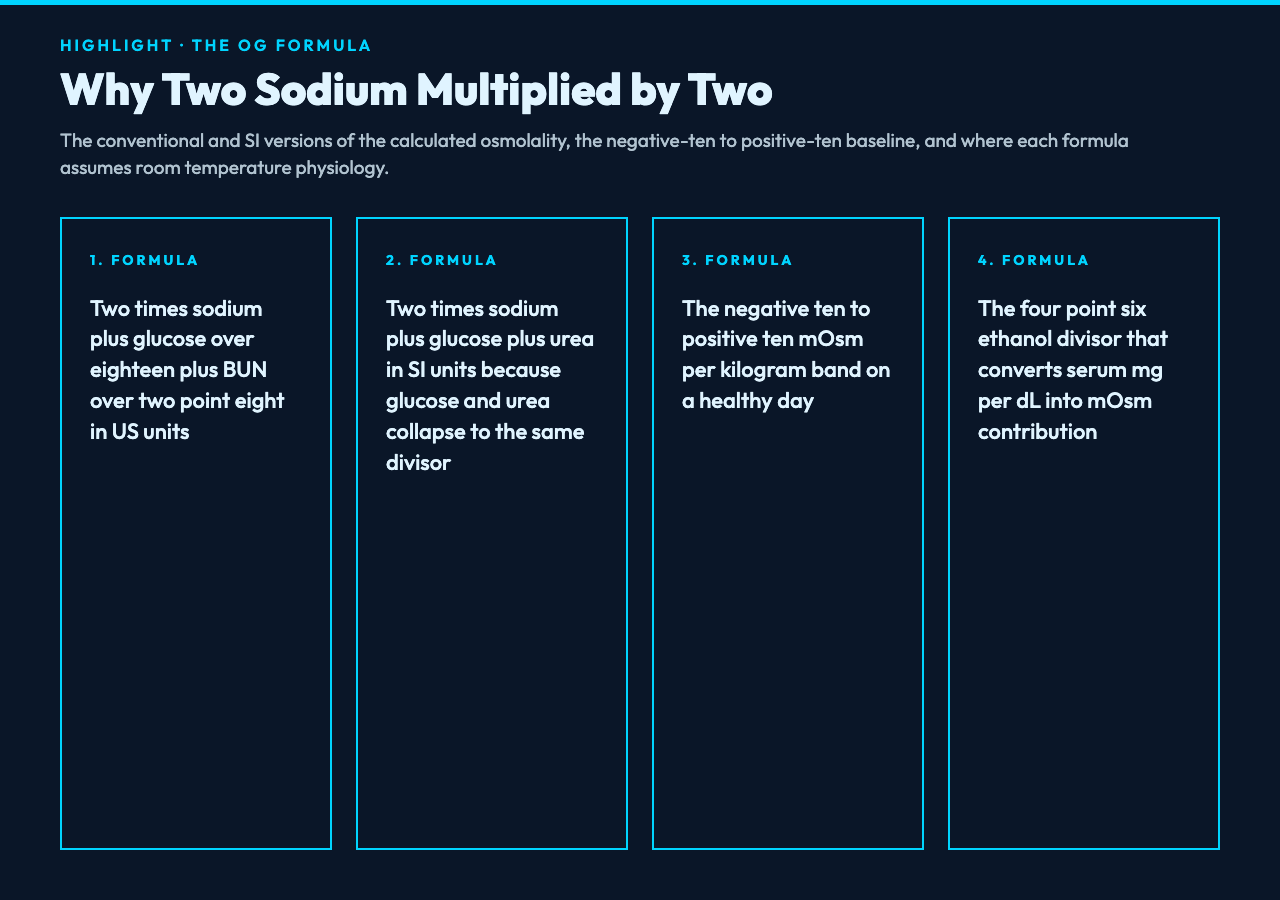
Two formulas are in common use. In US labs with glucose and BUN reported in mg/dL, the formula is two times sodium plus glucose over eighteen plus BUN over two point eight. In SI units with glucose and urea in mmol/L, the same formula simplifies to two times sodium plus glucose plus urea. Both give the same predicted number on the same patient. The cut-point on a healthy day is roughly negative ten to positive ten mOsm per kilogram. Anything outside that band is an unmeasured osmole you did not budget for. Anything inside is normal, but only on the day the patient walked in.
Why the conventional formula undercounts at the extremes
The formula assumes sodium salts and a clean urea baseline. In a hypernatremic patient the calculation overestimates because the formula multiplies sodium by two on the assumption of accompanying chloride and bicarbonate. In a severely hyperglycemic patient the correction factor of glucose over eighteen holds only when glucose stays below about six hundred mg/dL. Above that the relationship drifts.
This matters because the most common reason the gap looks falsely low is hyperglycemia. The lab analyzer reads the measured number correctly; the calculated number overshoots; the difference shrinks; and the team concludes there is no toxic alcohol when there very plausibly is. The calculator at Elysia Tools lets you enter glucose in either mg/dL or mmol/L and reports the conventional and SI formulas side by side, so the audience of a borderline result can decide which unit set is closer to the hospital.
A worked example from the published literature
The Whittington 2009 case series walks through forty-six patients with suspected toxic alcohol ingestion. Two illustrative cases distilled from the paper. Patient A drinks an unknown bottle at a party, arrives two hours later with measured osmolality three hundred and twenty mOsm per kilogram and sodium one hundred and forty, glucose one hundred and twenty, BUN ten. The conventional formula yields two hundred eighty-three. The gap is thirty-seven mOsm per kilogram, well above the ten unit upper cut point. The team initiates fomepizole, calls the poison center, and confirms ethylene glycol on a later serum level.
Patient B arrives twelve hours after a methanol splash at work. Measured osmolality is two hundred and ninety, sodium one hundred and thirty-eight, glucose ninety, BUN eight. Formula gives two hundred seventy-nine. The gap is eleven, technically positive but inside the conventional normal band. The anion gap is twenty-eight and the blood gas shows a metabolic acidosis with pH seven point one eight. The conclusion is not that the methanol has cleared but that the parent compound has been metabolized to formic acid and what is left is the anion gap signal, the renal failure signal, and the visual symptoms. Treat the gap, the anion gap, and the timing of ingestion as one picture, not three.
Why the ethanol corrected gap is the next move
When the patient says yes to a drink of any kind in the last eight hours, you have to know how much of the gap is ethanol and how much is something else that is not. The ethanol concentration is reported by the lab in mg/dL on most analyzers. Each one hundred mg/dL of ethanol raises the measured osmolality by roughly twenty-two mOsm per kilogram. The conventional approximation divides ethanol by four point six on a milligram over deciliter basis.
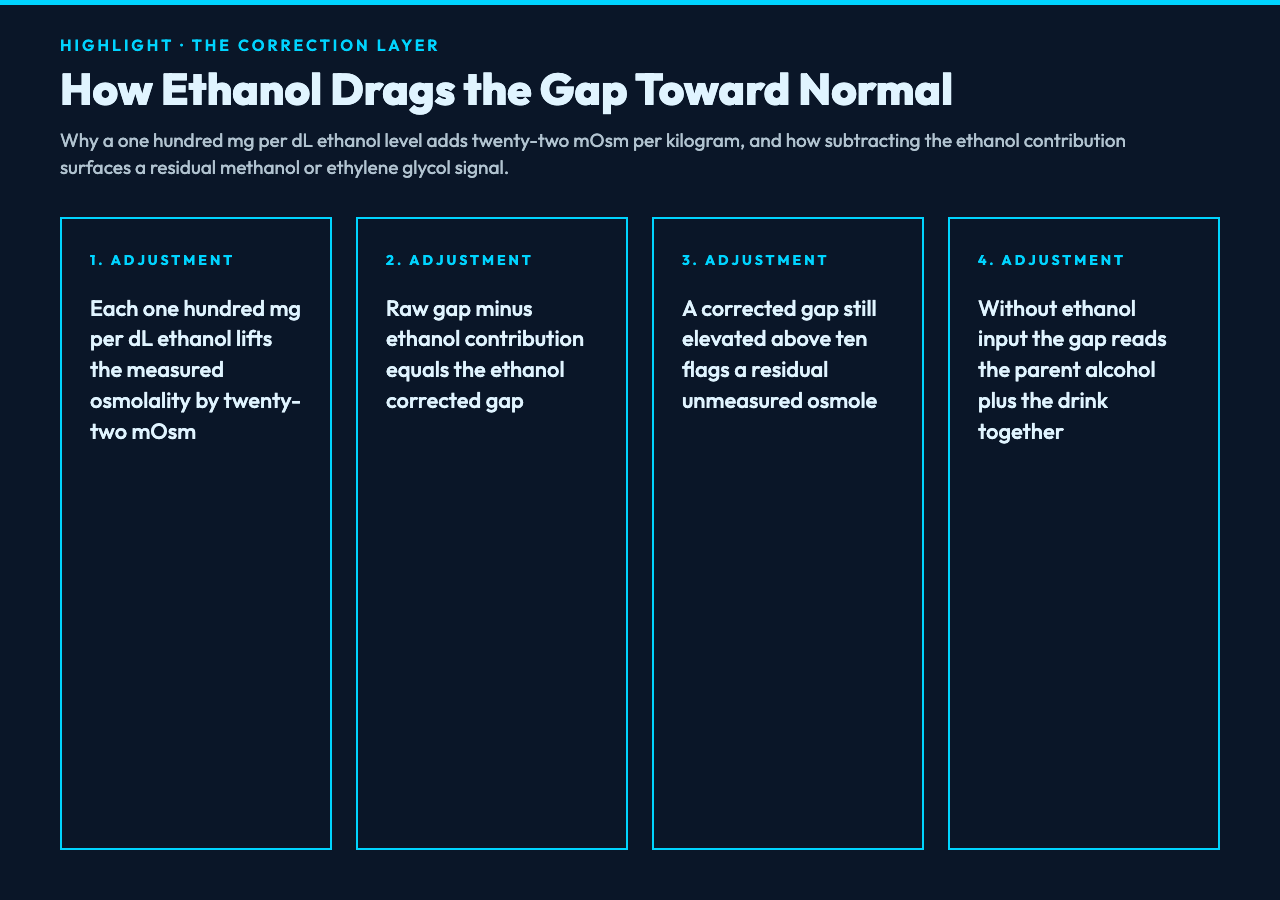
The ethanol corrected gap is the raw gap minus the ethanol contribution. In the calculator at Elysia Tools, entering an ethanol level of one hundred twenty mg/dL and a raw gap of thirty drops the corrected gap to four, which suggests the gap is fully explained by the ethanol. The same patient with a raw gap of fifty and the same ethanol ends up with a corrected gap of twenty four, which is what your team needs to know about residual unmeasured osmoles such as methanol or ethylene glycol.
When the osmolar gap is normal but you still suspect poisoning
This is the failure case that burns every first year resident and a fair number of attendings. The patient comes in with a story that fits the textbook and a gap that does not. The reason is timing. The alcohols that cause the worst poisonings are small molecules that the body metabolizes quickly. Methanol half-life is on the order of eight hours in a patient who has been drinking ethanol alongside it. Ethylene glycol half-life is similarly fast. By the time the patient arrives in the ED, the parent alcohol has been converted to the acid that closes the gap and opens the anion gap.
Use the osmolar gap to rule in unmeasured osmoles, not to rule them out. Pair it with the anion gap, the arterial blood gas, the serum calcium, the urine sediment for calcium oxalate crystals, and the timeline. A normal gap inside the first two hours is not the same data point as a normal gap twelve hours in. Document the time of ingestion in the note. Treat the trend, not the single number.
The pitfalls the formula book does not tell you
Three classes of false normals and false abnormals are worth memorizing. First, in chronic kidney disease the measured BUN drives the calculated number upward, the measured osmolality can drift with uremic osmolytes, and the gap compresses. Second, in diabetic ketoacidosis the glucose correction gets large and the calculated osmolality runs high, so a meaningful gap can look small. Third, in patients on lactulose, mannitol, or high dose sorbitol the unmeasured osmole is iatrogenic and the gap is informative about the medication, not the ingestion.
None of these caveats invalidate the test. They change how you read it. The calculator shows both formulas and lets you toggle glucose and BUN between mg/dL and mmol/L so the unit confusion does not enter the chart. Run the numbers the way the rest of the team reads them on shift.
Reading the gap with the anion gap, the gas, and the history
The right column is the one most textbooks skim past. Patients rarely present with one clean lab finding. The osmolar gap is one triangle of a triangle of three: gap, anion gap, blood gas, then history and timing on top. A high osmolar gap with a normal anion gap is pre-metabolism and still actionable. A normal osmolar gap with a high anion gap is post-metabolism and time sensitive. A mixed picture across two consecutive draws over four hours is the strongest evidence the toxic alcohol is clearing on its own or that fomepizole is doing its job.
The published MDCalc reference, the Kraut 2024 review, and the Whittington case series all converge on this triad. Save the gap in the chart next to the anion gap and the gas. Trend them together. The single number is a snapshot. The trend is the verdict.
What to do with the number, in order
The four-question decision tree is the one the toxicology team actually uses. First, was there a credible ingestion of a toxic alcohol within the last twelve hours? Second, is the osmolar gap elevated above ten mOsm per kilogram? Third, is the patient symptomatic, acidotic, or showing crystalluria? Fourth, is the corrected osmolar gap still elevated after subtracting ethanol?
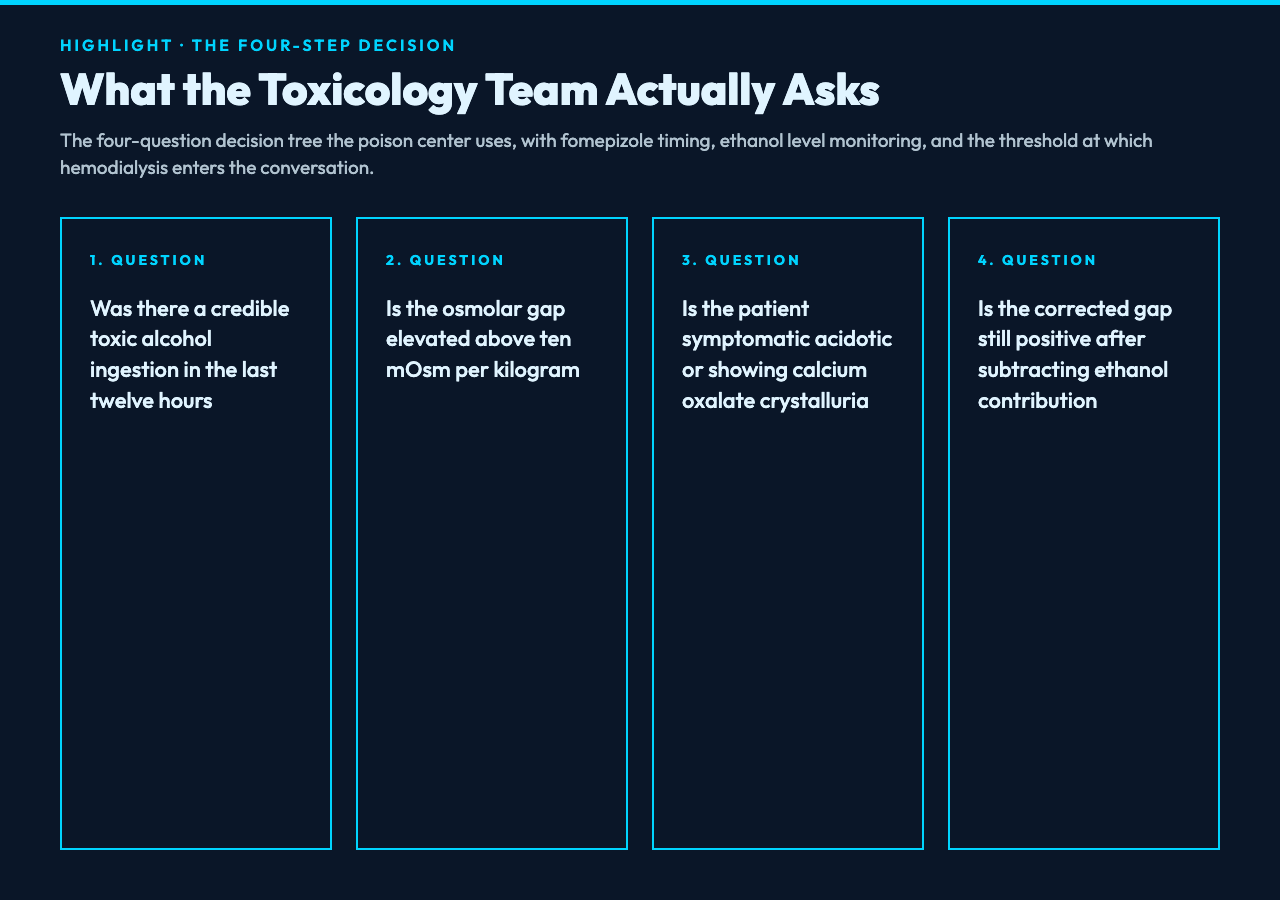
A positive answer on the first question alone is enough to call the poison center and start hemodialysis planning if the patient is acidotic. A positive on the second and third calls for fomepizole, four hours of infusion, and ethanol level monitoring if the patient is a chronic alcoholic. A positive on the fourth is what tells you there is a residual methanol or ethylene glycol signal under the ethanol.
The number is not a verdict. The number is the start of a four-step conversation with the toxicology team. The osmolar gap is the widest lens you have for the undifferentiated patient who drank something at a party, walked into a workplace chemical the morning of an ED shift, or arrived from a household with antifreeze in an unlocked cabinet. The lens works because it lets you rank probability before the confirmatory send-out returns hours later. The lens fails only when the team treats the single number as the answer rather than the question.
The osmolar gap is one of the few lab values where the textbook formula matches the bedside decision closely enough to act on. Pair it with the calculator at Elysia Tools so the unit arithmetic does not slow you down. Run it the same hour as the anion gap and the gas. Trend all three over the next four hours and let the toxicology team on call see the picture with you, not after you.
