
Hand the same 17-nucleotide primer to two melting-temperature models and I get 52.0 °C from the Wallace 2-4 rule and 52.8 °C from the SantaLucia nearest-neighbor sum. Same sequence, same 50 mM buffer, 0.8 °C apart. Yet move the calculation to a ten-base GC oligo and the disagreement widens to 16.6 °C. Two melting points for one primer is not a defect — the gap between them is the signal.
The 2-4 Rule Counts Letters, Not Neighbours
Wallace’s rule from 1979 asks one question: how many A-or-T bases and how many G-or-C bases does this oligo contain? Its answer is Tm = 2 °C × (A + T) + 4 °C × (G + C). The M13 forward primer GTAAAACGACGGCCAGT holds eight A-or-T bases and nine G-or-C bases, so the rule returns 2×8 + 4×9 = 52 °C. That is the whole computation.
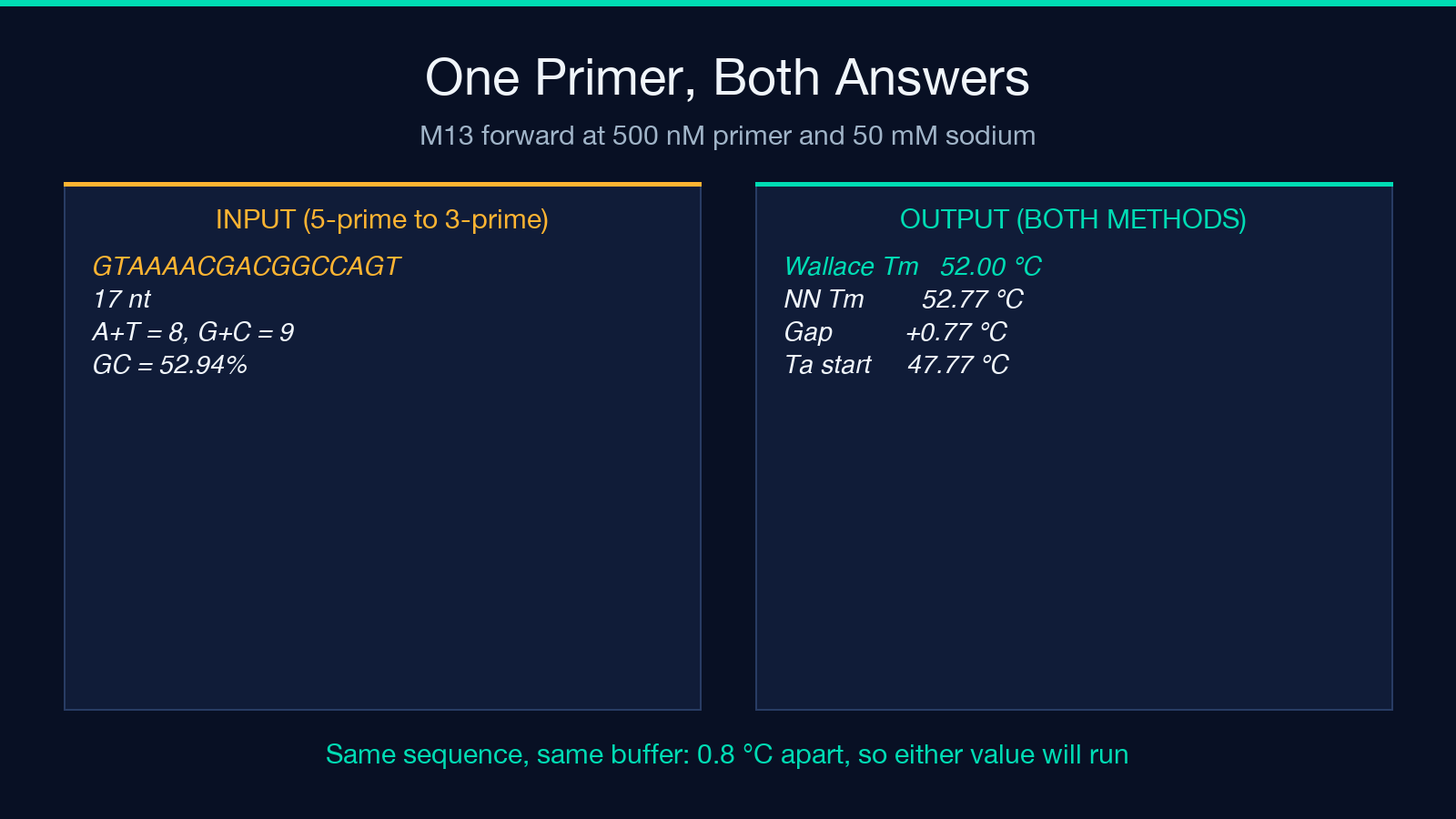
Nothing in it knows which base sits next to which. A ten-base oligo with ten G-or-C bases scores 40 °C, and one with six scores 32 °C, whatever order the letters arrive in.
The rule survived forty-five years because it stays roughly right inside one narrow window. For example, Primer3 defaults to the SantaLucia 1998 model for its oligotm work, and the 2-4 rule survives mainly as a sanity check. For 14- to 20-mers at around 50 mM salt and 0.2 to 1 µM primer, the errors it makes tend to cancel. Step outside that window and it stops being a rough estimate. It becomes a wrong answer printed to one decimal place, and no reviewer catches it because the number looks plausible.
Sixteen Stacking Steps Replace Two Base Counts
The nearest-neighbor model treats a duplex as a stack of dinucleotide steps instead of a bag of letters. Each of the N−1 adjacent pairs in the primer contributes an enthalpy and an entropy term read from a measured table, and the two terminal bases add an initiation term. Sum them and you hold ΔH and ΔS for the whole helix.
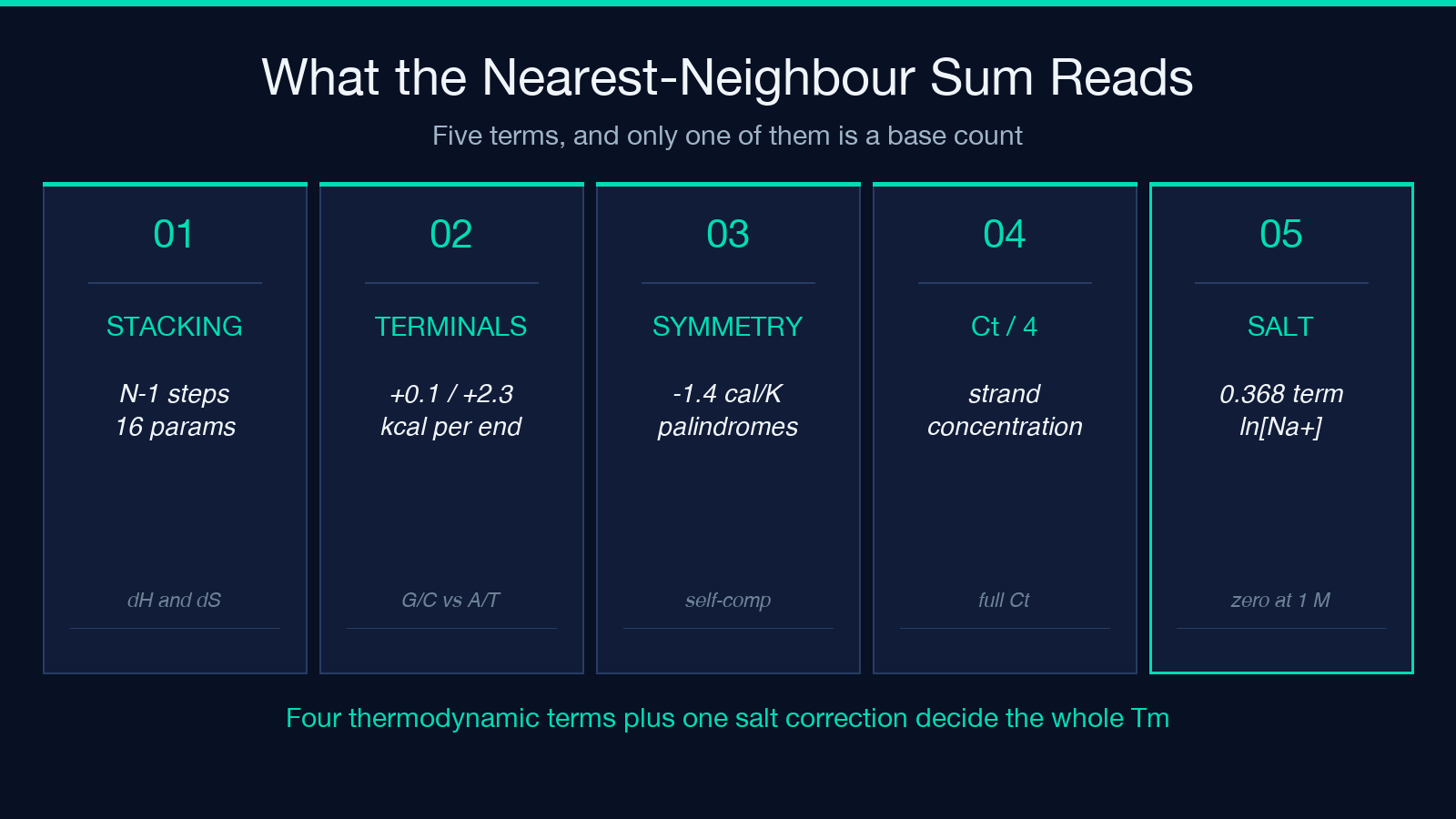
The published form of the SantaLucia 1998 model is:
Tm = 1000·ΔH / (ΔS + R·ln(Ct/4) + 0.368·(N−1)·ln[Na+]) − 273.15
R is the gas constant at 1.987 cal/(mol·K), Ct is the primer strand concentration, and the last term is the 1996 salt correction folded into ΔS, according to the SantaLucia parameter set. All that decides the answer sits in the two thermodynamic sums.
The measured parameters are not interchangeable. A CG step carries −10.6 kcal/mol of enthalpy against −27.2 cal/(mol·K) of entropy, while an AT step carries −7.2 and −20.4. Rotational symmetry reduces the sixteen possible pairs to eleven distinct parameter sets, which is why published tables look shorter than the 4×4 grid you expect.
Apply that sum to the same ten-base GC oligo and the answer changes to 56.63 °C, which is 16.63 °C above the rule’s 40 °C. Nothing about the molecule changed. The model began reading the seams between bases instead of counting them. You can run both side by side in the primer Tm calculator on any sequence you like.
Two Terminal Bases Move the Answer by 1.5 °C
The first and last bases are the only ones that appear in a single stacking step, so the model charges them separately. A terminal G or C contributes +0.1 kcal/mol and −2.8 cal/(mol·K); a terminal A or T contributes +2.3 and +4.1. The asymmetric sign matters. A dangling AT end is floppier than a stacked GC end, and the table says so.
I measured this against the rule using oligo pairs with identical base composition. For example, GAATTCGC ends in G and C and computes to 16.59 °C. AATTCGGC holds the same eight bases, ends in A and C, and computes to 17.94 °C. Wallace reports 24.0 °C for both, because it can’t see the ends at all.
A second case agrees: GCAATTCGC ends in G and C at 27.67 °C, while AAGCTTCCG ends in A and G at 26.12 °C. Same composition, 1.55 °C apart, and again the 2-4 rule gives 28.0 °C for both.
Salt and Primer Concentration Are Two Pedals Left at Defaults
Melting temperature is defined at a stated concentration, so anyone who quotes a single Tm without both dials is quoting half a measurement. Salt shows how much the missing half costs. On the unchanged M13 forward primer at 500 nM, the nearest-neighbor model returns 45.40 °C at 10 mM sodium, 49.55 °C at 25 mM, 52.77 °C at 50 mM, 56.04 °C at 100 mM, and 59.39 °C at 200 mM. That is a 14 °C swing observed across five salt concentrations, with the sequence untouched.
Primer concentration changes it less, but not nothing: 49.17 °C at 50 nM up to 53.86 °C at 1 µM, measured at fixed salt with no change to the sequence. The Ct/4 divisor carries the physics here. A duplex needs two strands to find each other, and the quarter factor comes from the strand-displacement equilibrium, not from an arbitrary convention.
Why does salt push upward? The 0.368·(N−1)·ln[Na+] term lands in the denominator, and a logarithm of a value below 1 M is negative, so raising [Na+] shrinks the denominator and increases Tm. At 1 M the term vanishes entirely. Below it, the salt correction isn’t a rounding detail — it’s the difference between a 45 °C anneal and a 59 °C one.
A Palindrome Drops the Ct/4 Divisor
A self-complementary primer is its own reverse complement, and the model applies two corrections. The entropy sum takes a −1.4 cal/(mol·K) symmetry correction, and the effective concentration switches from Ct/4 to the full Ct.
ACGTACGTACGT is a true palindrome, and it lands at 42.65 °C at 250 nM in 100 mM sodium with both corrections applied. Remove them, apply Ct/4 like an ordinary primer, and the same sequence computes to 56.90 °C. That is a 14.25 °C error, large enough to break a program that trusted it.
In practice this matters because a self-complementary primer is also a primer-dimer candidate. The symmetry correction is the model telling you the molecule can pair with a copy of itself, and the concentration switch is the model telling you that pairing happens sooner than it does for a normal duplex. Both signals point at the same bench problem.
Six Primers, One Honest Scorecard
I ran six representative oligos through both methods at 500 nM and 50 mM sodium to see how often the two numbers stay close. In one case out of six, the two methods sat within 2 °C.
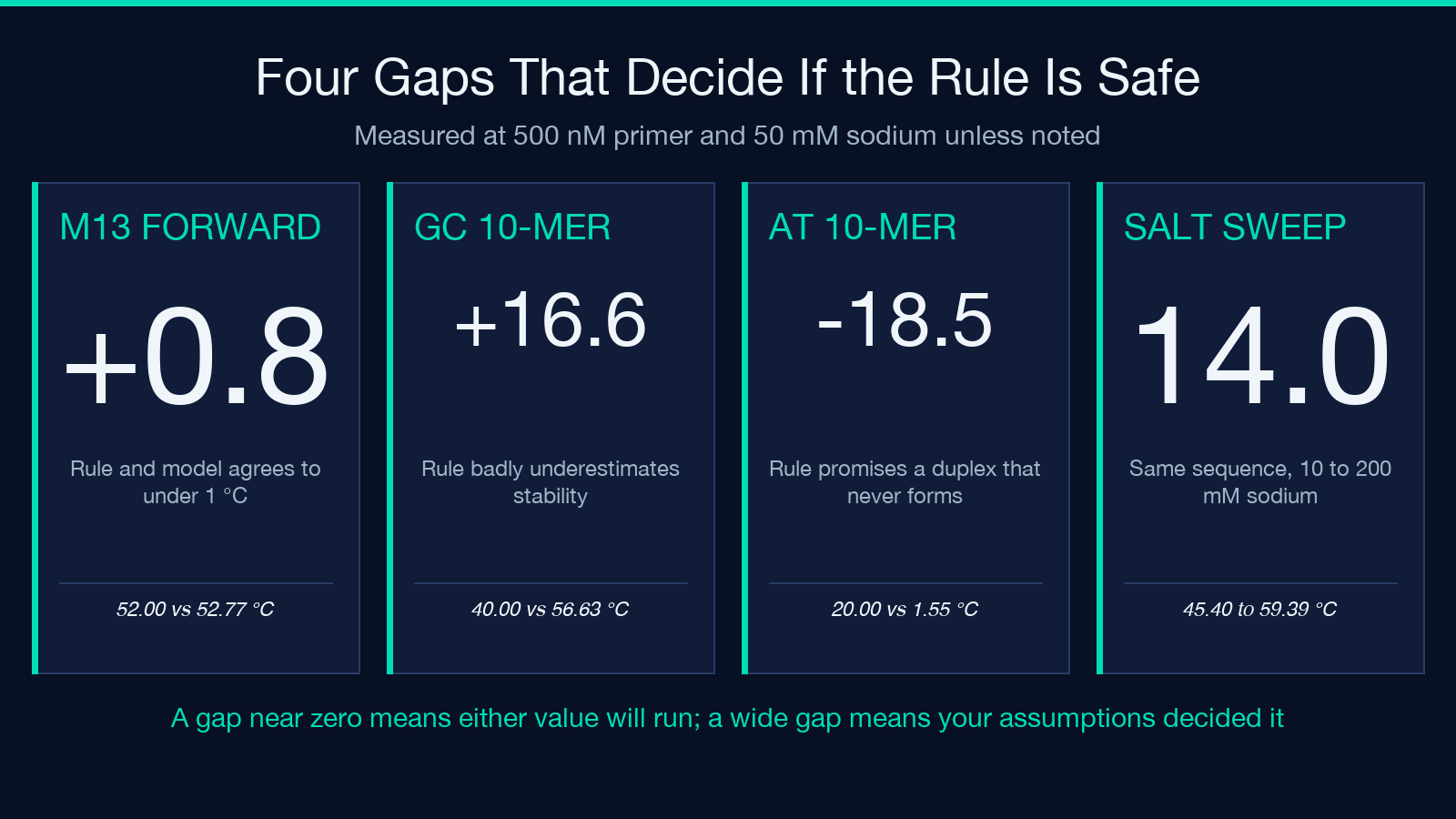
- M13 forward, 17 nt, 52.9% GC: Wallace 52.00 °C, nearest-neighbour 52.77 °C, gap +0.77 °C.
- 20-mer at 50% GC: Wallace 60.00 °C, nearest-neighbour 55.01 °C, gap −4.99 °C.
- 12-mer palindrome at 50% GC: Wallace 36.00 °C, nearest-neighbour 41.11 °C, gap +5.11 °C.
- GC-rich 10-mer GCGCGCGCGC: Wallace 40.00 °C, nearest-neighbour 56.63 °C, gap +16.63 °C.
- AT-rich 10-mer ATATATATAT: Wallace 20.00 °C, nearest-neighbour 1.55 °C, gap −18.45 °C.
- Six-base GATTAC: Wallace 16.00 °C, nearest-neighbour −17.19 °C, gap −33.19 °C.
The sign shows which way the rule fails. A positive gap means the 2-4 rule underestimates stability, which is the GC-rich and stacked case where the crude rule credits only 4 °C per GC pair. A negative gap means the rule overestimates, which is the AT-rich and short case where it credits 2 °C per AT pair to a helix that barely forms.
The AT-rich row is the one I find useful in conversation. The rule promises 20 °C, which sounds workable. The measured thermodynamic sum reports 1.55 °C, which means the oligo has no meaningful duplex at any temperature you’d run. Those are not two estimates of one quantity. They are a green light and a red one. The M13 agreement doesn’t prove the 2-4 rule is right; it proves that a 17-mer at 50 mM salt lands where the two models happen to meet.
The Suggested Ta Follows Whichever Method You Clicked
This is the trap worth naming, because it hides inside a tidy output. The calculator reports both Tm values, which keeps the rule’s bias visible. But the suggested annealing temperature is computed as Tm − 5 from the selected method, not from the better one.
Take the 12-mer palindrome at 250 nM primer and 100 mM sodium. Select Wallace and the tool prints Tm 36.00 °C with a suggested Ta of 31.00 °C. Select nearest-neighbor on the identical sequence and it prints Tm 42.65 °C with a suggested Ta of 37.65 °C. One click forces 6.65 °C of difference, on a screen that reads equally confident both ways.
Both numbers are reported from the same input in the same run, so the fix is procedural, not mathematical. Read the suggested Ta off the nearest-neighbor value, and treat Tm − 5 as a starting point for a gradient, not a set temperature. For a primer pair, keep the two nearest-neighbor Tms within 2 to 3 °C of each other, because a pair whose members melt 6 °C apart will amplify one allele and miss the other.
What the Model Refuses to See
The calculator accepts 5 to 60 nucleotides, 1 to 10000 nM primer, and 1 to 1000 mM sodium, and those bounds are honest about its scope. Inside them, several real effects are absent from the arithmetic.
There’s no mismatch term, so a single internal mismatch costs nothing in the output, with penalties reported between 1 and 3 °C on the bench depending on position. There’s no secondary-structure term, so a hairpin or a self-dimer never appears in the number. No additive term exists either, and co-solvents such as DMSO lower Tm by roughly 0.6 °C per percent. There’s no modified-base term, so an LNA or a 2′-O-methyl residue is scored as plain DNA.
One more honest gap sits inside the parameter set itself. This tool carries the SantaLucia 1998 unified values, where AA/TT is −7.9 and −22.2. The 2004 revision used by several libraries lists −7.6 and −21.3 for the same step. The two data sets disagree by a few tenths of a degree on most primers, which is far smaller than the method gap you’re trying to read — but it means a Tm quoted to one decimal place isn’t a measurement of the molecule, it’s a measurement of the model plus the molecule.
That’s why the gap is the durable number and the absolute value is the disposable one. A 0.8 °C gap between models tells you the answer is stable under a change of method. A 16 °C gap tells you the answer is an artefact of your assumptions, and no amount of decimal places will fix it.
Explore more tools at elysiatools.com.
Here’s the habit I’d keep from this work: read the gap before you read the number. A gap near zero means both models describe the same molecule, and either value will run. A sixteen-degree gap means they describe different molecules, and the buffer determines whether your thermocycler builds the duplex you designed. In the end, the primer in your hand matters less than the salt around it. Which of your primers is quietly in the second group?
本文有中文版:一条引物,两个解链温度:16 °C 的差距才是信号
