
Stop Guessing Golden Hour: 5 Free Tools Every Photographer Needs in 2026
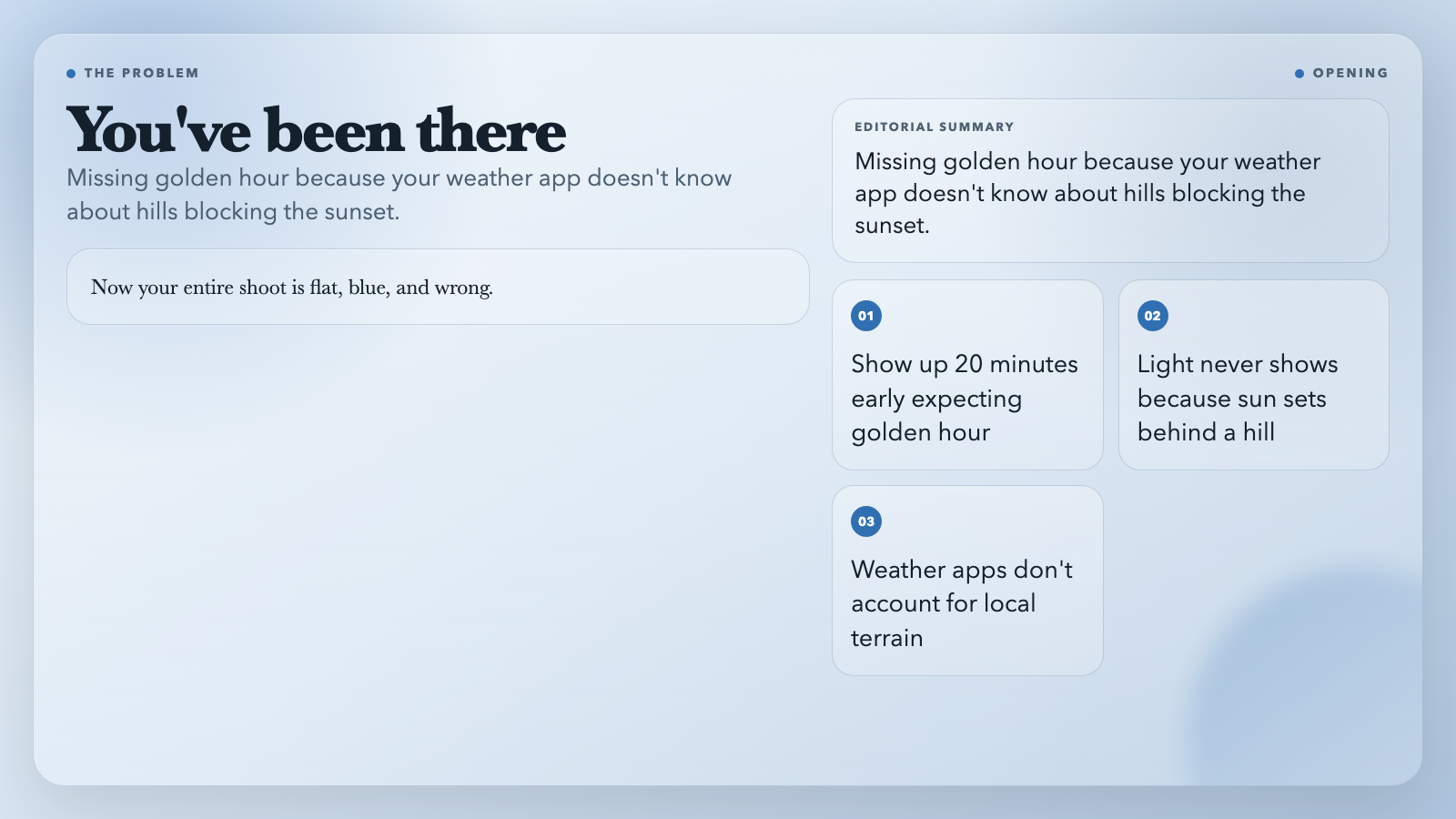
You know that feeling. You show up to a location 20 minutes before sunset, expecting golden hour. The light never shows. It turns out the sun set behind a hill your phone’s weather app couldn’t see. Now your entire shoot is flat, blue, and wrong.
The photographers who consistently nail golden hour aren’t luckier. They do math.
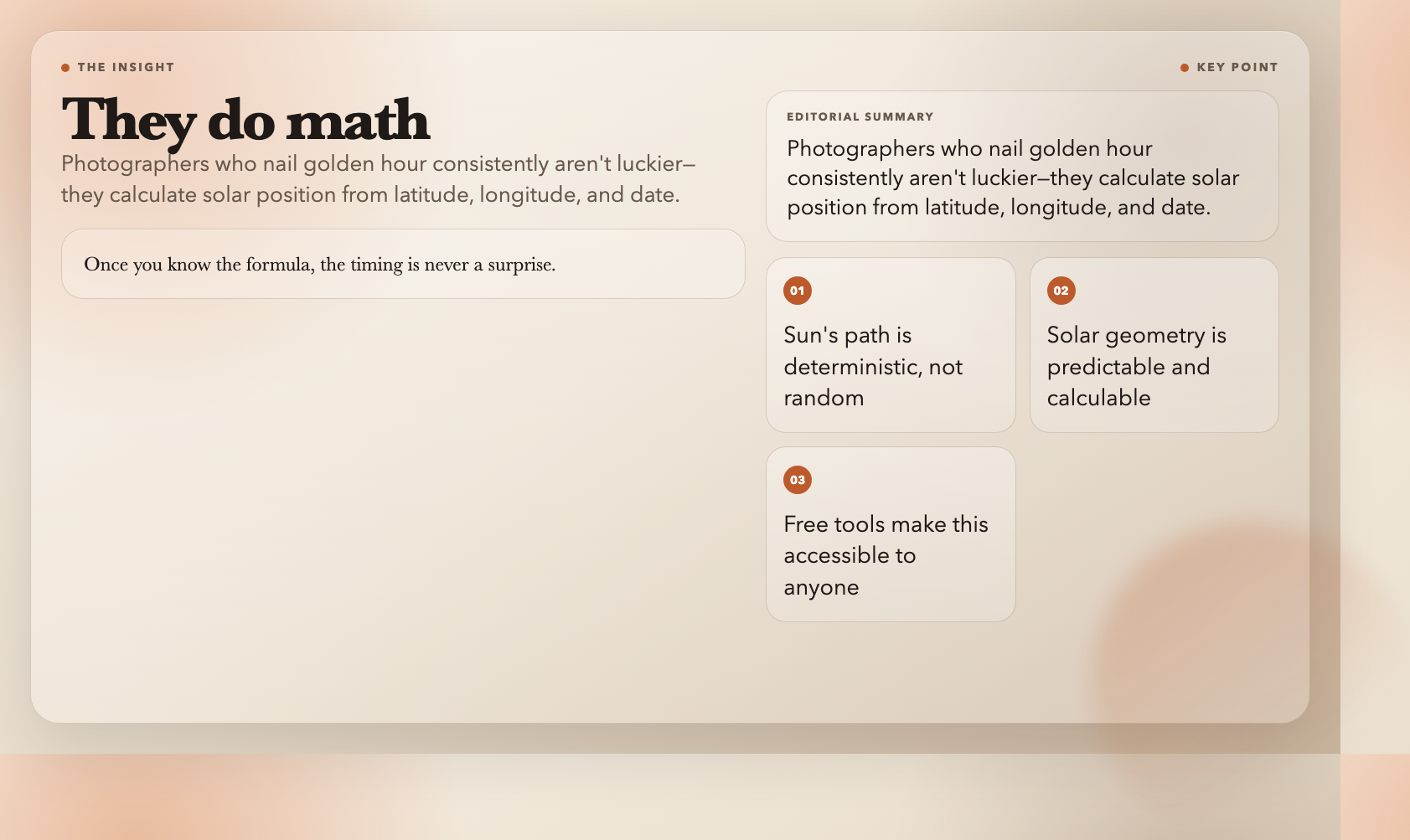
Specifically, they use free calculators that crunch the actual solar position for their exact coordinates and date. The sun’s path is deterministic—latitude, longitude, time of year. Once you know the formula, the timing is never a surprise.
Here are five free tools that turn solar geometry into actionable photography schedules.
1. Blue Hour Calculator
Blue hour is that window of deep blue twilight before sunrise and after sunset. It’s prized for cityscapes and architecture because artificial lights contrast sharply against the dark sky. The Blue Hour Calculator gives you precise start and end times for both morning and evening sessions, customized to your GPS coordinates.
What makes it worth using:
– It accounts for latitude. Golden hour in Miami in July runs until 8:30 PM. In Reykjavik the same date, it’s done by 10 PM.
– It handles edge cases. In Tromsø, Norway during winter polar night, blue hour doesn’t exist.
– It provides photography tips specific to each phase, including recommended exposure settings.
Use it here: Blue Hour Calculator
2. Golden Hour Calculator
Golden hour is technically the first and last hour of daylight when the sun is low enough for warm, directional light but high enough to work with. The Golden Hour Calculator gives you exact start and end times for your location and date.
Unlike weather apps that give you vague “sunset at 6:47 PM,” this tells you exactly when usable golden light begins and ends. That’s the difference between setting up at 5:30 PM and finding perfect light versus scrambling at 6:15 PM and watching it end.
Key details:
– Morning golden hour: sunrise to one hour after
– Evening golden hour: one hour before sunset to sunset
– Works globally, including polar regions
– No signup, no ads, instant results
Use it here: Golden Hour Calculator
3. Daylight Calculator
Golden hour only exists within daylight hours. The Daylight Calculator tells you how much total daylight you’ll have—useful for planning winter shoots where you might only get 7 hours of usable light, or summer shoots in high latitudes where you have 18.
This tool is particularly valuable for travel planning. Shooting the Northern Lights in Iceland in December? You’ll have about 4-5 hours of actual darkness. In June, the sun barely sets and aurora photography becomes nearly impossible. The Daylight Calculator quantifies this so you can plan realistic itineraries.
What you get:
– Sunrise and sunset times to the minute
– Total daylight hours and minutes
– Solar declination angle (tells you sun height and shadow direction)
– Automatic handling of polar day/night edge cases
Use it here: Daylight Calculator
4. Meteor Shower Predictor
Meteor photography is timing-dependent in two ways: you need a dark sky (moon phase) and you need an actual shower happening. The Meteor Shower Predictor gives you a full calendar of annual meteor showers filtered by hemisphere and year.
Notable data points per shower:
– Peak dates (sometimes a specific night, sometimes a range)
– Zenithal hourly rate—how many meteors per hour under ideal dark sky conditions
– Best viewing direction and time (pre-dawn beats midnight for most showers)
– Parent body (comet or asteroid origin)
The Perseids in August typically hit 100 meteors per hour. The Quadrantids in January are famous for fireballs—slow, bright meteors that photograph stunningly. Planning around these peaks, rather than shooting randomly, dramatically improves your hit rate.
Use it here: Meteor Shower Predictor
5. Moon Phase Calculator
A full moon is the enemy of dark sky photography. It can reduce visible stars by 80% and wash out the Milky Way entirely. The Moon Phase Calculator tells you current lunar phase, illumination percentage, and dates for upcoming phases.
This is essential planning for:
– Milky Way shoots (target new moon or <25% illumination)
– Meteor shower photography (a bright moon destroys meteor visibility)
– Night landscapes where the moon provides secondary illumination
The tool shows moon age in days and gives exact dates for next new moon, first quarter, full moon, and last quarter—letting you plan weeks ahead rather than showing up to a full moon by accident.
Use it here: Moon Phase Calculator
How Professionals Use These Together
A real workflow for planning a meteor photography trip:

1. Check the Meteor Shower Predictor for upcoming “Excellent” or “Good” rated showers in your hemisphere
2. Cross-reference with Moon Phase Calculator—pick a date when the moon is <25% illuminated or absent entirely
3. Use Daylight Calculator to confirm sufficient dark hours for your trip location
4. Enter your coordinates in Blue Hour Calculator to know exactly when to set up
5. Calculate golden hour times for each day of your trip
This isn’t complicated. It’s just math the sun already does—you’re just reading the answers.
The Question Nobody Asks
Most photographers spend more time researching which filter to buy than planning when the light will actually be good.
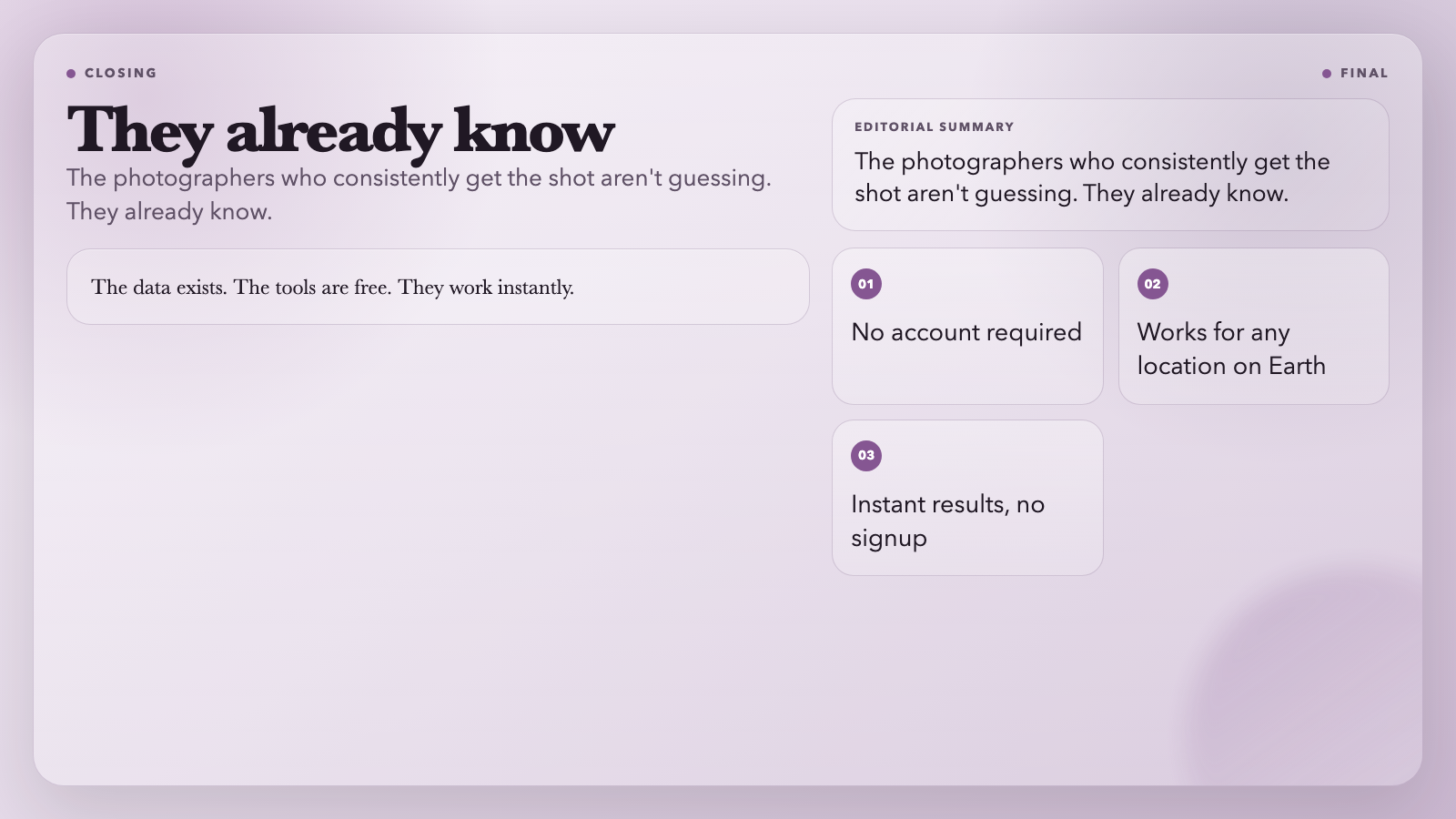
The data exists. The tools are free. They work instantly and require no account.
The photographers who consistently get the shot aren’t guessing. They already know.
Try all five tools: ElysiaTools