In 2007, a Wall Street firm named Amaranth Advisors made what seemed like a conservative bet: natural gas prices would stay within a predictable range. The fund had earned solid returns for years using sophisticated risk models. Then natural gas collapsed in ways their models had deemed statistically impossible. Amaranth lost $6 billion in six weeks. The models had not failed — they had never accounted for the possibility that needed accounting for.
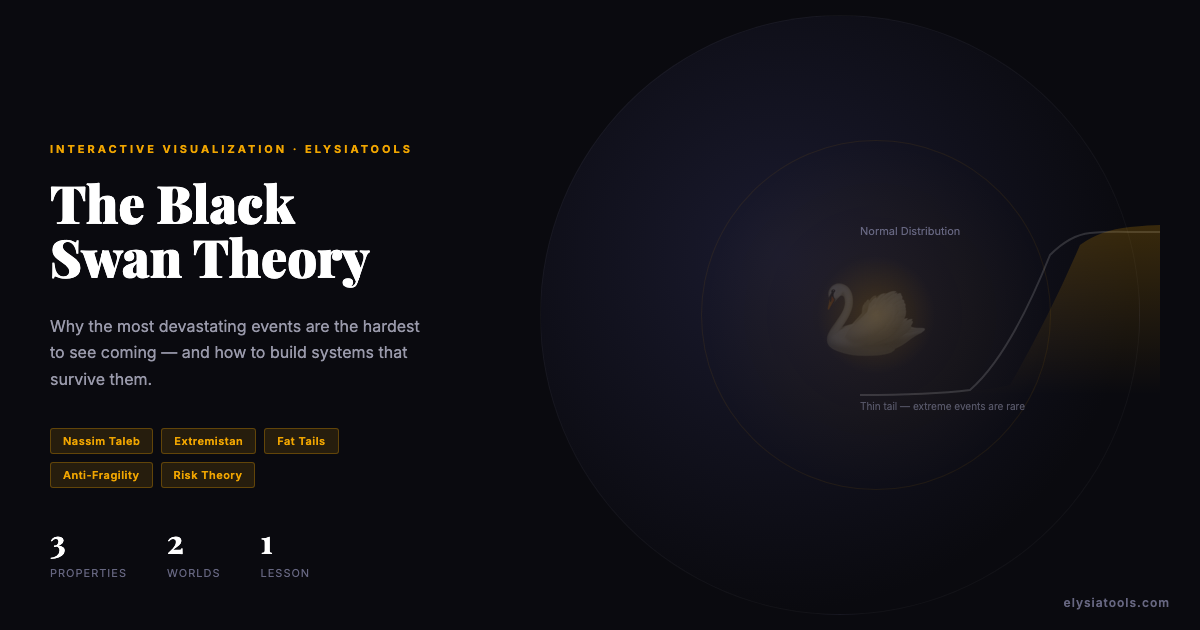
This is the central puzzle of Nassim Nicholas Taleb’s Black Swan Theory, now beautifully visualized in an interactive tool at ElysiaTools. And it reveals something uncomfortable about how we think about risk, prediction, and the limits of learning from history.
The Difference Between Two Worlds
Taleb draws a sharp line between what he calls Mediocrestan and Extremistan — two kinds of domains that behave so differently that the same mental toolkit will serve you well in one and destroy you in the other.
In Mediocrestan, the following holds: when you sample a population, the average converges reliably. Think of human height. If you measure ten random people, the average will be close to the true average. Measure ten thousand, and the average barely moves. Outliers exist but they don’t dominate. A person 7 feet tall is an interesting novelty, not a structural force. Your grandmother’s height and a basketball player’s height average out.
In Extremistan, this breaks completely. Consider wealth. If you sample ten random people, the average is almost entirely determined by one or two billionaires in the sample. The median net worth might be $30,000. The mean could be $10 million. There is no convergence. One observation — one data point — can dominate the entire distribution. The same statistical intuition that protects you in Mediocrestan will actively mislead you in Extremistan.
Most social phenomena — wealth, income, book sales, market returns, viral events, network effects, city populations — live in Extremistan. Most natural phenomena — height, weight, caloric intake, IQ — live in Mediocrestan. We evolved in Mediocrestan and our intuitions are calibrated for it. That mismatch is the source of nearly every forecasting disaster.
What a Black Swan Actually Is
The term “black swan” has been diluted into meaning any unexpected event. Taleb’s actual definition is stricter and more precise. A Black Swan has three properties:
It is an outlier — nothing in the past prepared you for it. There was no gradual build-up of evidence that should have made it predictable. The event falls outside the range of normal expectations.
It has massive impact — it reshapes the landscape in profound ways. After 9/11, the world did not return to its previous state. After the 2008 financial crisis, banking regulation became a central political issue for a decade.
We construct post-hoc explanations that make it seem predictable — we tell ourselves stories about warning signs that were there all along, even though those warning signs were equally present in hundreds of prior periods that produced no catastrophic outcome.
The 9/11 attacks fit all three criteria perfectly. So did the fall of the Soviet Union, the success of the internet, and the 2020 pandemic. By definition, Black Swans cannot be predicted. But they can be prepared for — and most of our institutions are structurally unprepared because they are designed by people who do not understand Extremistan.
The Power Law Perspective
The mathematical structure behind Black Swans is the fat tail — or more precisely, power law distributions. In a normal distribution, extreme events are exponentially rare. In a power law, they are polynomial. The difference is enormous.
In a normal distribution of human heights, a 10-sigma event would mean someone roughly 7’10” tall. We have never documented one. A 10-sigma event in a power law distribution — like the distribution of city sizes or earthquake magnitudes — is not merely possible but routine. The 2011 Tōhoku earthquake and tsunami, which killed nearly 20,000 people, was roughly a 10-sigma event under the prevailing risk models. The models had been calibrated assuming a maximum plausible magnitude of around 8.0. The actual event was 9.1.
The visualization at ElysiaTools lets you manipulate parameters and watch how probability distributions behave under different assumptions. This is genuinely valuable because it builds intuition that numbers alone cannot. Most people, when told “this distribution has fat tails,” nod and then proceed to act as if it doesn’t. Seeing the shape change as you adjust the power law exponent creates a different kind of understanding — one that lives in the gut, not just the head.
Fragile, Robust, and Antifragile
Here is where Taleb’s framework becomes most practically useful. He draws a three-way distinction that most risk management frameworks miss entirely.
Fragile things break under stress. A glass is fragile. An over-optimized portfolio is fragile. A system that is highly tuned to perform well in normal conditions but cannot survive shocks is fragile. Most modern financial systems are fragile.
Robust things resist stress and stay the same. Titanium is robust. A diversified portfolio is somewhat robust. But robustness has a cost: it often means accepting lower returns in exchange for stability.
Antifragile things improve when stressed. This is the counterintuitive category. Your immune system is antifragile — it gets stronger from exposure to pathogens. Muscles are antifragile — they grow under stress. Evolution is antifragile — it requires extinction events to drive adaptation. The core insight is that many systems in Extremistan are antifragile at the systemic level even though their individual components are fragile. Nature is antifragile. Markets are not.
The practical implication: if you are designing a system that will operate in Extremistan, you should not aim for robustness. You should aim for antifragility. This means keeping options open. It means preferring redundancy over optimization. It means preferring asymmetry — where the downside is capped and the upside is uncapped. These are not conservative choices. They are rational choices in a domain where over-optimization is the most common path to catastrophic failure.
Why We Keep Getting Surprised
The Amaranth disaster, the 2008 financial crisis, the 2020 pandemic, the collapse of Long-Term Capital Management in 1998 — all of these were Black Swans in Taleb’s sense. They were not merely unexpected. They were genuinely outside the range of what the prevailing models could accommodate. And yet, after each one, the same people with the same mental models rebuilt the same kinds of systems that had just failed. Why?
Taleb’s answer is uncomfortable: we are wired to find patterns, to narrate, to construct coherent stories about the past that make the future seem predictable. This served our ancestors well in Mediocrestan, where pattern recognition genuinely does help you survive. But in Extremistan, it actively misleads us. We see signals that are not there. We mistake randomness for causation. We construct explanations for events that had no explainable cause — that were genuinely unpredictable in principle, not just in practice.
The historian’s fallacy — the belief that past events were predictable because we can now describe them in detail — is the central cognitive obstacle to understanding Black Swans. The visualization at ElysiaTools helps break this illusion by showing how different the future can be from the past, and how our intuitions about probability systematically deceive us.
The Only Rational Response
If Black Swans cannot be predicted, what can you do? Taleb is frustratingly clear: the only rational response is to build systems that benefit from Black Swans rather than being destroyed by them.
This means keeping options open. It means avoiding concentration of any kind — in investments, in careers, in relationships, in geopolitics. It means thinking in terms of “what is the worst that can happen” rather than “what is most likely to happen.”
Most importantly, it means understanding which domain you are in. Mediocrestan and Extremistan require completely different strategies. The same person who is right to diversify their stock portfolio across sectors may be wrong to diversify their reading across fields — sometimes depth in Mediocrestan beats breadth. The challenge is knowing which world you are standing in before you choose your strategy.
The Black Swan Theory visualization at ElysiaTools is one of the best tools available for building this kind of judgment. It is not a prediction engine. It is a calibration tool. It recalibrates your sense of what is possible, what is likely, and what kind of preparation actually matters.
That calibration will not prevent Black Swans from happening. But it might keep you from being the one standing on the rubble of an optimized, fragile system, wondering how the models could have been so wrong — when the honest answer is that they could not have been right, by definition, about events that cannot be predicted in principle.
The question is never how to predict the unpredictable. It is how to build systems that survive it.