Why the Strongest Strategies Don’t Always Win: The Mathematics of Evolution
In 1973, evolutionary biologist John Maynard Smith had an insight that would change how we think about competition, cooperation, and change in living systems. He asked a deceptively simple question: when two strategies compete inside a population — not just in a single game, but across generations — what determines which one survives?
The answer he developed, called replicator dynamics, turned out to be one of the most elegant mathematical frameworks in all of science. It explains everything from why Rock-Paper-Scissors never settles on a winner, to why some species evolve cooperation instead of pure aggression, to why certain business practices spread through an industry even when they’re not obviously the best. And now there’s an [interactive Replicator Dynamics Visualizer](https://elysiatools.com/en/visualizations/replicator-dynamics) on ElysiaTools that lets you explore this entire universe from your browser.
What Is Replicator Dynamics?
At its heart, replicator dynamics describes a brutally simple rule: strategies that perform better than average grow; strategies that perform worse shrink.
That’s it. No consciousness required, no grand plan — just the mechanical consequence of differential reproduction. If a strategy earns higher payoffs, more agents in the population adopt it. Over time, the population shifts toward the more successful strategy. This is the logic behind Darwinian natural selection, but expressed in the precise language of mathematics.
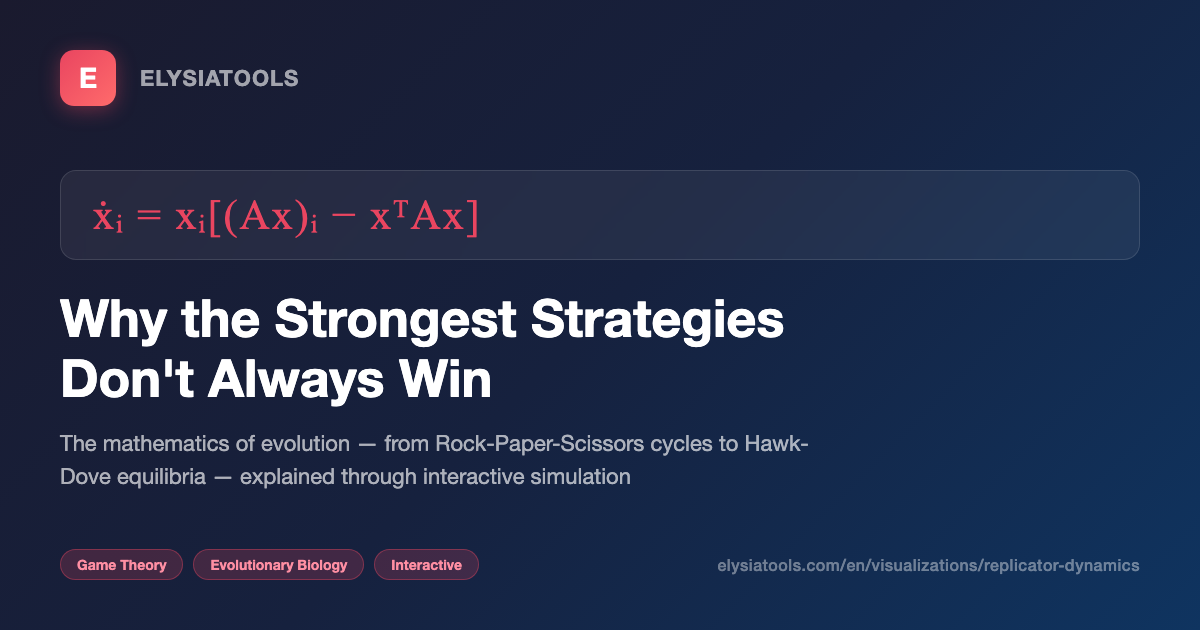
The core equation looks like this:
> **ẋᵢ = xᵢ[(Ax)ᵢ − xᵀAx]
Don’t let the notation intimidate you. Here’s what it actually says:
– xᵢ is how common strategy i is in the population (its frequency)
– (Ax)ᵢ is how well strategy i is performing right now
– xᵀAx is the average performance of the whole population
– ẋᵢ is the rate of change — whether strategy i is growing or shrinking
The term [(Ax)ᵢ − xᵀAx] is the crucial piece: it’s the relative advantage of strategy i. If your strategy is doing better than the average, your share of the population grows. If it’s doing worse, you decline. The stronger you are relative to the group, the faster you expand.
This creates a powerful prediction engine. Given any set of strategies and their payoffs (expressed as a payoff matrix), replicator dynamics tells you how the population will evolve over time.
The Simplex: A Geometry of Possibility
To really understand replicator dynamics, you need to meet the simplex — a geometric object that represents every possible state of a population.
For three strategies, the simplex is a triangle. Each corner of the triangle represents a pure strategy — everyone in the population plays the same thing. Any point inside the triangle represents a mixed population, where multiple strategies coexist in specific proportions.
The constraints are elegant: every point in the triangle satisfies x + y + z = 1, meaning the proportions always sum to 100%. A point exactly in the middle means all three strategies have equal share (about 33% each). A point near one corner means one strategy dominates nearly the entire population.
What makes the simplex so powerful is that you can watch the population move across it. Starting from any initial position, replicator dynamics generates a trajectory — a path that shows how strategy frequencies evolve over time. Some trajectories spiral toward stable equilibria. Others cycle endlessly around the triangle. The geometry doesn’t just represent the outcome; it is the dynamics.
The ElysiaTools visualization renders this simplex interactively. You can click anywhere on the triangle to set an initial population state, then watch the system evolve in real time.
Classic Games, Universal Lessons
Replicator dynamics becomes most illuminating when you apply it to specific games — structured payoff scenarios where defined strategies interact. Each classic game in the visualization reveals a different facet of how competition works.
Rock-Paper-Scissors: The Cycle That Never Ends
The classic three-strategy game where Rock beats Scissors, Scissors beats Paper, and Paper beats Rock is deceptively simple. You might expect replicator dynamics to eventually settle on one dominant strategy. It doesn’t — and that’s precisely the point.
In Rock-Paper-Scissors, there is an interior equilibrium at the exact center of the simplex: all three strategies have equal frequency. This equilibrium is mathematically a center — trajectories around it don’t converge or diverge, they cycle. The population goes around and around the triangle forever, with no strategy winning overall.
What does this mean in the real world? In biological systems, this corresponds to cyclical dominance — like the three male mating strategies in some lizard populations, where each type is common enough that it maintains the others. No strategy drives the others to extinction because the rock-paper-scissors relationship creates a self-sustaining loop. Permanence through competition.
Hawk-Dove: Why Aggression Isn’t Always Winning
The Hawk-Dove game models conflict between aggressive and passive strategies. Hawks fight fiercely for resources; Doves display peacefully but retreat when challenged. The payoff matrix creates a tension: if everyone is dove, a single hawk can dominate. But if hawks become too common, they injure each other in their fights, and doves actually come out ahead.
The result is a stable mixed equilibrium — not a single winning strategy, but a permanent coexistence where the proportion of hawks and doves settles to a specific ratio. The exact equilibrium depends on the cost of conflict.
This is a profound lesson: in many competitive environments, the optimal population composition isn’t “all of the best strategy.” It’s a specific balance. Pure aggression doesn’t win — it self-limits.
Stag Hunt: Safety vs. the Big Prize
The Stag Hunt game captures one of the deepest tensions in all of cooperation: the choice between a safe, reliable payoff and a higher payoff that requires trusting others.
In the original story, two hunters can either cooperate to hunt a stag (high payoff, but requires both committing) or hunt hare individually (low but certain payoff). If your partner bails on the stag hunt, you’re left with nothing.
The game has two stable equilibria: one where everyone hunts stag (payoff-dominant but risky), and one where everyone hunts hare (risk-dominant but lower-reward). Starting from different initial conditions, the population can end up at either equilibrium — and once there, it may be trapped. A population of all-hare players can’t spontaneously generate enough trust to reach the stag equilibrium.
This maps directly to real-world coordination problems: why some markets stay stuck in low-quality equilibria, why companies fail to adopt superior standards, why social norms can persist even when better alternatives exist.
Coordination: When Consensus Is the Goal
In coordination games, players benefit from doing the same thing as everyone else. The classic example: two drivers approaching each other on a road, both must choose to drive on the same side to avoid a crash. Neither side is objectively better — what matters is matching.
These games have multiple stable equilibria — two or more states where everyone is doing the same thing and no one has incentive to deviate. The challenge isn’t finding the “best” strategy in isolation; it’s coordinating on one of the available equilibria.
Replicator dynamics in coordination games shows how history matters. Which equilibrium wins often depends on which one got a slight early advantage. Small perturbations in initial conditions can determine which outcome the entire population converges to.
Evolutionarily Stable Strategy (ESS): When Stability Means Invinciability
One of the most important concepts in evolutionary game theory is the Evolutionarily Stable Strategy (ESS) — a strategy that, if adopted by an entire population, cannot be invaded by any mutant strategy.
The definition is subtle. A strategy is an ESS if, when 100% of the population plays it, no single mutant playing something different can do better and slowly take over. ESS is stricter than Nash Equilibrium: every ESS is a Nash equilibrium, but not every Nash equilibrium is an ESS.
Some games have pure ESS — Hawk-Dove, for instance, has a stable mixed equilibrium that qualifies as ESS. Rock-Paper-Scissors, by contrast, has no ESS at all (because the interior equilibrium is unstable — tiny perturbations send the population cycling). Coordination games have multiple ESS.
The ElysiaTools visualization marks both Nash equilibria and ESS points on the simplex, so you can see exactly where the stable points are and what makes them special. The phase portrait — showing the vector field of evolution at every point — reveals the basins of attraction: regions of the simplex that flow toward each stable point.
Why It Matters Beyond Biology
Replicator dynamics started in evolutionary biology, but its applications reach far beyond the natural world.
In economics, it explains how behaviors, norms, and practices spread through markets. Why do certain products become dominant despite inferior alternatives? Why do some industries converge on particular standards? Replicator dynamics offers a framework for understanding market selection — not as rational optimization, but as differential propagation.
In social science, it models how cultural traits spread, how languages evolve, how social norms form and collapse. Ideas and behaviors that gain even a slight advantage in visibility or adoption can trigger cascading shifts through a population, even if they’re not objectively better.
In computer science, replicator dynamics underlies multi-agent learning systems, algorithmic game theory, and distributed optimization. When autonomous agents interact in unknown environments, replicator-style dynamics inevitably emerge — successful strategies get copied, unsuccessful ones fade.
Exploring It Yourself
The [Replicator Dynamics Visualizer on ElysiaTools](https://elysiatools.com/en/visualizations/replicator-dynamics) is a remarkable interactive laboratory. You can:
– Choose from preset games (Rock-Paper-Scissors, Hawk-Dove, Coordination, Stag Hunt) or build your own custom payoff matrix
– Click anywhere on the simplex to set initial conditions and watch the population evolve
– Toggle the vector field to see the direction of evolution at every point
– Watch the time series chart showing how each strategy’s frequency changes over generations
– Analyze equilibrium points and see which are stable (ESS) and which are unstable
– Adjust simulation speed and time step to watch dynamics in slow motion or fast forward
The visualization is built around the same mathematical framework that powers evolutionary game theory research, but it presents everything with unusual clarity. The simplex is the centerpiece — watching trajectories flow across it is one of the best ways to develop genuine intuition for how these systems behave.
The Deeper Pattern
Replicator dynamics reveals something fundamental about how complex systems work: local rules generate global patterns. No central authority decides which strategy wins. No perfect information guides the population toward optimal outcomes. The entire sophisticated behavior emerges from the simple rule that better-performing strategies replicate more.
This same logic operates in markets, in cultures, in ecosystems, in neural networks, and in the algorithms that learn from data. The mathematics of replicator dynamics is, at its core, a mathematics of selection — and selection is one of the most powerful forces in the universe.
What makes the Replicator Dynamics Visualizer so valuable is that it makes this deep structure tangible. You can set up experiments, test intuitions, and watch the mathematics come alive. In a world full of complex systems that feel opaque and mysterious, that’s a rare and valuable clarity.
The implications extend in unexpected directions. Pharmaceutical companies use evolutionary game theory to design drug cocktails that suppress resistant bacterial strains before they emerge. Tech platforms model how features spread through user populations the same way biologists model predator-prey cycles. Traffic engineers apply coordination game logic to design road systems that prevent gridlock. The same equation — ẋᵢ = xᵢ[(Ax)ᵢ − xᵀAx] — runs underneath all of them, silently selecting for what works and eliminating what doesn’t.
Try the [Replicator Dynamics Visualizer](https://elysiatools.com/en/visualizations/replicator-dynamics) on ElysiaTools. Start with Rock-Paper-Scissors and watch it cycle. Then switch to Hawk-Dove and notice how the population finds its own equilibrium without anyone telling it to. The simplex is a mirror — whatever question you have about competition, cooperation, or change, the geometry has an answer.