# The Butterfly Effect Was an Accident: How One Meteorologist Discovered Chaos Theory
In 1961, Edward Lorenz wanted to rerun a weather simulation. To save time, he started from the middle of a previous run—but typed in slightly different starting conditions. He kept three decimal places instead of six. The simulation diverged completely.
Two trajectories that should have matched ended up on entirely different paths. Lorenz had just discovered the Lorenz attractor. He had also accidentally invented chaos theory.
What Is the Lorenz Attractor?
The Lorenz attractor is a strange attractor: a shape that a chaotic system’s trajectory spirals around forever, never quite repeating, never escaping a bounded region. Draw it in 3D and it looks like a figure-eight owl—or a butterfly mid-flap.
Three differential equations define it:
“
dx/dt = σ(y - x)

dy/dt = x(ρ - z) - y

dz/dt = xy - βz
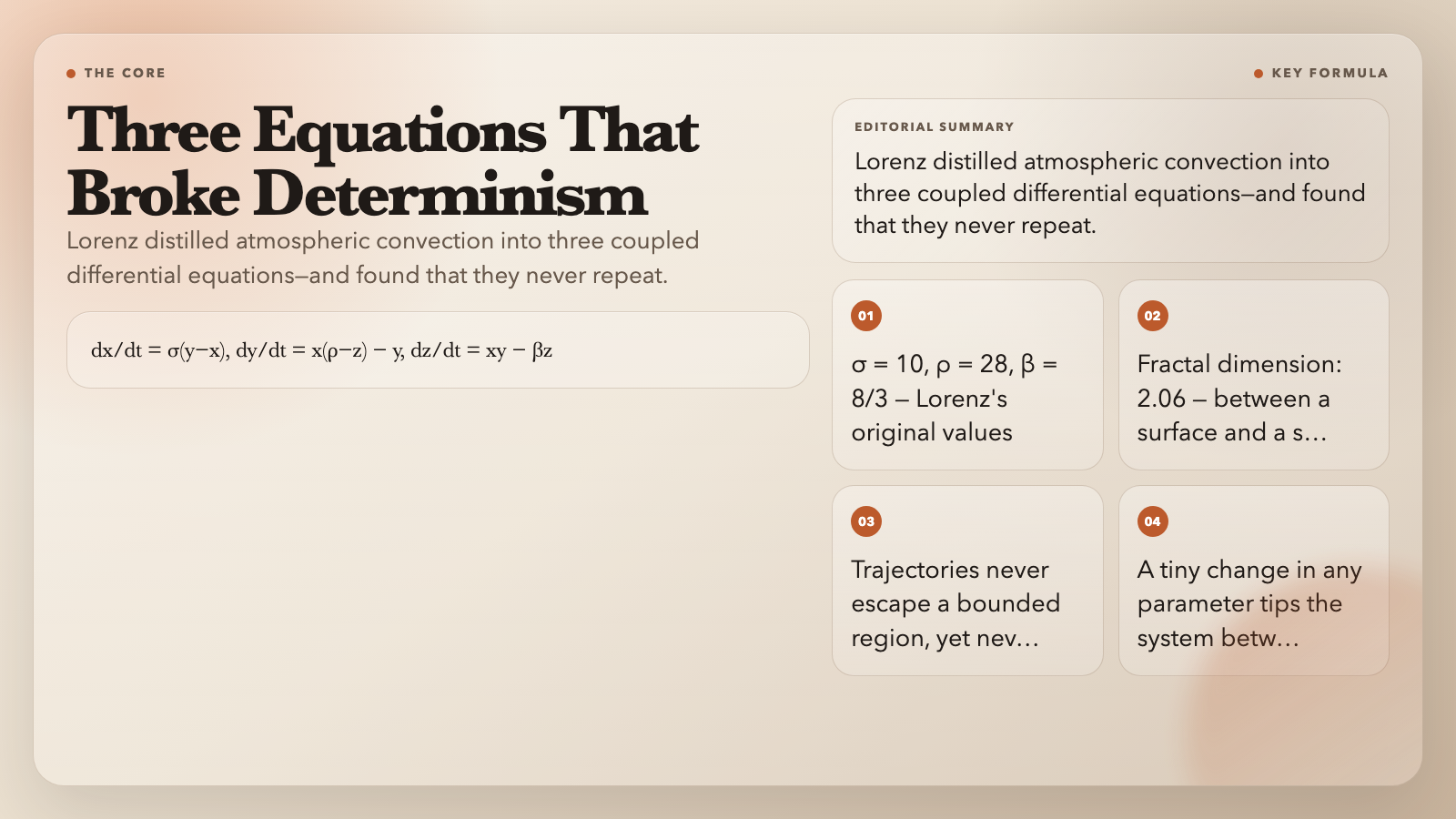
With σ=10, ρ=28, β=8/3—the values Lorenz used—the system lives in chaos. Its fractal dimension measures approximately 2.06. That places it between a surface and a solid. It is a shape that should not exist in three dimensions, yet the equations trace it endlessly.
Why the Butterfly?
Lorenz posed the question famously in 1972: “Does the flap of a butterfly’s wings in Brazil set off a tornado in Texas?” The metaphor stuck because it captures something counterintuitive: two nearly identical starting conditions—differing by 0.001—produce entirely different outcomes over time.
One trajectory spirals clockwise around one wing of the butterfly. The other goes counterclockwise on the opposite side. They never reconcile. The difference compounds until the two paths are utterly unrelated.

This is not a quirk of weather. It is mathematics. Push ρ above 24 and order dissolves into chaos. Drop it back down and periodicity returns. The system tips between two worlds with small parameter changes.
Why Meteorologists Give Up
Lorenz was a meteorologist at MIT. He was not theorizing about abstract dynamics—he was modeling atmospheric convection. The implication for his field was direct and brutal.
If a rounding error of one part in a million diverges over time, your forecast is only as good as your initial conditions. Initial conditions always carry rounding errors. Lorenz estimated that useful predictions might hold for 2–3 days, with meaningful divergence within two weeks.
This is why your five-day forecast is unreliable and your two-week forecast is essentially random. Not because meteorologists lack skill—because the system rejects prediction beyond a certain horizon.
The U.S. National Weather Service ran an experiment: they fed identical data into two identical models on two different computers. The results diverged within days. Researchers spent years hunting for the bug. There was none.
Chaos Shows Up Everywhere
Once scientists knew to look for it, chaos showed up across disciplines:
– Turbulent flow: transitions from smooth to chaotic remain one of physics‘ unsolved problems
– Cardiac arrhythmia: irregular heartbeats follow chaotic trajectories; doctors now monitor them for early warning signs
– Power grids: cascading failures spread through networks in chaotic cascades
– Population dynamics: predator-prey cycles never repeat, even in controlled lab settings
– Secure communications: chaos-based cryptography creates keys that are, for practical purposes, unbreakable
The Lorenz attractor told scientists where to look. It became a template for recognizing deterministic chaos wherever it hides.
What You Can Do Right Now
You do not need a supercomputer to explore the Lorenz attractor. An interactive visualization at ElysiaTools lets you:
– Watch two trajectories diverge from nearly identical starting points in real-time
– Adjust σ, ρ, and β and see the attractor morph from periodic to chaotic
– Rotate the 3D view to understand the structure from every angle
– Restart from different starting positions and observe how initial conditions change the outcome
Try it here: Lorenz Attractor — Interactive Visualization
Start with the default parameters and click “Compare Traces.” Watch two lines that begin nearly indistinguishable slowly peel apart over 30 seconds. The butterfly effect stops being a metaphor. It becomes something you saw happen.
The Question That Does Not Close
What makes Lorenz’s story remarkable is the accident. He was not searching for chaos. He was trying to cut computer time on a weather model.
He published his findings in 1963 in a paper titled “Deterministic Nonperiodic Flow.” The math community largely ignored it for a decade. Chaos theory only coalesced when other researchers began connecting similar stories—accidental discoveries in fluid dynamics, lasers, circuits, and biology.
Lorenz died in 2008. By then, chaos theory had reshaped everything from epidemiology to the search for extraterrestrial intelligence, where researchers now use chaos detection to filter signal from noise.
Here is what still unsettles physicists: knowing a system is chaotic does not prove you can predict it. You can measure the chaos, model it, visualize it in stunning 3D. And you are still blocked at the same wall Lorenz hit in 1961—two weeks of useful weather data, and then the sky goes dark.
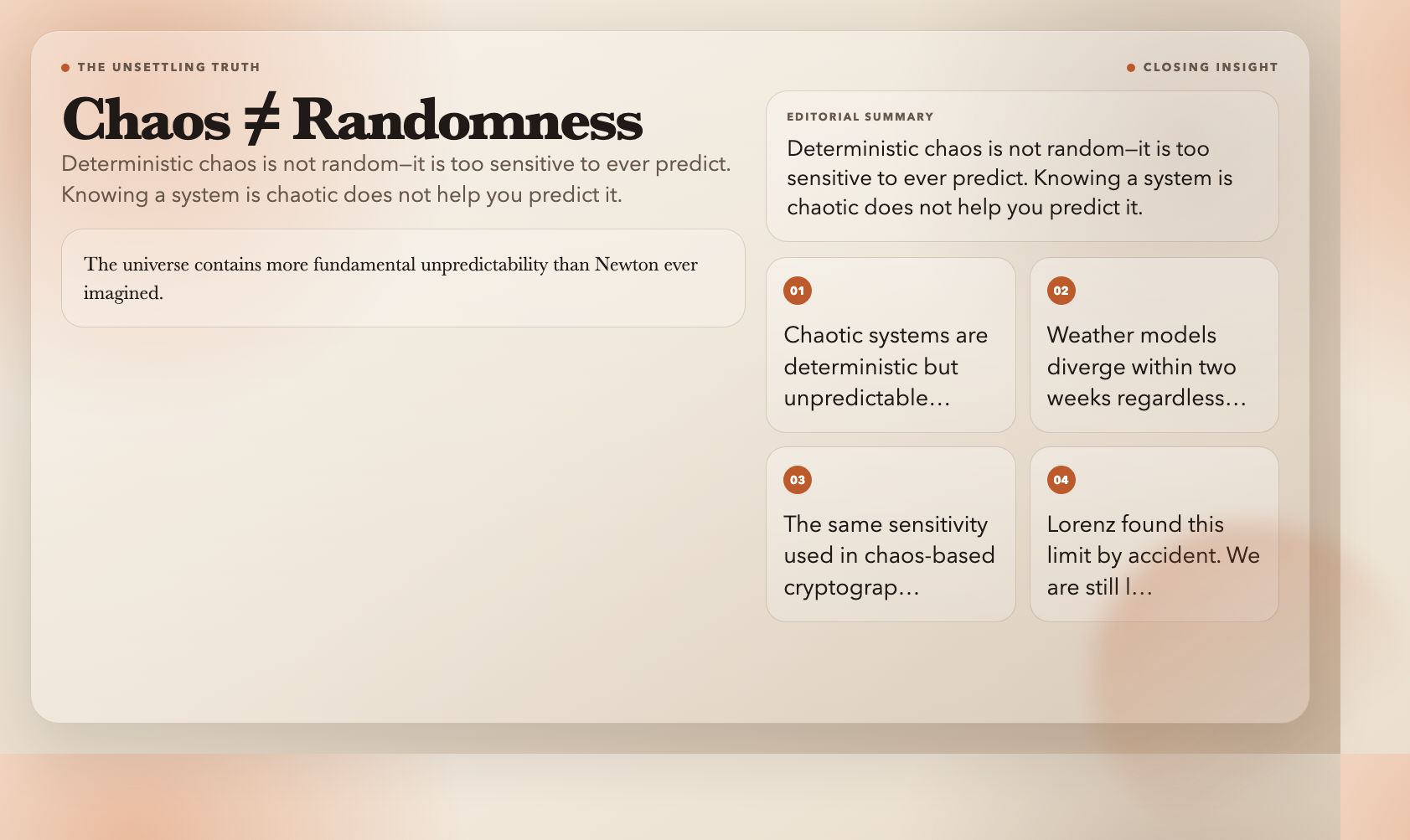
The deeper implication cuts both ways. If deterministic systems can be fundamentally unpredictable, then maybe the universe is full of order we cannot see—not because it is random, but because it is chaotic. Lorenz’s accidental butterfly showed us that some things are beyond prediction not because they are random, but because they are too sensitive to ever hold still.