The Accidental Discovery That Changed Everything Scientists Believed About Predictability
In 1963, Edward Lorenz wanted to rerun a weather simulation. To save time, he started from the middle of the original run — but typed in only three decimal places instead of the original six. The result shattered a centuries-old assumption about the universe.
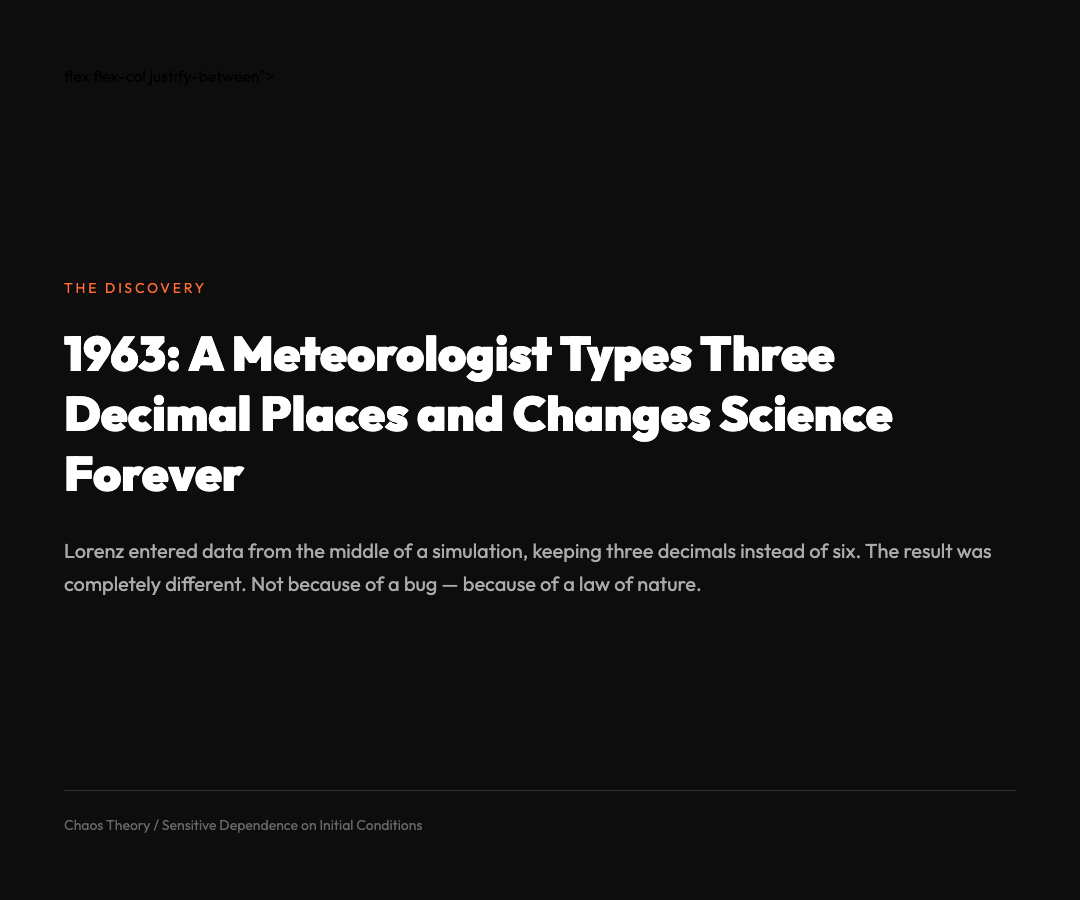
The new simulation diverged so dramatically from the original that Lorenz initially suspected a computer malfunction. It took weeks before he understood what he’d actually found: a system so sensitive to its starting conditions that two trajectories starting 0.001 apart would, after enough time, look nothing alike.
He called it “deterministic nonperiodic flow.” The press would call it “the butterfly effect.” And it rewrote the rules for everything from weather forecasting to philosophy.
The Equations Behind the Chaos
The Lorenz system is deceptively simple — just three coupled differential equations describing fluid convection:
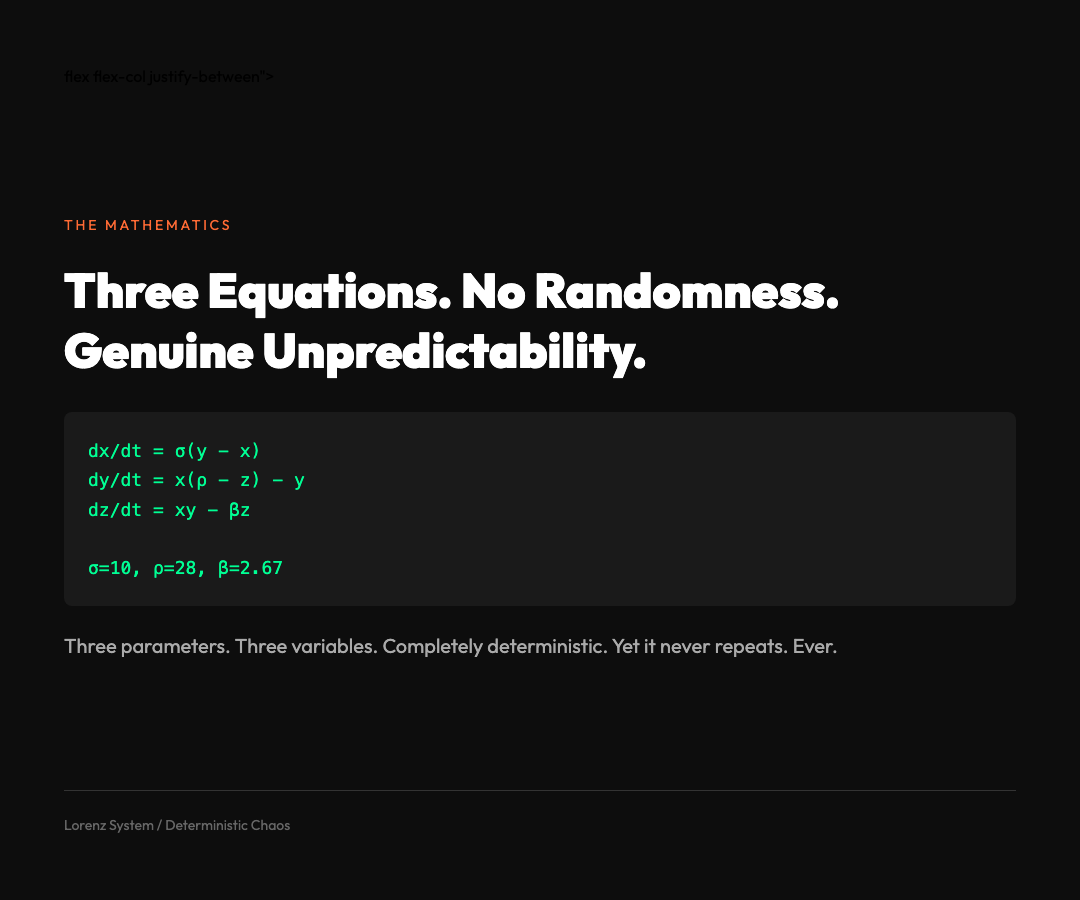
dx/dt = σ(y - x)
dy/dt = x(ρ - z) - y
dz/dt = xy - βz
Three parameters: σ (Prandtl number), ρ (Rayleigh number), and β (geometric factor). Three variables describing the state of the system at any moment. No randomness, no noise, no external influences. Completely deterministic.
Yet when Lorenz set σ=10, ρ=28, β=2.67 — values his meteorological models suggested — the solution traced something none of the world’s mathematicians had ever seen: a butterfly-shaped object that never closed on itself, never repeated, yet never flew apart.
What a Strange Attractor Actually Means
The shape this system traces is called a strange attractor. The word “attractor” makes sense — nearby trajectories are drawn toward it, pulled into its gravitational-like grip. But “strange” is what makes it revolutionary.
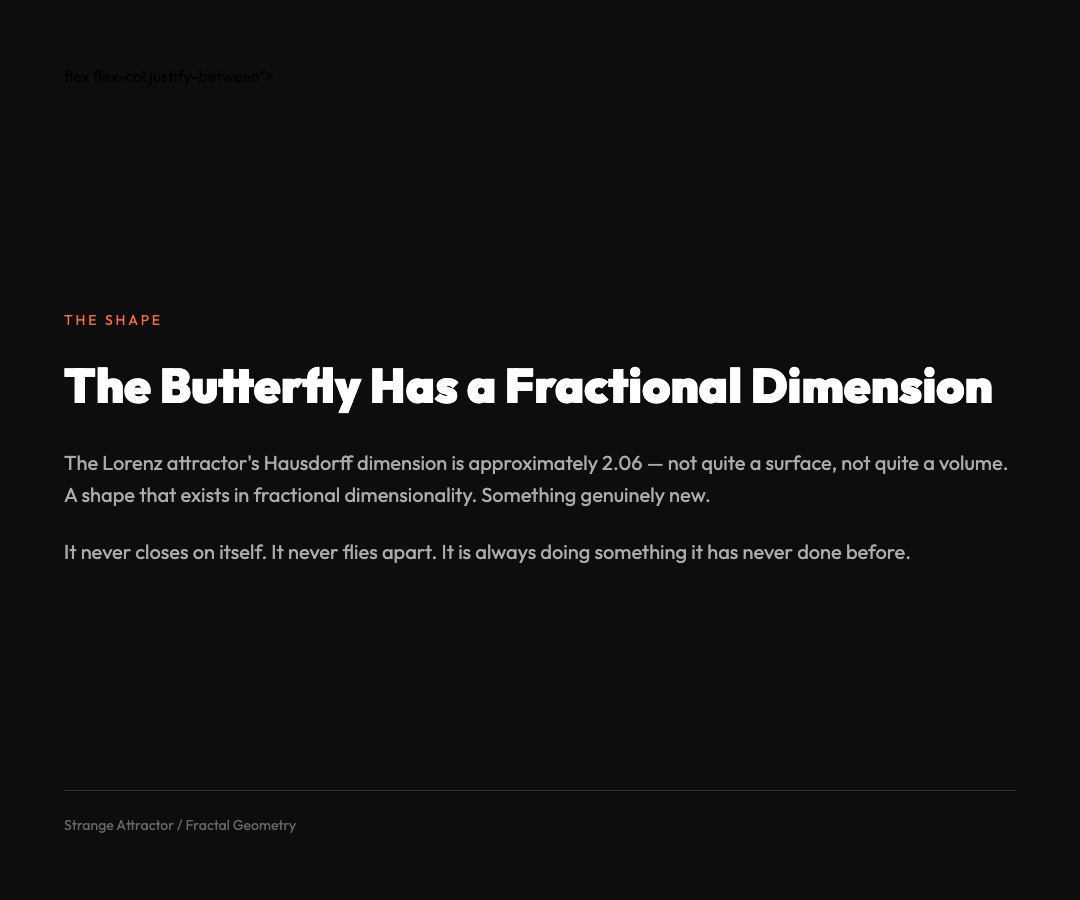
Classical attractors — a pendulum settling to rest, a planet orbiting a star — have integer dimensions. A point has dimension zero. A circle has dimension one. A sphere has dimension three. The Lorenz attractor has a Hausdorff dimension of approximately 2.06. It exists in fractional dimensionality. It is neither a surface nor a solid. It is something genuinely new.
More importantly: those trajectories on the attractor? They never repeat. Ever. Mathematicians had proven that deterministic systems with integer dimensions eventually become periodic. Lorenz found a counterexample that never stops being interesting. The system is always doing something it has never done before.
The Three Body Problem Had Nothing on This
Isaac Newton solved the two-body problem in 1687. Three centuries later, mathematicians still couldn’t fully solve the three-body problem — not because they lacked computational power, but because the equations resisted analytical solutions. But even the three-body problem, in its full chaotic glory, wasn’t as disturbing as what Lorenz found in three simple equations.
The three-body problem can be chaotic, yes. But the Lorenz system is a minimal example. Three equations. No approximations. No missing terms. Just pure, deterministic mathematics that produces irreducible randomness.
This is what haunts every meteorologist, every economist modeling markets, every biologist modeling population dynamics. If this — three equations, no randomness — can be unpredictable, then unpredictability isn’t a measurement problem. It’s baked into the structure of certain deterministic systems.
The Interactive Demo That Makes It Real
The Lorenz Attractor visualization lets you do something textbooks can’t: watch it evolve in real time.
Start with the default parameters (σ=10, ρ=28, β=2.67) and let the trajectory draw itself. You’ll see the system spiral around one lobe of the butterfly, then unpredictably jump to the other lobe, then back again — never in the same pattern twice.
The most instructive experiment: click “Compare Traces” and watch two trajectories start from points 0.001 apart. For the first few seconds, they’re essentially identical. Then slowly, imperceptibly, they begin to diverge. After a minute of simulation, they’re tracing completely different paths. The future states are no longer similar, even though the starting conditions were nearly indistinguishable.
This is what Lorenz discovered by accident, and it’s why long-range weather prediction will always be fundamentally limited. The atmosphere is a Lorenz-like system with无数 parameters, not three. The same mathematics applies.
Why This Matters Beyond Weather
The Lorenz attractor isn’t just a meteorological curiosity. The same structure — deterministic chaos, sensitive dependence, strange attractors — appears everywhere complex systems interact:
Ecology: Predator-prey populations oscillate in ways that look random but aren’t. Fisheries have collapsed not because of sudden environmental changes but because their models ignored the chaotic dynamics hiding in plain sight.
Medicine: Heart arrhythmias show chaotic patterns that Lorenz-style analysis can distinguish from random noise. Certain cardiac conditions produce the mathematical signature of a strange attractor.
Engineering: Power grids, telecommunications networks, and financial markets all exhibit chaotic regimes. Understanding Lorenz showed engineers that stable-looking systems can have hidden instabilities.
Cryptography: The very unpredictability of chaotic systems makes them useful for generating pseudo-random sequences. Modern chaos-based encryption exploits the properties Lorenz accidentally discovered.
The Real Legacy: The End of Laplacian Determinism
Before Lorenz, the dominant view in science was essentially Laplacian: if you knew every particle’s position and velocity, you could predict the entire future of the universe. It was just a computational problem — eventually, given sufficient computing power, the future would be knowable.
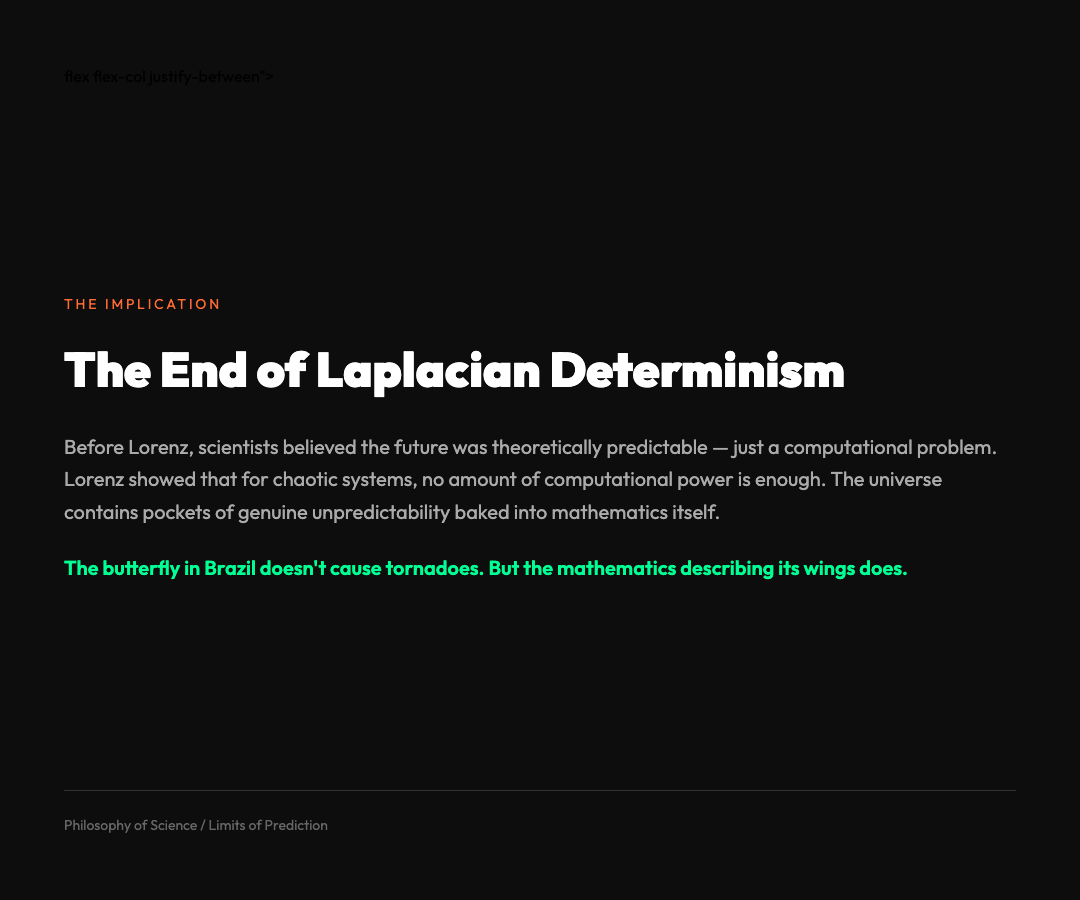
Lorenz didn’t disprove this. He showed it was irrelevant. For chaotic systems, knowing the initial conditions to six decimal places is not enough precision. To predict the state of a Lorenz attractor one hour in the future, you would need initial conditions specified to an absurd number of decimal places — more precision than any physical measurement could ever achieve.
The universe contains pockets of genuine unpredictability, not from quantum randomness or measurement limitations, but from the mathematics itself. This was the conceptual earthquake Lorenz triggered, and its aftershocks still reshape how we think about prediction, complexity, and the limits of human knowledge.
The butterfly in Brazil doesn’t cause tornadoes. But the mathematics that describes the butterfly’s wings does, in principle, influence whether Texas gets a tornado next month. That’s not mysticism — it’s the strange, beautiful, genuinely surprising truth that Lorenz pulled out of a weather model by accident, and that the world is still learning to live with.
Try the Lorenz Attractor visualization to watch chaos unfold in real time — adjust parameters, compare trajectories, and see why the butterfly effect isn’t a metaphor, it’s a mathematical fact.