Why the Next Economy Won’t Be About Buying More Stuff
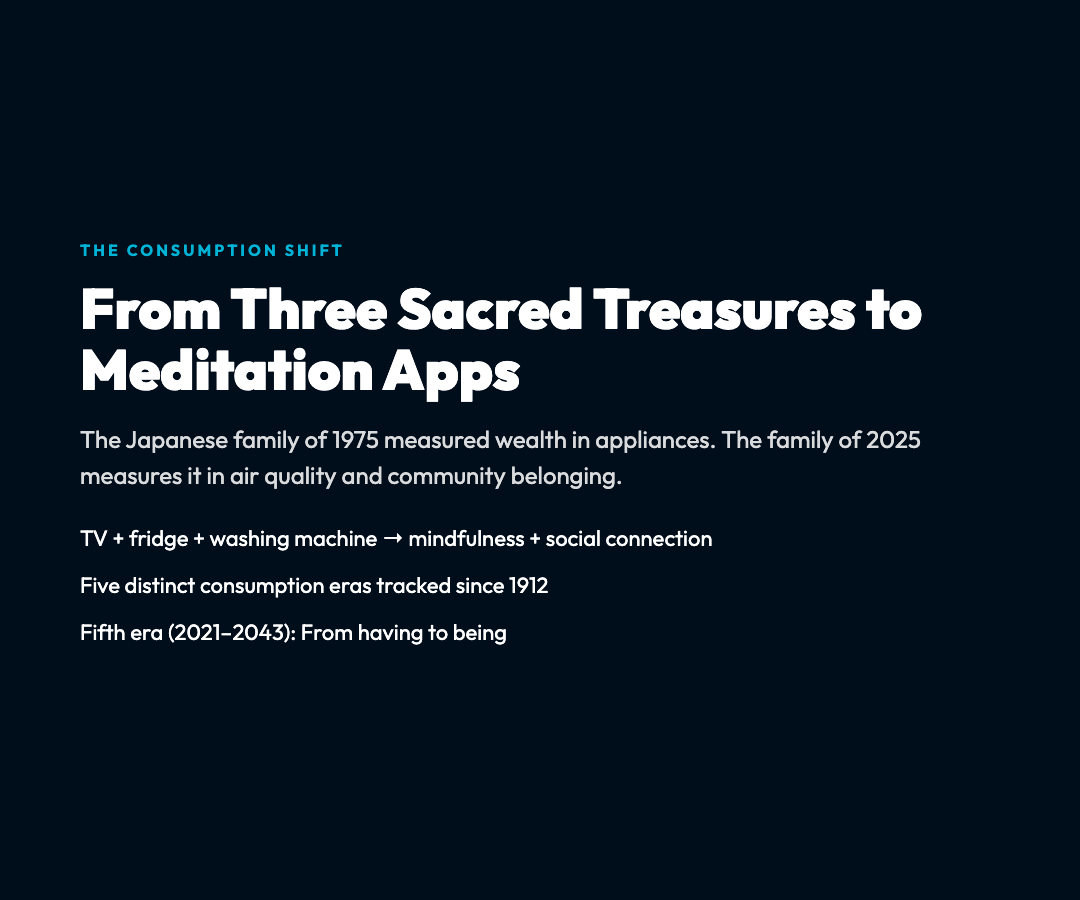
In 1975, a Japanese family was proud to own a television, a refrigerator, and a washing machine — the so-called “Three Sacred Treasures” of the second consumption era. Forty years later, that same family is more likely to measure wealth in mindfulness apps, community connections, and air quality. Something fundamental has shifted in what humans want from the economy.
The Fifth Consumption Era (2021–2043) marks the first time in modern history that the dominant cultural narrative is turning away from material accumulation toward something harder to buy: spiritual fulfillment, emotional connection, and a sense of belonging.
From Having to Being
Economists have tracked five distinct waves of consumer behavior since the early 20th century:
– First Era (1912–1937): Westernization and the emergence of the middle class. Department stores appear. Western goods enter daily life. – Second Era (1955–1974): Mass production and mass consumption. The “Three Sacred Treasures.” Suburban living becomes the dream. – Third Era (1975–2004): Individualization and brand consciousness. Luxury goods. Personal identity expressed through consumption. – Fourth Era (2005–2020): The peak of materialism — and its cracks. Economic anxiety meets climate awareness. Minimalism begins as a fringe movement. – Fifth Era (2021–2043): Well-being focus. Social connection. Sustainability as default, not sacrifice. From having to being.
The pattern is not linear progress. Each era didn’t simply replace the last — it built on it. But the direction of cultural energy has reversed. After a century of defining progress as owning more, the leading edge of consumption is now defined by needing less.
The 7S Framework: Seven Dimensions of the New Consumer
What does a fifth-era consumer actually want? The ElysiaTools visualization models this through seven interconnected dimensions — the 7S Framework:
– Slow: Quality over convenience. Experiences that unfold over time, not instant gratification. – Small: Local over global. Supply chains you can trace. Businesses you can name. – Sociable: Shared over solitary. Consumption as social glue — not status signaling. – Soft: Flexible over rigid. Adaptable products and services that fit life, not the other way around. – Sustainable: Required over optional. Not a premium feature — the baseline. – Sensuous: Multi-sensory over purely functional. Products that feel good to touch, not just to own. – Solution: Outcome over ownership. Pay for the result, not the asset.
No single dimension dominates. The fifth-era consumer weighs all seven simultaneously, and the products and services that thrive are those that score well across the entire framework.
The Demographic Cliff Behind the Shift
This cultural shift is not happening in a vacuum. It coincides with the most significant demographic restructuring in human history.
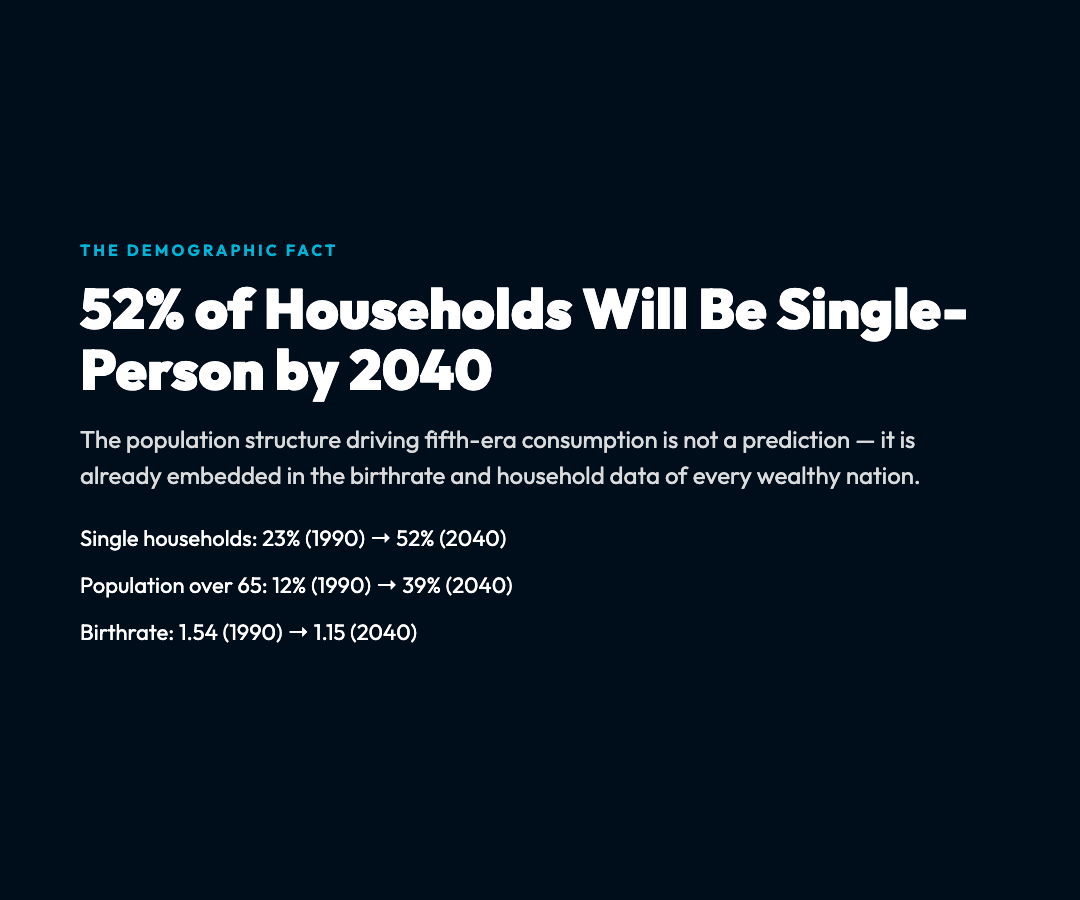
In developed economies, the proportion of single-person households is projected to reach 52% by 2040, up from 23% in 1990. Nuclear families continue to shrink. Aging populations (those over 65 will constitute 39% of the population in many developed nations by 2040) are redefining what a “useful” product means.
When you live alone and are retired, the value of a meditation app exceeds the value of a second car. The value of a community garden exceeds the value of a bigger apartment.
Birthrates across the developed world have fallen from 1.54 in 1990 to a projected 1.15 by 2040 — below replacement level in virtually every wealthy nation. Smaller families mean fewer dependents to provide for, and more resources per person to direct toward well-being rather than necessity.
The economy is not shrinking. The economy is being redrawn.
What This Means for Businesses
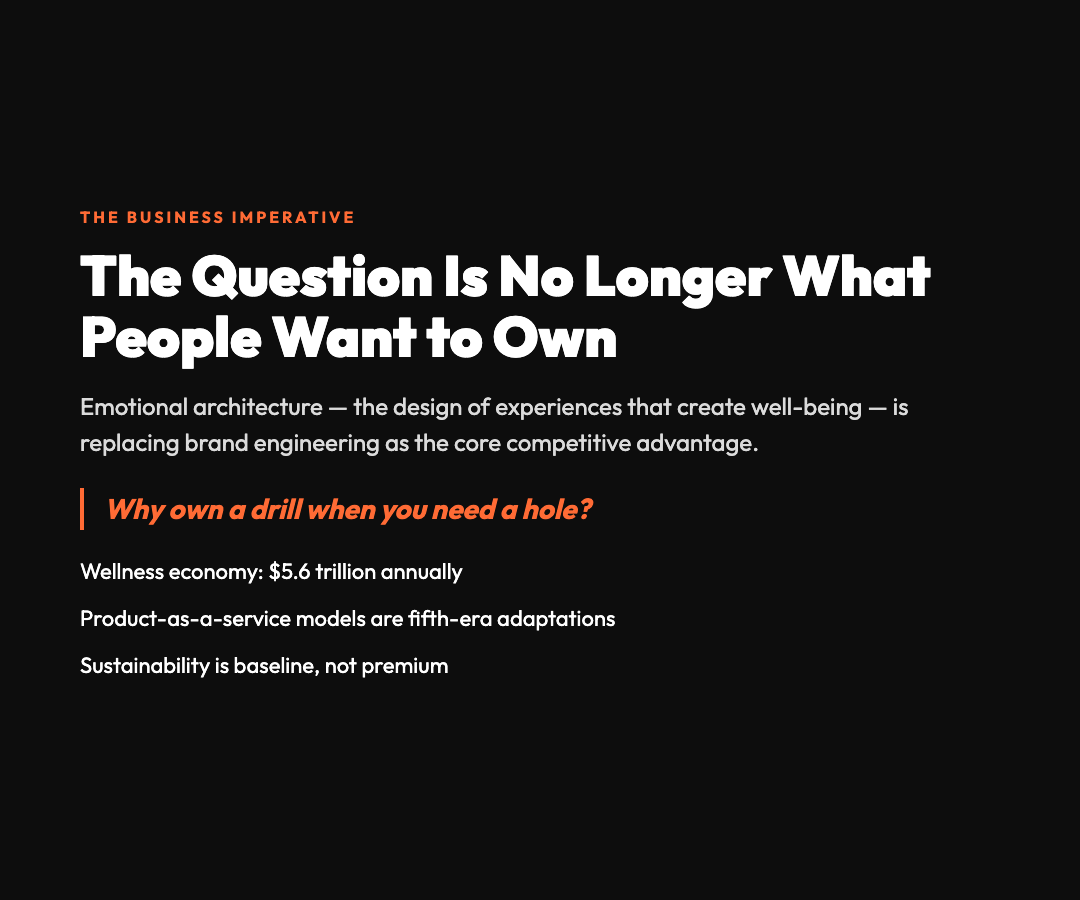
If the first four consumption eras were won through manufacturing excellence, brand engineering, and supply chain optimization, the fifth era will be won through emotional architecture — the design of experiences that create a felt sense of well-being.
This is not a niche trend. It is a structural shift in what the market demands. Consider:
– The global wellness economy exceeds $5.6 trillion annually. – “Slow” brands — Patagonia, Nothing, Aesop — command premium valuations and extraordinary customer loyalty precisely because they refuse the logic of the fourth era. – The sharing economy and product-as-a-service models are not disruptions — they are fifth-era adaptations. Why own a drill when you need a hole?
The Fifth Consumption Era is not about consuming less. It is about consuming differently — with more intention, more connection, and more awareness of consequence.
The Hard Part: Measuring What Can’t Be Stocked
Here is the economic catch-22 of the fifth era: the things people value most are precisely the things that are hardest to price, hardest to own, and hardest to scale.
Happiness is not inventory. Community belonging does not appear on a balance sheet. Air quality has no SKU.
This is why fifth-era economics requires new tools — not just for tracking traditional metrics like GDP and consumption volumes, but for visualizing the relationships between social cohesion, environmental quality, demographic change, and individual well-being.
The ElysiaTools Fifth Consumption Era visualization makes these connections visible. It lets you model the 7S Framework across different national contexts, track demographic transitions, and see how well-being indicators interact with economic behavior.
It is, in a small way, a tool designed in the spirit of the era it describes: focused on outcomes over objects, on connection over possession, on understanding over optimization.
The economy of the next twenty years will belong to those who understand that the question is no longer what do people want to own? — but how do people want to live?
Interactive Visualization: Explore the Fifth Consumption Era visualization on ElysiaTools to model the 7S Framework across different national contexts, track demographic transitions, and see how well-being indicators interact with economic behavior.