Why Water Finds Its Own Level: The Surprising Physics Behind Communicating Vessels
Open any physics textbook and you’ll find it stated as obvious: water seeks its own level. But if you stop to think about why, the explanation leads deep into the heart of how pressure propagates through fluids — and why the humble communicating vessels experiment still surprises anyone who hasn’t seen it before.
The Scene That Defies Intuition
Imagine two containers of completely different shapes — one tall and narrow like a wine bottle, the other wide and shallow like a dinner plate. Connect them at the bottom with a thin tube. Now fill the tall container until the water reaches halfway up. What happens in the plate?
Most people guess the plate stays nearly empty. The tall column should hold more water, right?
When you open the connection, the water pours from the tall vessel into the flat one — but it doesn’t stop until both surfaces are exactly level. Not approximately. Exactly.
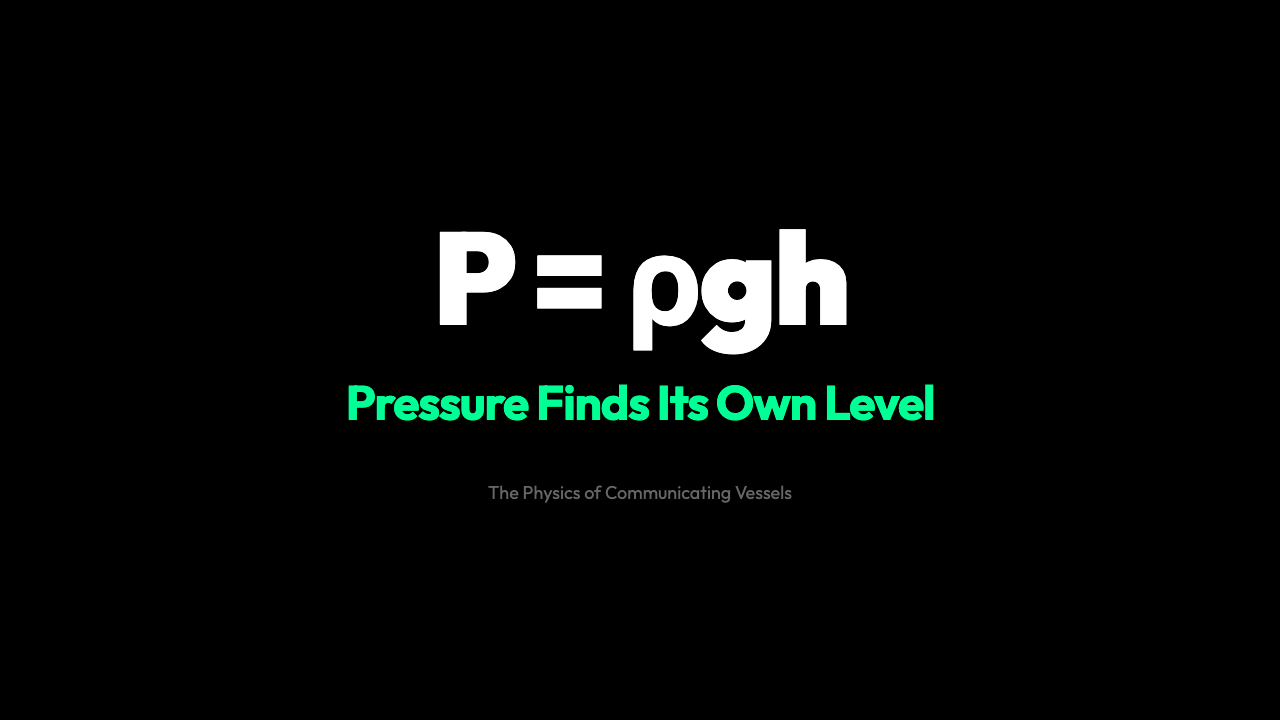
The water has no idea what shape the container is. It only feels pressure. And pressure at a given depth depends only on one thing: how far below the surface you are.
Pascal’s Principle: Pressure, Not Force
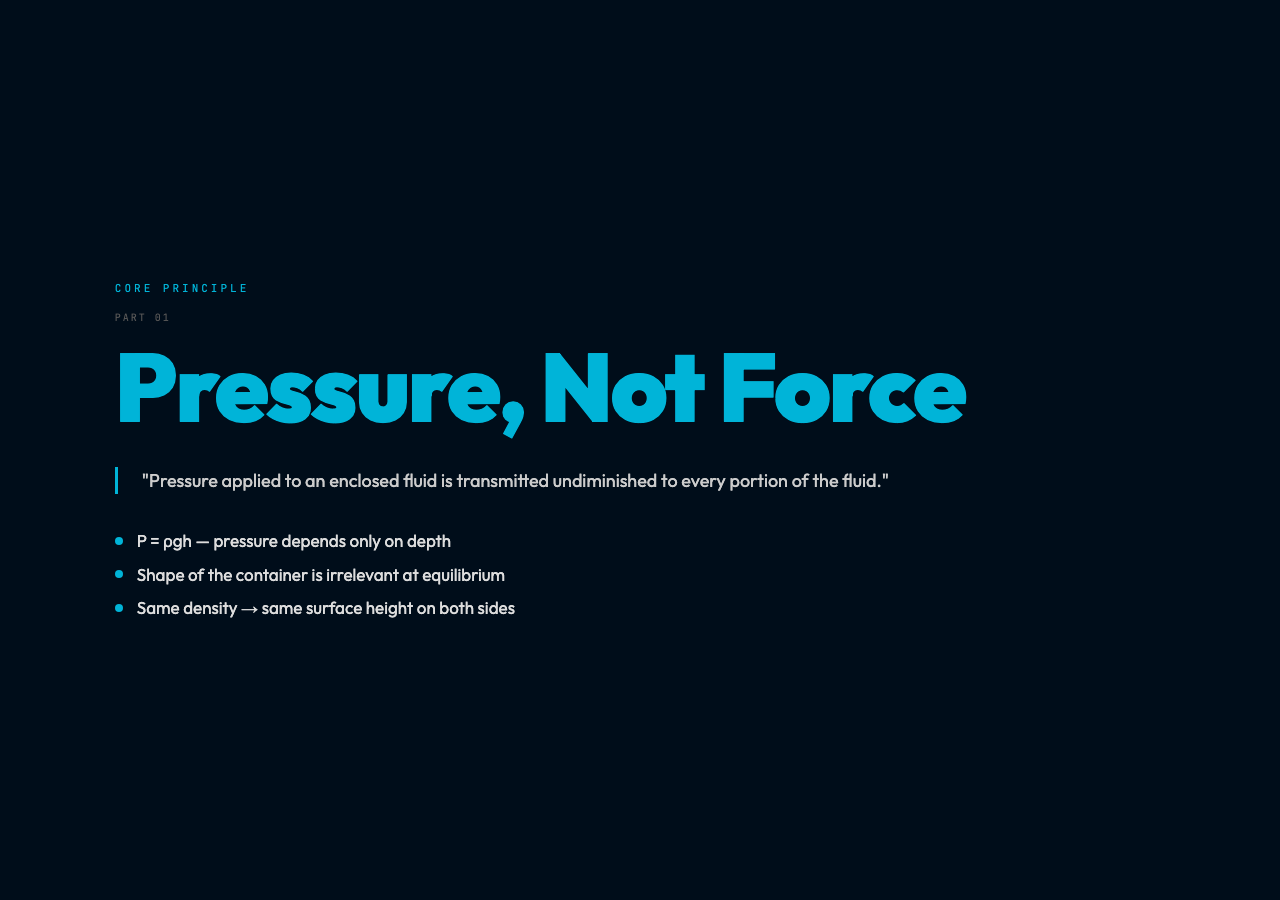
The French mathematician Blaise Pascal formulated the principle that explains this in the 17th century: pressure applied to an enclosed fluid is transmitted undiminished to every portion of the fluid and the walls of the containing vessel.
This is why a hydraulic jack can lift a car with nothing but a foot pedal. Push down on a small piston, and the pressure travels through the fluid to a larger piston, which pushes up with greater force. The smaller displacement you create with your foot becomes a larger displacement of the car — but the pressure is the same everywhere in the fluid.
In communicating vessels, the pressure at the bottom of the connection is determined solely by the height of the water column above it — not by how much water is in each column or what shape those columns are. Since both bottoms are at the same depth, they must experience the same pressure.
And since the fluid is connected, any imbalance drives flow until the pressures are equal. When the pressures equalize, the surface heights must be equal too.
The Hydrostatic Paradox
Here’s where it gets genuinely strange.
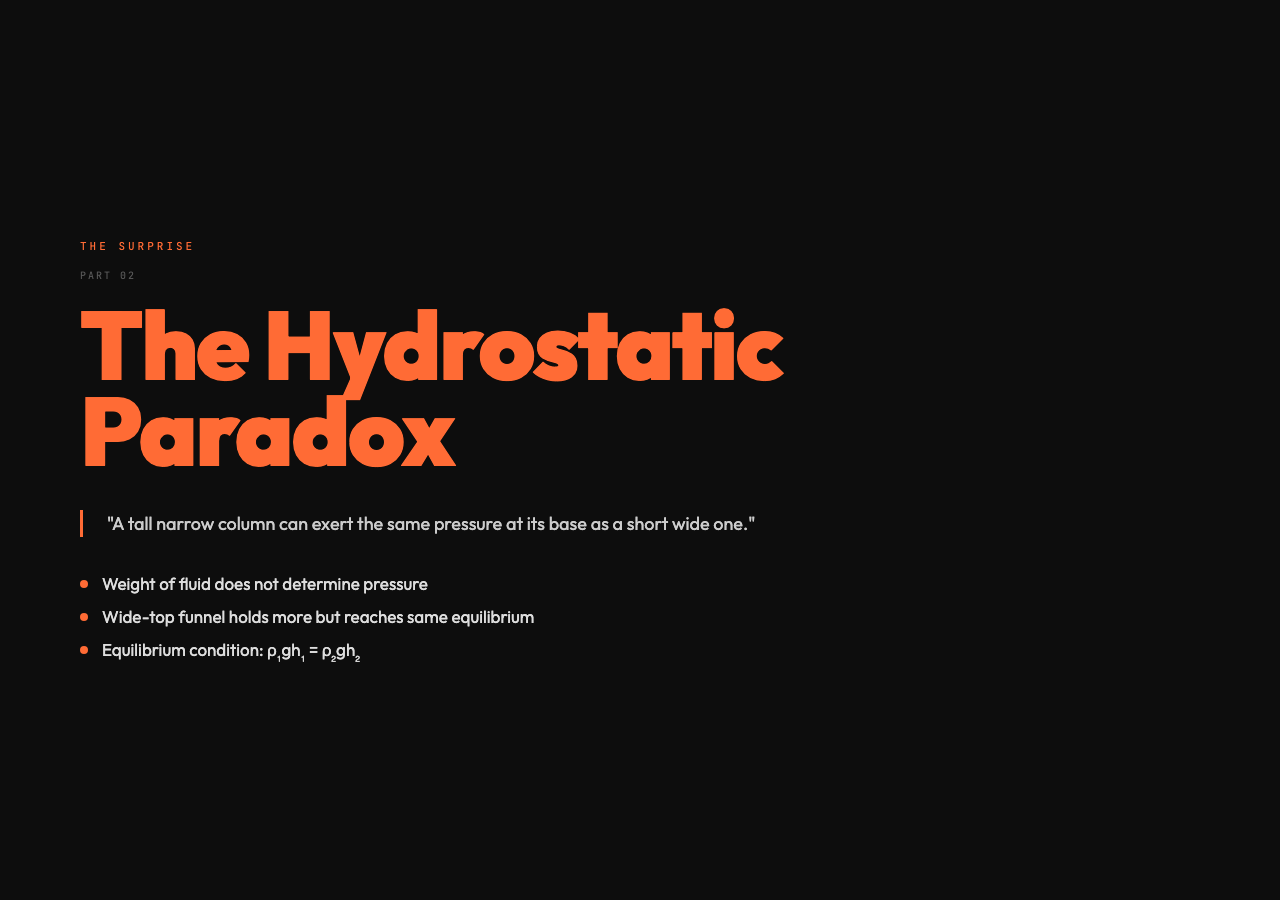
Fill a vessel shaped like a funnel — wide at the top, narrow at the bottom — and connect it to a simple cylinder. The pressure at the bottom depends only on the height of the water, not the total volume. So a tall, narrow column of water can exert the same pressure at its base as a short, wide one.
But the weight of water in each column is completely different. The funnel might hold five times as much water as the cylinder — yet if their surface levels are equal, the pressures at the bottom are identical.
This is the hydrostatic paradox: the pressure at the bottom of a fluid depends only on depth, not on the weight of the fluid above it. A container with a shape like a funnel — wide at the top, tapering to a narrow tube at the bottom — can hold far more water than a simple cylinder of the same height. Yet when you connect it to that cylinder, the water levels balance as if weight didn’t matter at all.
The interactive simulation lets you adjust the width of each vessel independently. Try making the left column much wider than the right. Fill the left to a modest height, the right to a tall one. Open the valve. The water doesn’t flow “downhill” toward the wider container — it flows toward equilibrium. If the right column is narrower but taller, it can actually push water into the wider one until both surfaces align.
What the Simulation Reveals
The ElysiaTools Communicating Vessels simulation shows this in real time. You can adjust:
– Left and right liquid densities: What happens if you connect two vessels containing fluids of different densities, like water and oil? The denser fluid will sit lower, and the interface between them will not be at the same height on both sides — but the pressure at the connection point still equalizes. – Gravity: Reduce gravity to lunar levels and the system still reaches equilibrium, just more slowly. The physics of pressure transmission is independent of the strength of the gravitational field. – Vessel widths: Making one vessel much narrower doesn’t change the equilibrium condition — it only changes how much water needs to flow to reach it.
The simulation also displays the pressure at the bottom of each vessel in Pascals. Watch those two numbers as you adjust the heights: they are always equal at equilibrium, regardless of how different the column heights look.
From Ancient Aqueducts to Modern Engineering
The principle of communicating vessels is older than Pascal by roughly two millennia. Roman aqueducts used the principle to maintain a constant water level across uneven terrain. Water would flow from an elevated source through buried pipes, and as long as the destination was at or below the source level, the water would find its own depth.
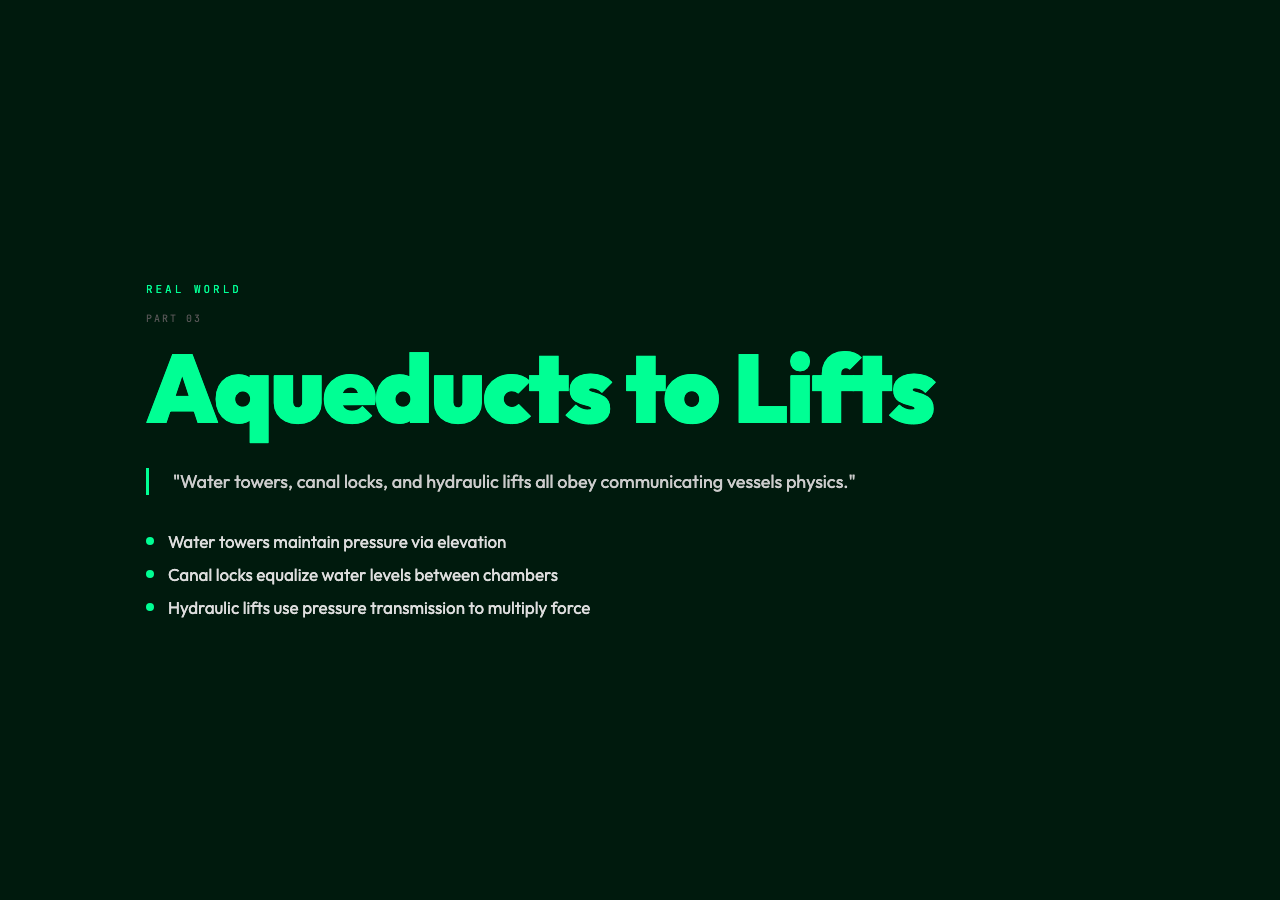
Today, the same principle appears in:
– City water towers: The elevated tanks maintain water pressure because the height of the water column produces pressure at ground level — regardless of how much water is in the tower at any moment. – Lock systems on canals: Ships move between different elevations when chambers connected by locks equalize water levels. – Hydraulic lifts in workshops and factories: The pressure transmission principle lets a small pump piston move a large load. – Water level indicators: Sight glasses on tanks show the water level because they are communicating vessels — the water level inside the glass is the same as in the tank.
The Deeper Insight
What makes communicating vessels so elegant is that it reveals pressure as a local property, not a global one. The fluid doesn’t “know” how much is above it in some absolute sense — it only knows the depth at its particular location.
This is why pressure increases with depth, why the shape of the container is irrelevant, and why fluids always flow toward equilibrium. The surface area, the total volume, the weight — none of these appear in the equilibrium condition.
The next time you see a water tower, a canal lock, or a hydraulic lift, you’re watching Pascal’s principle play out in the world. And if you ever have the chance to perform the communicating vessels experiment yourself — two containers, a bit of water, and a tube — watch closely. The water finds its own level with a certainty that still feels like a small magic trick.
Key Parameters in the Simulation
| Parameter | Symbol | Typical Value | Units | |———–|——–|—————|——-| | Liquid density | ρ | 1000 | kg/m³ | | Gravitational acceleration | g | 9.81 | m/s² | | Height (each vessel) | h | variable | m | | Hydrostatic pressure | P = ρgh | variable | Pa |
The equilibrium condition for two vessels connected at the bottom is simply:
ρ₁gh₁ = ρ₂gh₂
When the fluids are the same density (ρ₁ = ρ₂), this reduces to h₁ = h₂ — the surface heights must be equal. When densities differ, the heights adjust proportionally to the inverse of the density ratio.
This is the quiet mathematics beneath every water tower, every canal lock, and every hydraulic lift on Earth.