Why Your Electric Bill Is Written in Watts: The Physics of Power
The next time you look at your electricity meter, notice the number. It is not measuring volts, not measuring ohms — it is measuring watts. Every appliance in your home, from the refrigerator humming in the kitchen to the phone charger beside your bed, has its appetite measured in this single unit. But what exactly is an electric watt, and why does it show up on every piece of equipment you own?
The answer lives in one of the cleanest relationships in all of physics.
The Three Faces of Electric Power
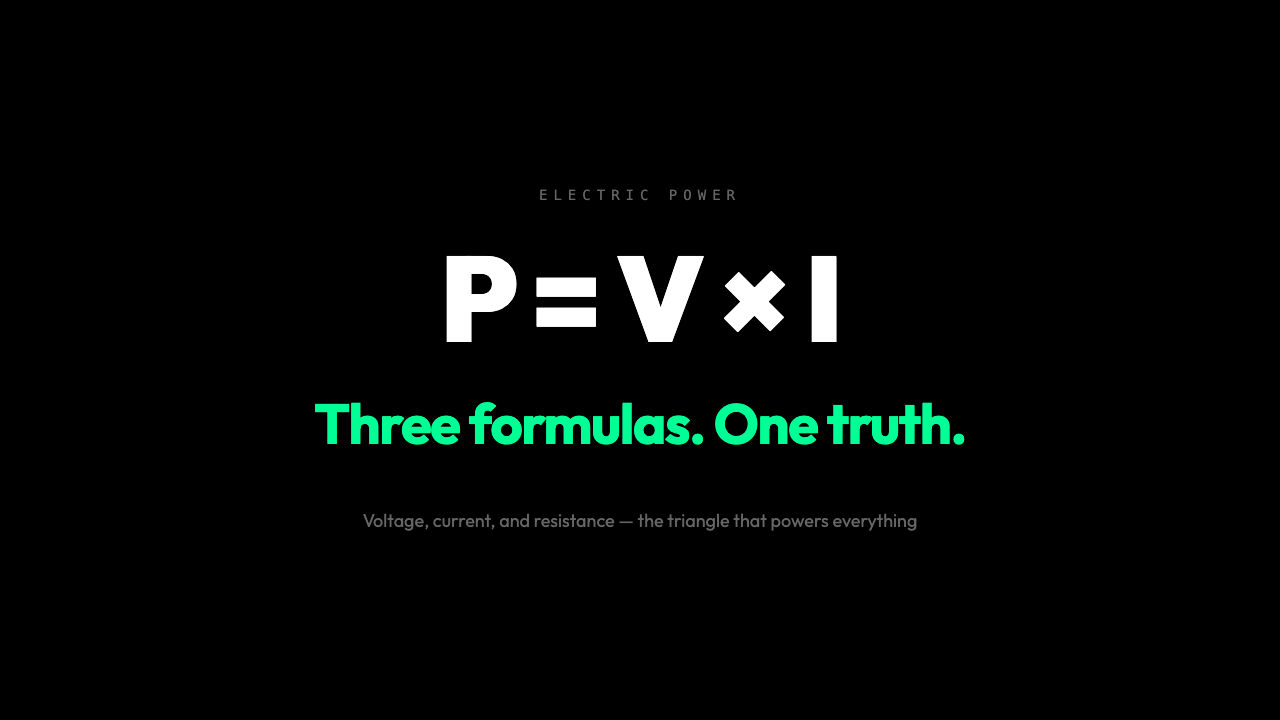
Electric power is the rate at which electrical energy is transferred or converted. In its most direct form, it is the product of voltage and current:

P = V × I
Power (watts) equals voltage (volts) times current (amperes). Push 230 volts through a circuit carrying 2.3 amperes, and you get roughly 530 watts — enough to run a modest space heater or a cluster of LED bulbs.
But the elegance of this formula does not stop there. Using Ohm’s Law — the relationship V = I × R — you can rewrite power in two equivalent forms:
P = I² × R P = V² / R
All three produce the same result. The first emphasizes current and resistance. The second emphasizes voltage and resistance. The third is the most convenient when you know the voltage and need to find power directly, without calculating current first.
This matters because in real circuits, you rarely have direct access to all three quantities at once. A light bulb labeled “60W on 230V” gives you voltage and power. From those, you can derive the current (I = P/V ≈ 0.26A) and the resistance (R = V²/P ≈ 880Ω) — neither of which is printed on the bulb.
Why the Same Formula Three Ways
Each version of the formula becomes the obvious choice in different contexts.
When engineers design power transmission lines, they prefer P = V²/R. Voltage on long-distance lines is extremely high — hundreds of kilovolts — and the formula makes it clear that doubling the voltage cuts the power lost to resistance in the wires by a factor of four. That is why the grid steps voltage up for transmission and back down again near your neighborhood.
When designing circuits inside a device — say, a laptop charging at 20V — engineers reach for P = I² × R. Current is what actually flows through the components, and resistance tells you how much of that current dissipates as heat. Every time current passes through a resistor, energy is lost as heat. The I²R relationship is the foundation of why your laptop charger gets warm.
When you buy a device and read its label, you usually see watts and voltage. That is the P = V × I form — the most intuitive expression of a device’s energy appetite.
Energy: The Other Half of the Story
Power tells you how fast energy is being used. Energy tells you what that use costs over time.

The relationship is straightforward:
E = P × t
Energy (in kilowatt-hours) equals power (in kilowatts) times time (in hours). A 2,000-watt hair dryer running for 10 minutes consumes:
E = 2 kW × (10/60) h ≈ 0.33 kWh
At an electricity price of $0.15/kWh, that 10-minute shower costs about 5 cents. Run it every day for a month and you are looking at roughly $1.50. The number sounds small, but scale it to an entire household — HVAC, water heater, oven, washer, dryer — and the monthly bill becomes comprehensible. You are paying for kilowatt-hours, not volts or amperes.
This is why the electric meter outside your house measures energy directly, and why energy companies bill in kWh. Power is the rate; energy is what you actually consume.
The Physics in Your Wall Outlet
A standard wall outlet does not supply a fixed amount of power. It supplies a fixed voltage — 230V in most of the world, 120V in the United States and Japan — and lets the appliance decide how much current to draw.
Plug in a 60W bulb and it draws about 0.26A. Plug in a 2,000W hair dryer and it draws about 8.7A. The outlet does not care. It holds the voltage steady and lets Ohm’s Law and the power formula do the rest.
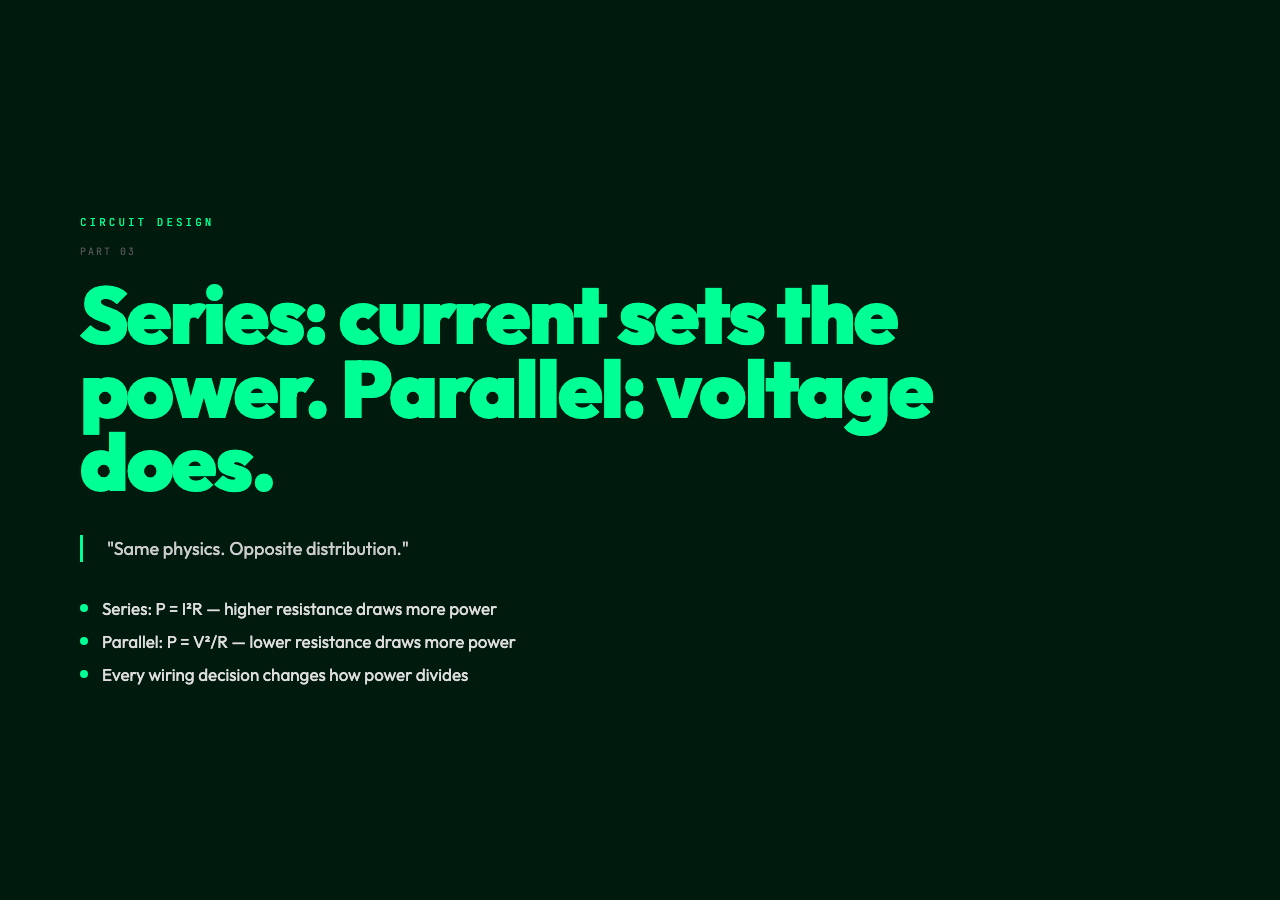
This is also why series and parallel circuits behave differently. In a series circuit, the same current flows through every component — so higher-resistance devices consume more power (P = I²R). In a parallel circuit, every component sees the same voltage — so lower-resistance devices consume more power (P = V²/R). The math is identical, but the way power distributes across the circuit depends entirely on how the components are wired.
The Interactive Graph
Use the simulation above to explore how the three formulas respond to changes in voltage, current, and resistance. Set any two values and watch all three power calculations update simultaneously. Notice that the three results are always numerically equal — that is not an accident. It is Ohm’s Law guaranteeing consistency across every possible way of asking the same question.
Notice also what happens when resistance approaches zero, as in a short circuit. The formula P = V²/R predicts power approaching infinity — which is exactly why a short circuit can destroy a wire before a breaker trips. The physics is not broken; it is telling you something dangerous about the real world.
What the Meter Is Actually Telling You
Next time you look at your electric meter or your utility bill, you now know what you are reading. Watts are the language of power — the rate at which your household converts electrical energy into light, heat, motion, and sound. Kilowatt-hours are the language of consumption — the accumulated cost of that power over time.
Every appliance is a vote for how you spend energy. Every watt you draw is the result of voltage, current, and resistance negotiating through the most elegant equations in physics.