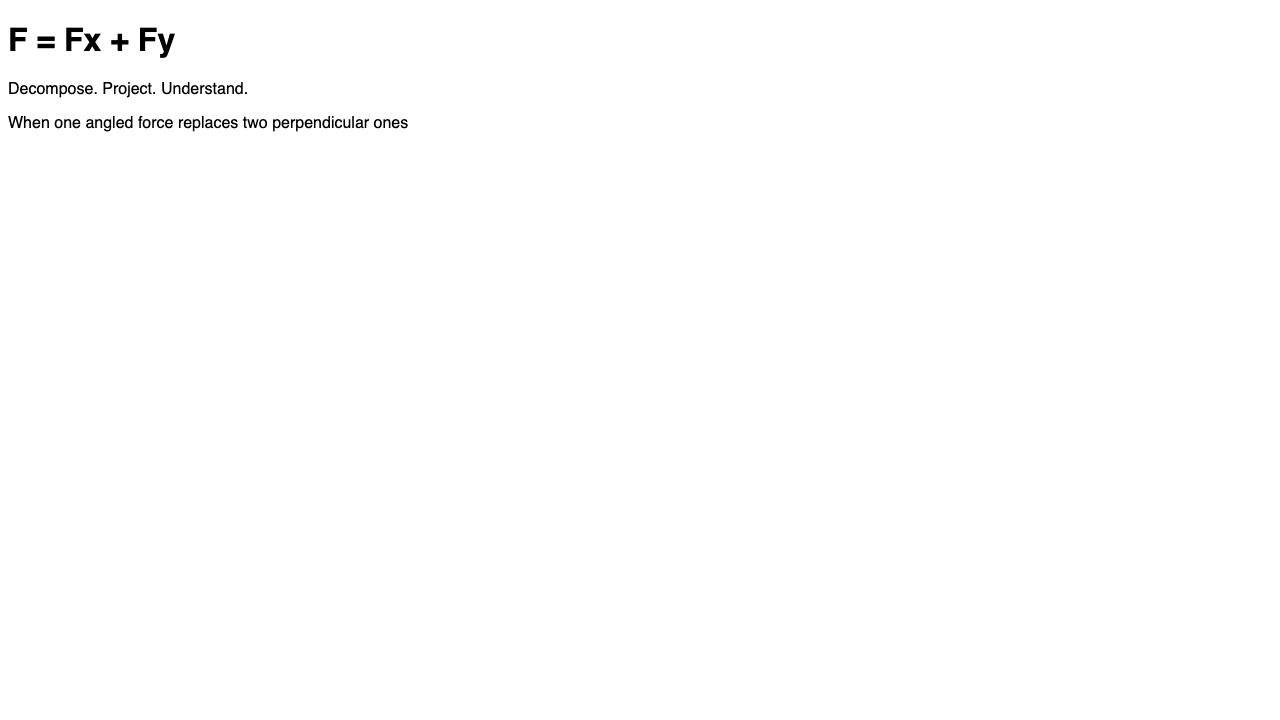
Why One Force Can Do What Two Angles Could: The Physics of Force Resolution
A sled sits at the bottom of an icy hill. You pull it with a rope at an angle — not horizontally, not vertically, but somewhere in between. The sled moves forward. But why? The rope’s force clearly isn’t pointing in the direction the sled is going. And yet the sled responds as if it were.
This is the puzzle at the heart of force resolution — the process of breaking a single angled force into components that point along the axes you care about. It’s one of the first concepts physics students encounter, and also one of the most powerful: a single well-angled push can accomplish what a brute-force horizontal pull never could.
The Core Insight: Decompose to Understand
When a force F acts at an angle θ from the horizontal, it can be decomposed into two perpendicular components:
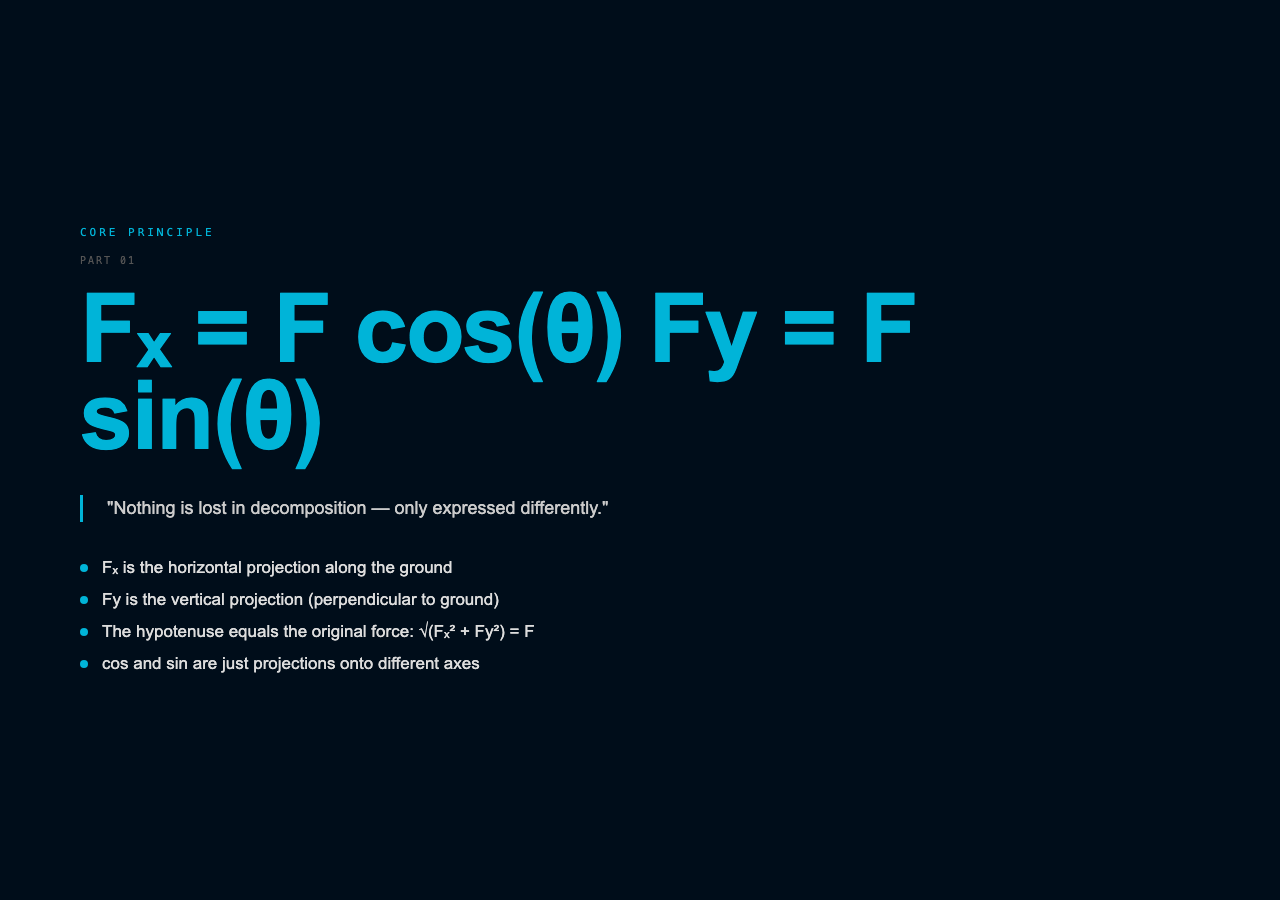
– Fₓ = F · cos(θ) — the horizontal component – Fy = Fy = F · sin(θ) — the vertical component (here Fy denotes the vertical component, distinct from the earlier Fy notation)
The force vector itself is the hypotenuse of a right triangle. Its components are the two legs. Trigonometry is what connects them.
The key insight is that these components act independently. Fₓ pulls the sled forward along the ground. Fy tugs it into the slope (or upward, if θ is negative). Only the horizontal component moves the sled forward. The vertical component either pushes into the surface (increasing friction) or lifts slightly (reducing it).
This is why pulling at a shallow angle is often smarter than yanking horizontally: the horizontal component grows as the cosine of the angle shrinks. Pull at 15° from horizontal and your horizontal component is cos(15°) ≈ 0.966 of the total pull. Almost all your effort goes into moving the sled.
Why cos(θ) and sin(θ)?
The choice between cosine and sine for the horizontal component depends on which side of the triangle you’re measuring. If θ is measured from the horizontal axis, then:
– The horizontal leg of the triangle is adjacent to the angle → cos(θ) – The vertical leg is opposite the angle → sin(θ)
This is the standard SOH-CAH-TOA framework applied to force vectors. The force magnitude F is the hypotenuse. Its horizontal projection is F · cos(θ). Its vertical projection is F · sin(θ).
For example, a 100 N force at θ = 30° resolves into: – Fₓ = 100 · cos(30°) = 100 · 0.866 = 86.6 N horizontally – Fy = 100 · sin(30°) = 100 · 0.5 = 50 N vertically
The vector sum of these components, √(86.6² + 50²) = √(7500 + 2500) = √10000 = 100 N, returns to the original force. Nothing is lost — the components are just a different way of describing the same push.
The Inclined Plane: Where Force Resolution Earns Its Keep
The real power of force resolution appears on an inclined plane. A box sitting on a ramp at angle α doesn’t just feel gravity mg pointing downward. Gravity pulls it into the ramp and down the ramp. To find out how hard it pushes down the slope, you project mg onto two axes: one parallel to the ramp surface, one perpendicular.

The component parallel to the ramp surface is mg · sin(α). This is the force that would accelerate the box if friction were absent. The perpendicular component is mg · cos(α). This is the normal force — the ramp pushing back.
Notice what happens as the ramp gets steeper: sin(α) grows, cos(α) shrinks. The down-slope force gets stronger while the normal force weakens. This is why it’s harder to hold a heavy object on a steep slope — and why friction, which depends on the normal force, becomes less effective at keeping it from sliding.
This is not a coincidence. It is the mathematics of projection doing exactly what it was designed to do: expressing the effect of a vector along any axis you choose.
Force Resolution vs. Force Composition
Force resolution is the inverse of force composition — the process of combining multiple forces into a single resultant. Where resolution breaks one vector into parts, composition adds parts into a whole.
The two operations are mirror images. To compose two perpendicular forces F₁ and F₂, you find their resultant magnitude: R = √(F₁² + F₂²) with direction tan⁻¹(F₂/F₁). To resolve, you do the opposite: given R and an angle, find the components using trigonometry.
Both operations appear constantly in physics. Statics problems usually require you to resolve all forces onto the same axes before summing. Dynamics problems often need you to isolate the component of a force along the direction of motion. The choice between resolving and composing is dictated by the geometry of the problem — not by the physics itself.
Interactive Visualization
The Force Resolution simulation lets you control the force magnitude and angle directly, then watch the components draw themselves in real time. The right triangle formed by the force vector and its components updates as you drag the sliders, making the relationship between the angle, the hypotenuse, and the two legs viscerally clear.
This is the kind of relationship that is easy to derive but hard to internalize. The formula tells you that the horizontal component equals F · cos(θ). The visualization shows you why — the horizontal leg of the triangle literally shrinks as the angle increases and the force rotates toward vertical.
The interactive pendulum scenario applies the same principle to a mass hanging from a string. The tension in the string has a horizontal component that drives the pendulum’s horizontal motion and a vertical component that balances gravity. The math is identical; the geometry is just easier to see when the string is swinging.
Why This Matters Beyond Physics Class
Force resolution is not a textbook abstraction. It is how engineers think about structures, how cinematographers rig cameras on angled mounts, how physical therapists design resistance exercises at specific joint angles.

When you pull a suitcase at an angle behind you, the handle force resolves into a component that lifts the suitcase (reducing the normal force and thus friction) and a component that pulls it backward. Smart luggage design exploits this: a slight upward angle at the right handle height minimizes drag.
When a satellite uses thrusters to adjust its orientation, each thruster fire is resolved into torque about the spacecraft’s center of mass. The thruster force doesn’t act through the center — that would only translate the spacecraft, not rotate it. By firing off-center, the force is resolved into a couple that spins the craft.
Force resolution is the mathematical habit of asking: along which axis does this force actually act? Once you learn to ask that question in any situation, a huge class of mechanical problems becomes straightforward.
The sled on the hill moves forward not because of the rope’s direction, but because of the horizontal projection of the rope’s force. Physics taught us to ask the right question.
Summary
A single force at an angle can be decomposed into perpendicular components using trigonometry:
| Component | Formula |
|---|---|
| Horizontal | Fₓ = F · cos(θ) |
| Vertical | Fy = F · sin(θ) |
These components act independently. On an inclined plane, the gravitational force resolves into a component down the slope (mg · sin α) and a component perpendicular to the surface (mg · cos α). The ratio between them shifts as the slope steepens, which directly explains why acceleration increases and friction becomes less effective on steeper inclines.
Force resolution is the inverse of force composition. Both operations are fundamental to statics and dynamics — the skill of choosing the right axis for projection is what separates a clean solution from a messy one.