
Imagine pushing a heavy filing cabinet across a concrete floor. You lean in, shoulder against the metal, and nothing moves. You push harder. Still nothing. Then — it lurches forward, and suddenly the resistance drops. Why does the force required to start motion suddenly become less than the force that held it still?
The answer lives in one of the most counterintuitive facts in introductory physics: static friction is stronger than kinetic friction. The same two surfaces that resist the first millimeter of movement offer less resistance once they are already sliding.
Two Forces, One Surface
When an object rests on a surface, the microscopic peaks and valleys of both materials interlock like exposed puzzle pieces. Even an apparently smooth surface is riddled with imperfections at the atomic scale, and these imperfections resist sideways motion through a mechanism called cold welding — metallic bonds that form where asperities make contact.

This interlocking produces a force called static friction (f_s). Its maximum value before motion begins is:
f_s(max) = μ_s × N
where μ_s is the static friction coefficient and N is the normal force (the perpendicular push of the surface against the object, equal to mg on a flat surface).
Once the applied force exceeds this threshold, the surfaces momentarily separate, the cold-welds break, and the object slides. What keeps it sliding is a different mechanism — a thin layer of adsorbed molecules, surface contaminants, and oxide films that act as microscopic ball bearings between the two solids. This produces kinetic friction (f_k), always smaller than the static maximum:
f_k = μ_k × N
where μ_k < μ_s for almost all material pairs.
The Numbers Behind the Jump
Consider a 5 kg block on a flat concrete surface (g = 9.81 m/s²). The normal force N = 5 × 9.81 ≈ 49 N.
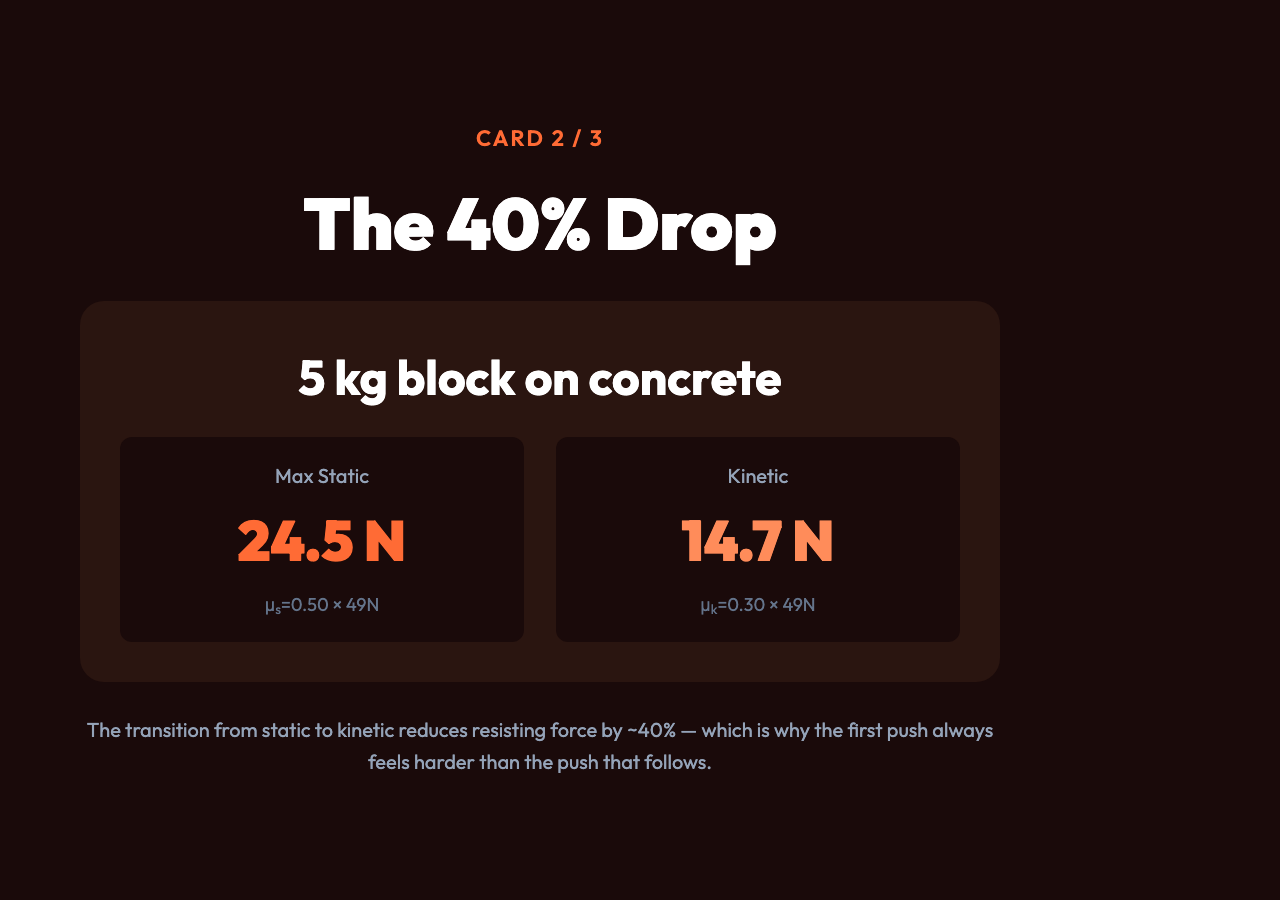
If μ_s = 0.50 (rubber on dry concrete) and μ_k = 0.30:
– Maximum static friction: f_s(max) = 0.50 × 49 ≈ 24.5 N (must push this hard to start motion) – Kinetic friction: f_k = 0.30 × 49 ≈ 14.7 N (less force keeps it sliding)
The transition from static to kinetic reduces the resisting force by about 40% in this example. This is why cars and bicycles feel harder to start rolling than to keep rolling — your muscles can sustain a lower force than the peak force needed at the threshold of motion.
Why Kinetic Friction Is Always Lower
The conventional explanation involves asperities: static friction locks asperities into deformation valleys, while kinetic friction lets asperities ride over each other on a quasi-liquid layer. But this oversimplifies. More recent research shows that the real mechanism in most dry contacts is adhesive junction growth — when two surfaces are pressed together under load, they actually form small cold-welded contact points. The total real area of contact (A_real) grows roughly with the load, and static friction is proportional to A_real.

As sliding begins, these adhesive junctions are continuously formed and sheared apart at the leading edge of each contact — but the contact area is temporarily reduced because the surfaces no longer sit in optimal registry. The result: less total adhesive strength, and thus less friction.
In everyday terms, the object “wants” to stick more than it “wants” to slide — once sliding, it has already broken the most favorable contacts and cannot rebuild them at the same rate.
The Coefficient Ratio: μ_s / μ_k
A useful parameter for engineering is the static-to-kinetic friction ratio. For rubber on dry concrete it is about 1.5–2.0. For steel on steel it can be 2–5. For wood on wood it is approximately 2.
This ratio tells you how much easier it is to keep something moving than to start it moving. A high ratio means the transition from rest to motion is dramatic. A low ratio means the transition is gradual.
This matters in vehicle safety: anti-lock braking systems (ABS) work precisely because the transition from static to kinetic friction at the tire-road contact is abrupt. If a wheel locks, the tire is now sliding (kinetic friction, lower grip) rather than rolling (static friction, higher grip). ABS pulses the brake pressure to keep each tire in the static-friction regime as long as possible.
The Threshold Force: What You Actually Feel
When you push the filing cabinet, the force you exert builds up silently while the cabinet resists with an equal and opposite static friction force. You feel the resistance grow. Once you hit f_s(max), the cabinet starts moving, and the resisting force drops to f_k. This jump in force is what you feel as a “give” — your muscles were calibrated to deliver a higher force, and suddenly the load is lighter than expected.
The same threshold explains why pulling a sticker off a wall feels harder in the first millimeter than in the last millimeter. The static friction at the initial contact point holds until the force overcomes μ_s × N. Once sliding begins, kinetic friction takes over and the sticker peels with less force.
Ice and the Exception That Confirms the Rule
The ice-on-ice case is a well-known anomaly: μ_s is only slightly greater than μ_k for ice. This is because at the contact interface, a thin quasi-liquid layer of water acts as a lubricant even before sliding begins. This is why it feels nearly as easy to start sliding on ice as to keep sliding — the mechanism that creates the static-kinetic jump is already partially active before motion.
The same principle applies to aquaplaning: a water film between tire and road removes direct contact and eliminates static friction entirely, dropping the tire into a kinetic-friction-only regime with dramatically lower grip.
A Deceptively Simple System
What makes sliding friction so rich is that it involves at least four simultaneous mechanisms — asperity interlocking, adhesive junction growth, plastic deformation at contact points, and surface film lubrication — each of which responds differently to load, speed, temperature, and material pairing.
The equations f_s(max) = μ_s × N and f_k = μ_k × N look simple, but they compress a great deal of microscopic complexity into two dimensionless coefficients. Those coefficients are not constants — they vary with surface roughness, contact time, temperature, and sliding speed.
Understanding why static friction is stronger than kinetic friction is not just an academic exercise. It is the reason your car stops when you want it to, why a sled catches when you step on it, and why the first push of any heavy object always feels harder than the push that follows.