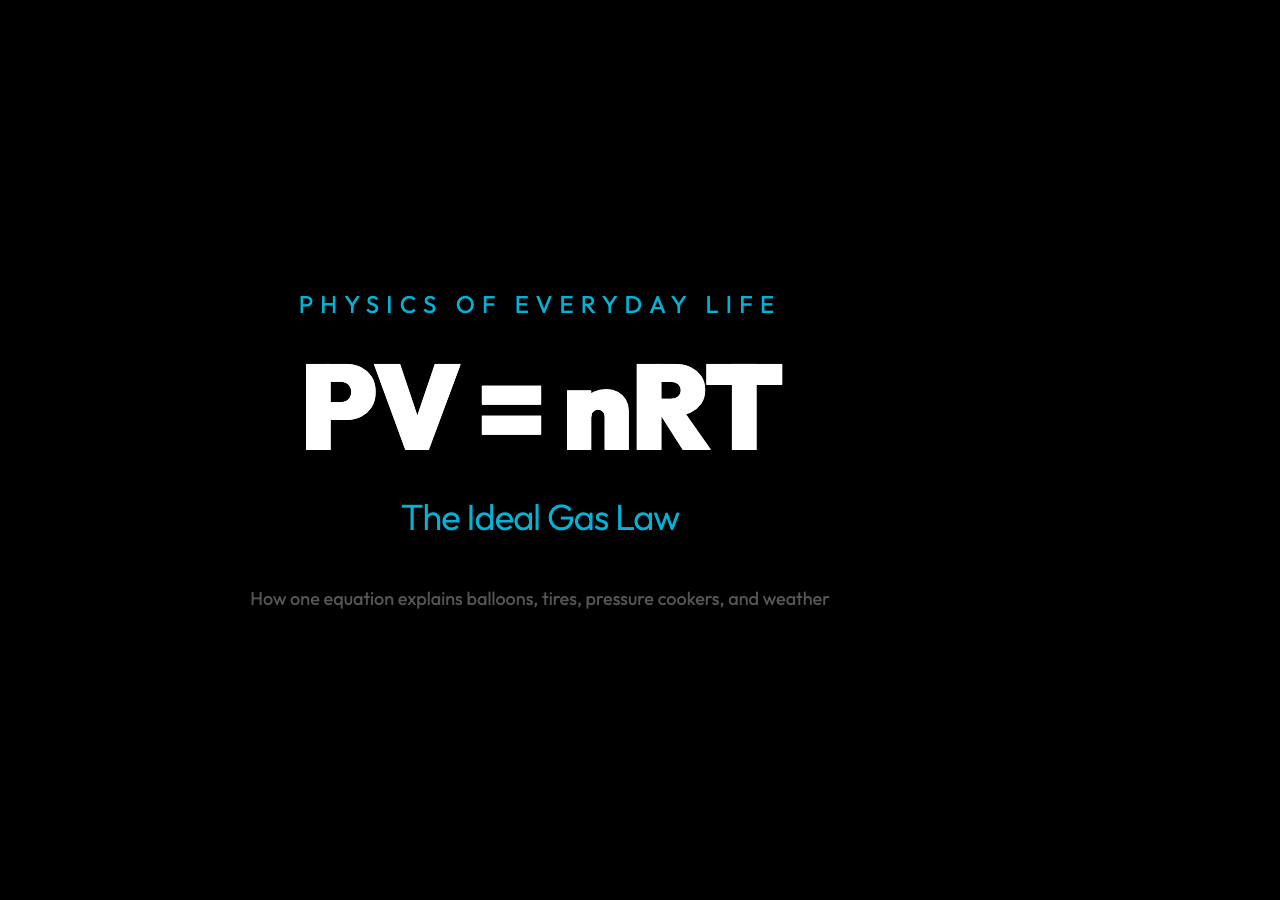
A balloon rises. A bicycle tire goes flat overnight. A pressure cooker cooks faster than an open pot. Three seemingly unrelated phenomena — and they all trace back to the same five-symbol equation that students memorize before they truly understand it: PV = nRT. The Ideal Gas Law is one of the most powerful unifying principles in physics, and yet its deepest meaning is often buried under drills and formula sheets. Here is what the equation actually says about the world you can see.
The Four Variables That Govern the Invisible World
The Ideal Gas Law relates four quantities that describe a gas: P (pressure), V (volume), n (the number of moles of gas), and T (temperature, measured in Kelvin). The constant R is the universal gas constant, equal to 8.314 J/(mol·K), and it converts everything into a consistent, universally comparable scale.
What makes this equation useful is that it describes how these four quantities depend on each other. If you heat a gas while keeping the volume fixed, the pressure rises — that’s why a scuba tank can become dangerous if heated after a fire. If you compress a gas by reducing its volume, the pressure rises — that’s why bicycle tires feel harder on a cold morning than on a warm afternoon, even though no air has been added or removed. Each of the three processes — isothermal, isobaric, isochoric — holds two variables constant and shows how the other two respond.
The Three Processes: Where the Real Physics Lives
The power of PV = nRT becomes most visible when you hold two variables constant and watch what happens to the others.

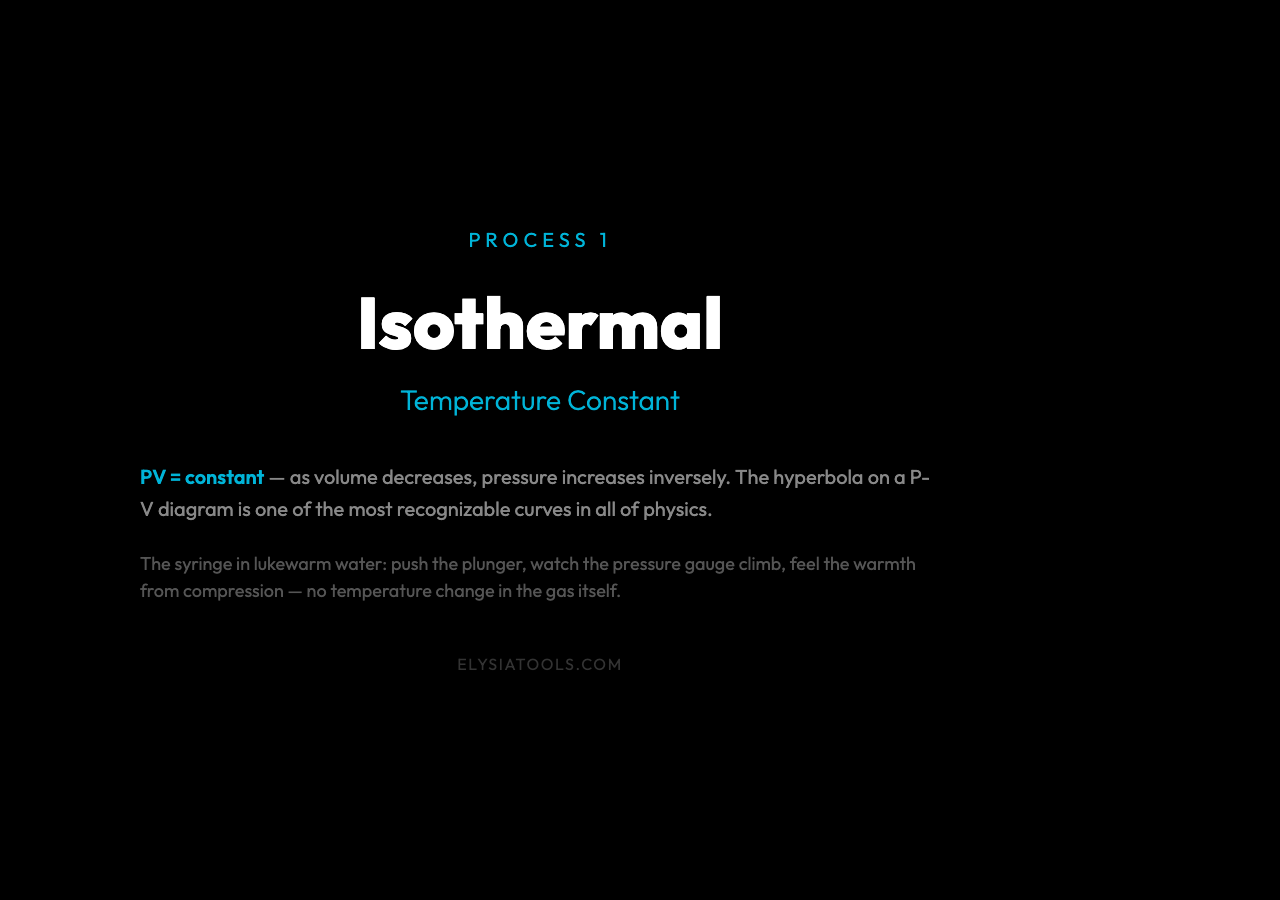
Isothermal means temperature stays the same. As you compress the gas — reducing V — the pressure P rises inversely, keeping the product PV constant. A syringe held in lukewarm water demonstrates this: pushing the plunger in slowly makes the pressure rise, but the temperature barely changes. The P-V curve on a diagram is a hyperbola, and the area under it represents the work done by the gas.
Isobaric means pressure stays constant. As you heat the gas, both V and T increase together. This is what happens inside a weather balloon as it rises: atmospheric pressure drops, so the balloon expands to maintain equilibrium with the outside air. The volume increases until the gas density inside matches the thinning atmosphere — and then the balloon keeps rising because the combined density of the helium plus the balloon material is still less than the surrounding air.
Isochoric means volume stays constant. As you heat the gas in a sealed rigid container, P and T increase together proportionally. A sealed rigid container demonstrates this: if you heat the air inside, the pressure rises with temperature. This is why pressure cookers work — the sealed container traps the gas, and as temperature rises, pressure inside climbs well above atmospheric pressure, cooking food much faster than boiling water alone.
The Piston as a Thinking Tool
Perhaps the most instructive way to understand the Ideal Gas Law is through a piston: a cylinder containing gas, with a plunger that can be pushed in or pulled out. When you push the plunger down, you reduce V. The molecules inside collide with the walls and each other more frequently — pressure rises. If the plunger is free to move, it settles at whatever position balances the external force with the internal pressure. That equilibrium is dynamic: molecules are constantly colliding, but on average the net force is zero.

The piston illustrates a deeper point: the Ideal Gas Law describes a system in dynamic equilibrium. It describes the continuous, statistical behavior of vast numbers of molecules. Each collision is transient, but the aggregate behavior — pressure, temperature, volume — is stable and predictable. This is why the equation works across different scales: whether you’re looking at a cubic centimeter of air or the entire Earth’s atmosphere, the same relationship holds.
Why Balloons Rise
A helium balloon rises because the gas inside it is less dense than the surrounding air. At atmospheric pressure, helium’s low molecular mass (4 g/mol) means fewer molecules occupy the same volume compared to nitrogen (28 g/mol) and oxygen (32 g/mol) in air. The balloon expands as it rises because external pressure drops — and PV = nRT guarantees that when P decreases and T stays roughly constant, V must increase. The balloon doesn’t float because helium is “light.” It floats because it is less dense than the air it displaces. Buoyancy is not about weight; it is about density difference.
This same principle applies to hot air balloons. The burner heats the air inside the envelope, and PV = nRT tells us that at higher T, a given amount of gas occupies more volume. The air inside becomes less dense than the surrounding cool air, and the balloon rises — not because it is light, but because the hot air inside is simply less dense than the cold air outside.
Why Tires Deflate in Cold Weather
Tire pressure drops in cold weather not because the tire leaks, but because the Ideal Gas Law demands it. The volume of a flexible tire casing changes only slightly with temperature. At constant V, pressure and temperature are proportional: when T drops by 20°C (from 300 K to 280 K), the pressure inside the tire drops by roughly 7%. A tire at 27°C that reads 32 psi will read about 30 psi at 7°C — without any air escaping. The Ideal Gas Law is not an approximation here — it is an exact description of what is happening inside a sealed, flexible container as temperature changes.
Where the Law Breaks Down
For most everyday conditions, PV = nRT is an excellent approximation. But at very high pressures or very low temperatures, real gases deviate from ideal behavior. The molecules themselves occupy a significant fraction of the total volume, and intermolecular forces become non-negligible. The van der Waals equation corrects for these effects by adjusting the pressure and volume terms — adding a term for molecular attraction and a term for molecular volume.
The Elysia Tools visualization demonstrates where these deviations become visible: as you compress a real gas to very high pressures, the P-V curve diverges from the hyperbola that the Ideal Gas Law predicts. Understanding when the law breaks down is just as instructive as understanding when it holds perfectly.
The Ideal Gas Law remains one of the most practically useful equations in all of science — a tool for predicting, explaining, and understanding the behavior of gases from a bicycle tire to a weather system. It is simple enough to write on a whiteboard, powerful enough to govern everything from combustion engines to atmospheric science, and deep enough to reveal something fundamental about the nature of matter in motion.