Why one total can earn four different scores
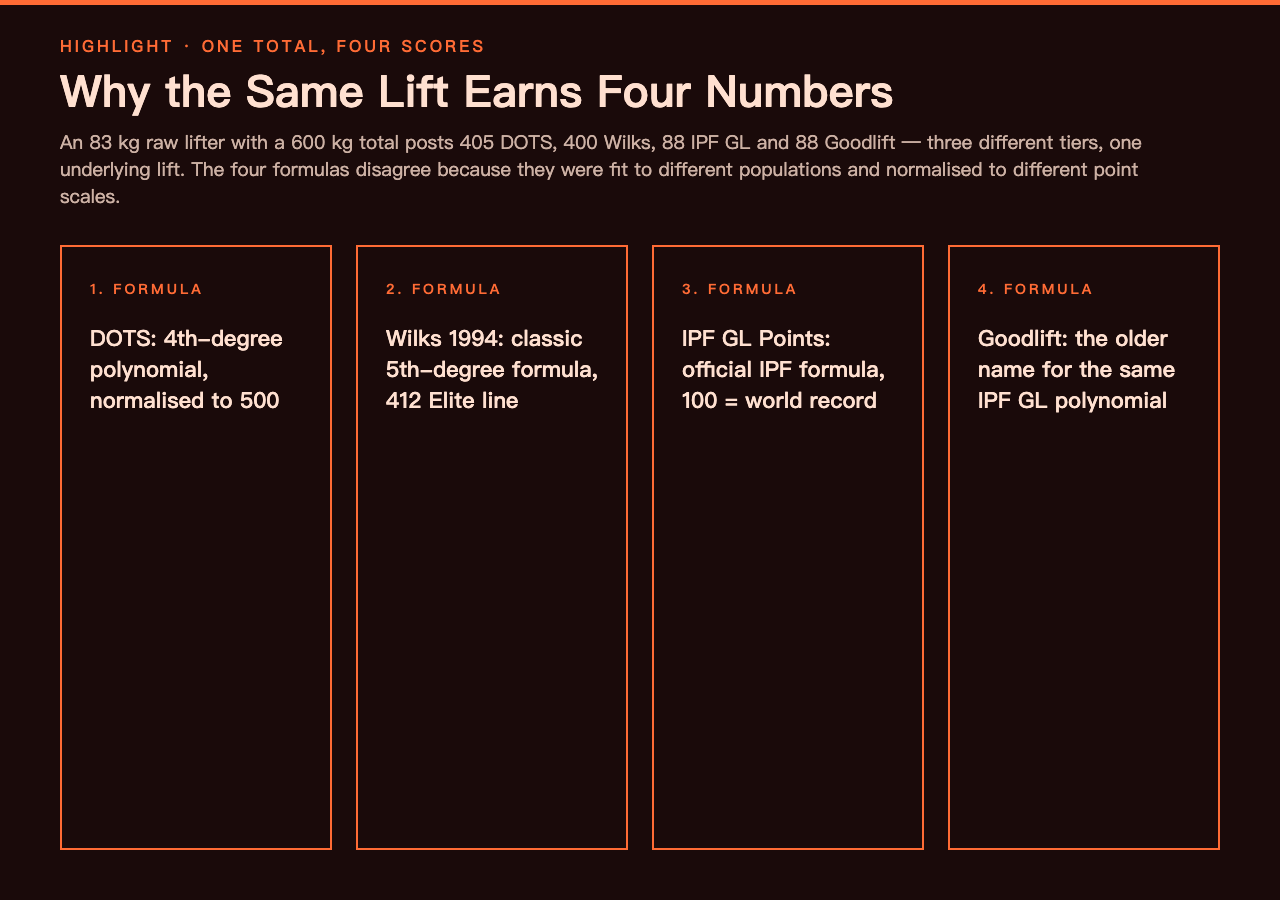
An 83 kg male raw lifter hits a 600 kg three-lift total — squat, bench, deadlift summed together. The number is the same in every formula. The score is not. DOTS puts him near 405 points, which lands him inside the elite tier on the open DOTS leaderboard. Wilks 1994 gives him roughly 400, just under the 412-line that separates Elite from Master. IPF GL Points reports about 88, comfortably below the 100 world-class threshold. Goodlift agrees with IPF GL within rounding. The same lifter, the same total, four different rankings — and a coach who quotes the wrong formula in a programming meeting will get politely corrected by anyone who knows the difference.
This article walks through what each of these four systems actually does, why they disagree so much on the same lift, and when to use each one. The goal is not to crown a winner — every formula has a defensible use case — but to give you a workflow for picking the right one for the conversation you are having.
The four systems, in plain language
Every strength coefficient answers the same question: given a lifter’s bodyweight and a three-lift total, how strong are they relative to other lifters at similar bodyweights? They disagree because each one fits a different curve to the population data and normalises to a different point scale.
DOTS is a 4th-degree polynomial that maps bodyweight to a denominator, then divides your total by that denominator and multiplies by 500. The 500 normalisation is its signature: it makes the comparison intuitive because the world-record total in any weight class produces a score around 500. DOTS replaced Wilks as the de-facto online ranking system around 2020 because it is statistically smoother at the heavy end of the male spectrum and does not collapse the female open class the way the 1994 Wilks formula does.
Wilks (1994) is the 5th-degree polynomial that dominated the sport for 25 years. It is still the official scoring formula for a handful of national federations and remains the only formula that the word “Wilks” reliably refers to in casual conversation. The classic Wilks curve peaks in the middle weight classes — the 82.5/83 kg class is right on the curve’s maximum, which is why lifters at that bodyweight often post the highest absolute Wilks scores in the open class. Its weaknesses are well documented: female lifters in the super-heavy class score disproportionately low, and male super-heavies past about 155 kg class get a Wilks number that no longer meaningfully differentiates them.
IPF GL Points is the formula the International Powerlifting Federation adopted in 2020 and which IPF-affiliated meets have scored lifters under ever since. It uses different polynomial coefficients for raw and equipped lifting, and its normalising constant is set so that 100 points corresponds to the all-time world-record total in each weight class. A 100 is the magic number — every point above it means you have set an open-class world record at that bodyweight. IPF GL Points updates when new world records are set, which is why “IPF GL = 100” is a moving target year over year.
Goodlift is the older name for the IPF GL formula on the openpowerlifting.org data set. The two produce identical numbers for the same inputs, but the historical leaderboards under each name track different lifter populations because the IPF formula’s coefficients have been refined twice since its first release. Most lifters who say “my Goodlift” are quoting the IPF GL score from a calculator rather than a federation-issued meet card.
Worked example: the 83 kg male, 600 kg raw total
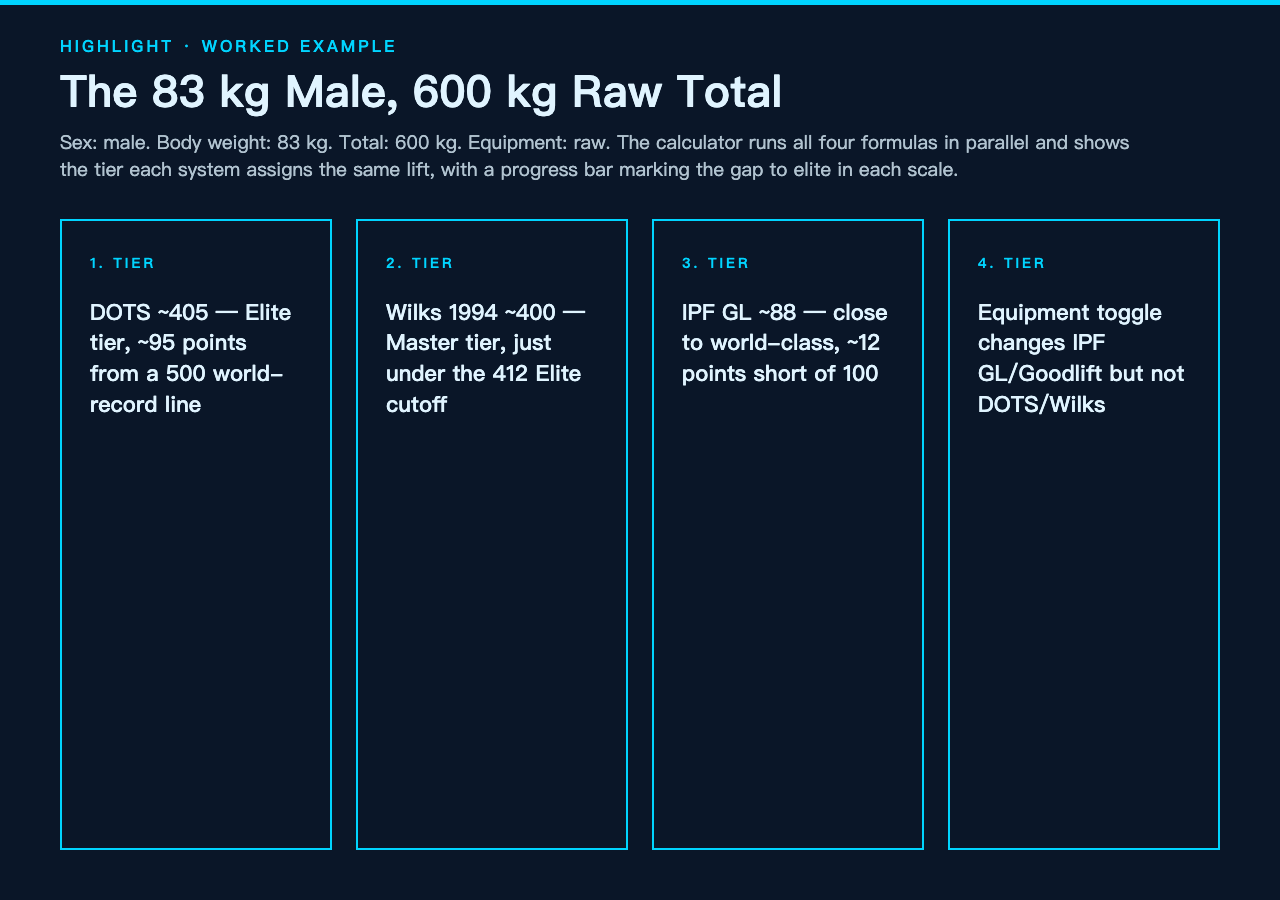
Plugging sex=male, bodyWeight=83, total=600, unit=kg, equipment=raw into the Powerlifting Coefficient Calculator returns:
- DOTS: ~405.05 — well inside the Elite tier for the 83 kg class. A 500 would be a current world-record-level total at that bodyweight.
- Wilks (1994): ~400.50 — Master tier on the classic Wilks leaderboard, just below the 412 Elite cutoff. This is the system where being on the wrong side of 12 points flips your tier label.
- IPF GL Points: ~88.18 — close to world-class but not quite. The IPF GL threshold for elite at 83 kg raw male is roughly 95, and 100 is the open-class world record.
- Goodlift: ~88.18 — identical to IPF GL because Goodlift is the older name for the same polynomial.
Note how the four systems disagree about whether 600 kg at 83 kg male raw is Elite, Master, or “almost elite but not quite.” That disagreement is the reason coaches quote more than one formula in programming discussions: depending on which system you cite, the same lifter is one of the strongest in his class or merely a strong contender.
Why the scales disagree so wildly
The DOTS and Wilks scales both top out near 500 in practice for elite male totals, but they normalise against different population statistics. IPF GL and Goodlift use a 100-point scale because 100 is the world-record line, not because lifters find 100 easier to read than 500. The 4.5x gap between the two scales is purely cosmetic, but it trips up newcomers every time.
The more important disagreement is at the heavy end. A 155 kg male raw lifter with a 1000 kg total posts roughly 430 DOTS, 350 Wilks, and 100 IPF GL — three different rankings of the same lift. DOTS treats the 155 kg class as a relatively flat region of the bodyweight curve and rewards the raw absolute total; Wilks penalises the heavy lifter for bodyweight gain; IPF GL keeps a tight scale because every class has its own world-record benchmark.
For the super-heavy female class, the disagreement is even more pronounced. A 120 kg female lifter with a 600 kg total is elite by DOTS, very high by IPF GL, but middling by Wilks — because the 1994 Wilks polynomial was fit on a much smaller female dataset than the post-2010 versions were. Most online discussion now defaults to DOTS or IPF GL for female lifters specifically because Wilks 1994 mis-ranks them.
Raw vs equipped matters for two of the four
The equipment selector in the calculator — Raw vs Equipped — is not cosmetic for IPF GL and Goodlift. Both formulas use different polynomial coefficients for raw and equipped lifting, because a 1000 kg total in a single-ply squat suit is a substantially different achievement than a 1000 kg total raw. Switching the equipment toggle in the calculator will change those two scores by 5-15 points while leaving DOTS and Wilks essentially unchanged.
This is why meet directors who score under IPF rules must record equipment accurately. Two lifters with identical bodyweight and total, one raw and one equipped, will post different IPF GL scores — and should, because the formulas are designed to reflect the population distribution of each population separately.
When to use which formula
The honest answer is that the formula you should quote depends on who you are talking to:
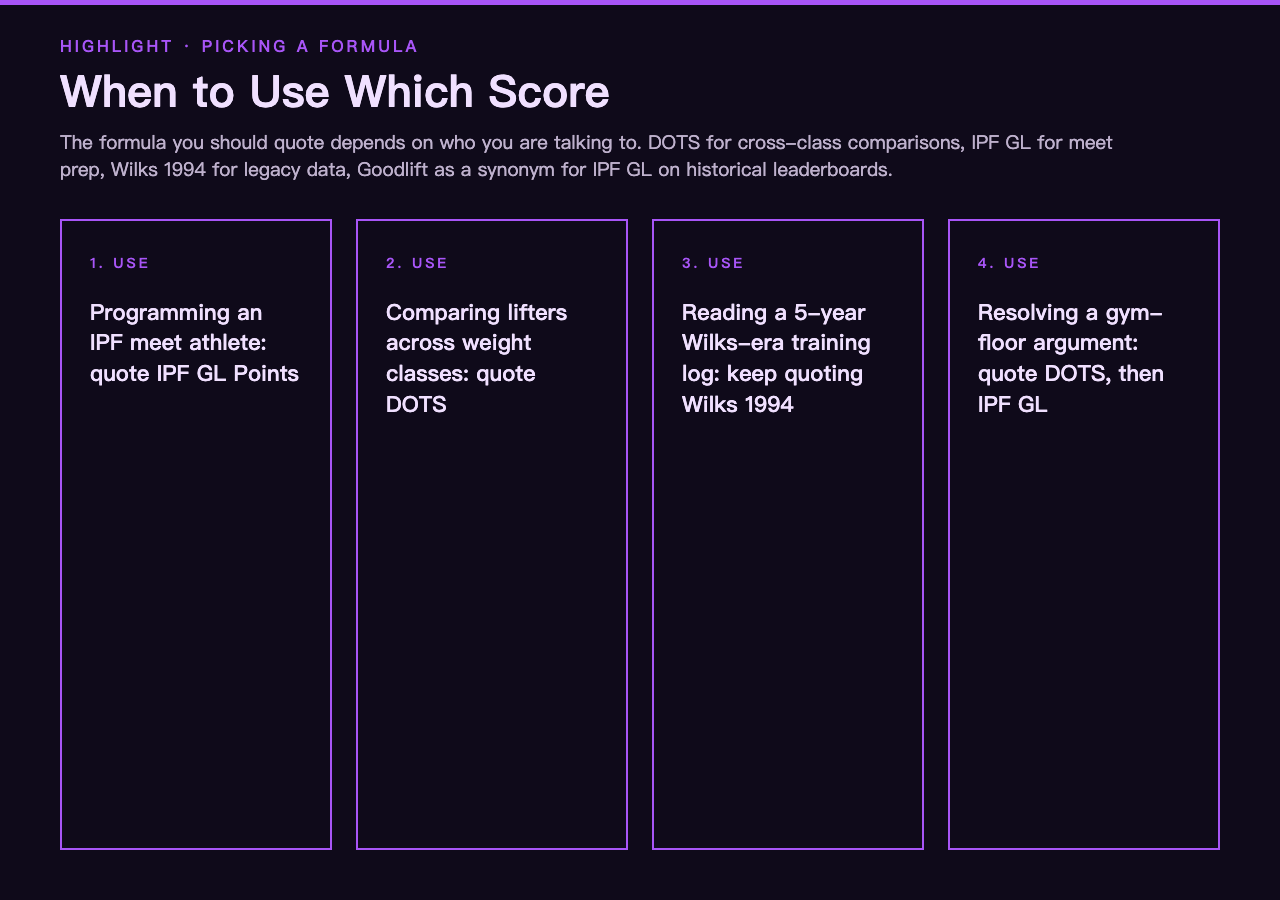
- Programming for a specific athlete: Use IPF GL Points, because the meet you will eventually enter will score under IPF GL. The progression you track in the gym should match the scoring system the federation uses, otherwise you are optimising for the wrong threshold.
- Comparing lifters across weight classes or eras: Use DOTS, because it is the system most online leaderboards, podcasts, and casual references default to in 2026. Quoting DOTS in a conversation with a serious coach or a meet director means your number is immediately comparable.
- Working with a Wilks-era lifter’s historical data: Quote Wilks 1994 alongside DOTS, because that lifter’s PRs are catalogued under Wilks in older databases. A 5-year training log is more useful when its numbers map to the same scale as the day they were set.
- Resolving a disagreement between two lifters at different bodyweights: Quote DOTS first, then IPF GL. DOTS is the system most non-IPF federations and most gym-floor arguments use, and it has the smoothest curve across the full bodyweight range.
Reading the progress bar in the calculator
The Powerlifting Coefficient Calculator shows a progress bar for each formula, scaled to the elite threshold of that specific system. For DOTS, the bar fills as you approach 500; for IPF GL, as you approach 100; for Wilks, as you approach the 412 Elite/Master boundary; for Goodlift, as you approach 100. The bar is the most useful part of the interface because it tells you at a glance how close the total is to elite in each system — without making you remember that 100 GL Points is world-class and 500 DOTS is world-class and 412 Wilks is just-barely-elite.
If your training log tracks DOTS, an 80%-full bar means you are roughly 80 points away from a 500-class total. If it tracks IPF GL, an 80%-full bar means you are 20 points from world-class. The percentages are not directly comparable across systems, but they are comparable within a system across different bodyweights — which is the comparison you actually care about when you are planning a meet.
Imperial input converts internally
One practical point: the calculator accepts pounds as well as kilograms and converts internally before applying the polynomials. A 138 lb female lifter with a 990 lb total becomes 62.6 kg bodyweight and 449.1 kg total under the hood, then runs through the same formulas as a lifter who typed the numbers in kilograms. This matters because meet cards in the United States are usually recorded in pounds while the federation’s coefficient formulas are defined in kilograms, and a calculator that requires you to convert manually introduces rounding error that compounds across four parallel scores.
What the calculator does not do
The tool is a pure polynomial evaluator. It does not pull live federation data, does not adjust for rule changes between 1994 and 2026, and does not score a meet — it scores a single total you have already lifted. If you need to look up an IPF GL coefficient changeover date or compare an old Wilks 2020 formula to the current one, you are looking for federation documentation, not this calculator.
It also does not normalise across lifting disciplines. Powerlifting-specific formulas like DOTS, Wilks, and IPF GL were fit on three-lift data and produce meaningless numbers if you plug in a bench-only total or a squat-only total. The calculator assumes a three-lift sum and the formulas assume three-lift data, so feed it three-lift totals only.
Putting the four scores together in practice
For a lifter working with a coach who programs in IPF GL, the workflow is: lift the total, score under IPF GL, plan the next training block to push that score toward 100. For a lifter who competes under a non-IPF federation or trains for general strength, the workflow is the same with DOTS substituted for IPF GL. The two workflows look identical on paper; they diverge in the elite tier, where the world-record threshold under each system is set by different lifters in different federations.
Quoting more than one formula in a programming conversation is not redundant — it is precise. “I hit 405 DOTS and 88 IPF GL” is more informative than either number alone, because the listener immediately knows where the lifter sits relative to both modern world records and the historical Wilks-era Elite line. The calculator returns all four side by side precisely so this comparison is one copy-paste away rather than four separate calculations.
Where to run it
The Powerlifting Coefficient (DOTS / IPF GL) Calculator runs entirely in the browser — no federation API, no account, no data upload. Inputs are sex, body weight, total, weight unit, equipment and decimal precision; outputs are the four scores with their tier labels and progress bars. It complements the existing Wilks calculator rather than replacing it, because most lifters still want the 1994 Wilks number for legacy comparisons even when DOTS or IPF GL is their primary score.
For coaches running a meet prep spreadsheet, the deterministic polynomial computation means every lifter’s number can be regenerated offline without depending on the calculator staying online. For athletes who want a sanity check after a meet, the calculator is fast enough to use between attempts on the platform.
The short version
If you remember nothing else: DOTS and IPF GL are the two modern formulas, Wilks 1994 is the historical baseline, and Goodlift is the same polynomial as IPF GL under a different name. The four scores disagree on the same total because they were fit to different populations and normalised to different point scales — none of them is wrong, but quoting only one hides the disagreement. Run the total through the calculator, read all four numbers, and pick the one your federation scores under.
Strength is bodyweight-relative. Four formulas, one total, four different conversations to have about it — and now you know which conversation uses which number.