
An OpenAPI spec is a contract you write once and trust forever — until the first silent rename blows up three downstream clients and a CI pipeline at 2:14 a.m. The OpenAPI / Swagger Validator field guide shows you how to lint the spec the way a senior API reviewer would, with a structural pass that catches the mistakes swagger-codegen and Stoplight Elements will quietly inherit and propagate. Most API teams discover their specs are broken only when a partner team complains about a missing field, a 404 they didn’t expect, or an operationId that suddenly produced two TypeScript classes with the same name. The fix is to treat the spec as a rigorous artifact and run each change through a structural validator before it lands on the trunk.
Why structural OpenAPI validation matters
OpenAPI 3.x and Swagger 2.0 documents are not free-form YAML. They nest schemas through $ref, declare paths with operation verbs, attach responses that may inherit from components, and require every operation to be uniquely identified. A single missing operationId causes generated client libraries to fall back to numeric method names. A duplicated operationId causes the codegen to throw a “two methods with the same name” error that nobody can reproduce locally. A $ref that points to a non-existent component silently produces an empty schema in the generated TypeScript types — which then compiles cleanly and reaches production.
The structural validator approach catches each of these mistakes before they reach the codegen step. For each problem class — required fields, path/operation completeness, response codes, $ref resolution, operationId uniqueness, component integrity — there is a deterministic check that runs in a few hundred milliseconds and produces a precise report. The cost of running the validator on every commit is tiny; the cost of shipping a broken spec is measured in pager hours and rollback stories.
The five checks that catch 90% of spec drift
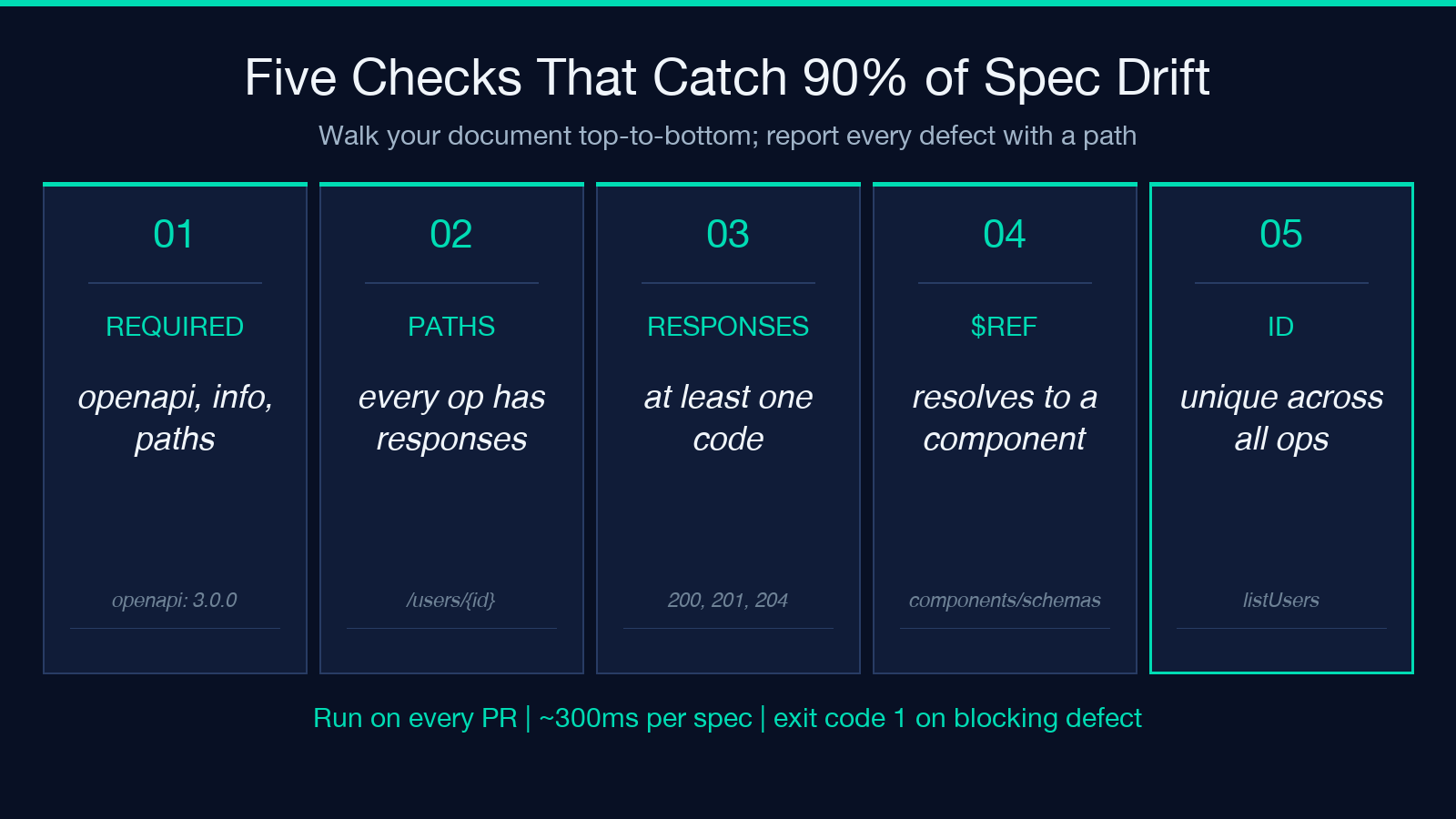
The validator audits five structural dimensions on every pass. Each dimension is small enough to reason about independently, but the dimensions interact — a missing operationId may obscure a $ref resolution problem, and a missing responses entry may be hidden by a partial component definition. The five dimensions are: required fields and spec version conformance, path and operation completeness, response codes and shape declarations, $ref resolution and component integrity, and operationId uniqueness. Together they cover the surface where most spec drift accumulates.
Shape conformance: required fields and version drift
The first check is the smallest and the cheapest, but it sets the pattern for the rest of the validator. A spec that fails the required-fields check is not a valid OpenAPI document at all — every downstream tool will behave badly on it.
Required fields and version drift. OpenAPI 3.0, 3.1, and Swagger 2.0 each have a non-empty list of required top-level fields. OpenAPI 3.x requires openapi, info, and paths. Swagger 2.0 requires swagger, info, and paths. Within info, title and version are mandatory. Within each path item, every HTTP method (get, post, put, patch, delete, head, options, trace) must include a responses object — even if the responses themselves are placeholders. The validator flags every missing field with a path like paths./users.get.responses so you can navigate to the defect without grep.
The version conformance check is separate from the field check. A document that says openapi: 3.0.0 but uses 3.1-only features (the webhooks top-level field, the examples array on parameters, the const keyword in schemas) is technically invalid. The validator surfaces the version mismatch and lists the offending feature.
Path and operation completeness. A path like /users/{id} is valid only if it declares at least one operation. A path that declares get but no responses is operationally incomplete — your client codegen will produce a method that returns unknown because the response schema cannot be inferred. The validator walks every path, lists the operations declared, and flags the operations that are missing required fields (summary, operationId, responses, and at least one response code).
The check also covers parameter placement. A path parameter like {id} must appear in the path’s parameters list with in: path. A query parameter declared at the path level must have a name and schema. The validator reports misplaced parameters with the path and the offending field.
Response codes and shape declarations. Every operation must declare at least one response. The response code can be default (an HTTP convention for “any non-declared response”), but a default-only response is a smell. The validator encourages the practice of declaring 200, 201, 204, 400, 401, 404, and 422 for typical CRUD operations, and flags operations that declare only default or omit specific success codes.
For each declared response, the validator checks that the response either references a component via $ref or defines a content block with a schema. A response with content: {} is meaningless — the client codegen will produce an empty type. The validator points at the offending response and reports the missing schema.
$ref resolution and component integrity. Every $ref in the spec must point to a real component under components/schemas, components/parameters, components/responses, or components/requestBodies. A $ref that points to a missing component is one of the most expensive mistakes in OpenAPI development — the generated TypeScript types will be any, the generated Python client will accept any payload, and the production system will accept whatever the upstream service sends and fail silently in a downstream consumer.
The validator walks every $ref, resolves it against the component tree, and reports unresolved references with the full path. The check also covers circular references (a schema that references itself, or a chain that loops back) — circular references are valid in OpenAPI but the validator flags them as a hint because most codegen tools handle them with care.
operationId uniqueness and the operation catalog. Every operation should have a unique operationId. The validator collects every operationId across the spec, sorts them alphabetically, and reports duplicates with the paths of the conflicting operations. A duplicate operationId is rare in small specs but extremely common in specs that have been grown through copy-paste over months. When the validator reports a duplicate, the fix is to rename one of the operations to a unique identifier — usually by appending the HTTP method or a sub-resource name.
The check also verifies that the operationId follows a sane pattern. While OpenAPI does not enforce a naming convention, the most common convention is camelCase (listUsers, createUser, getUserById). The validator treats non-camelCase identifiers as a warning rather than a failure, but the report includes the offending identifier so a code review can spot the inconsistency.
How to use the validator in a CI pipeline
The validator is most effective when it runs on every pull request that touches the spec file. The integration pattern is straightforward: add a GitHub Actions step that runs the validator on the spec file, parses the output, and posts a PR comment listing the failures. The validator returns a structured report so the comment can be formatted as a checklist.
For teams that want to enforce a zero-failure policy, the validator’s exit code is non-zero when any blocking defect is present. The CI step can fail the build and block the merge. For teams that prefer a softer approach, the validator can be configured to post warnings only and let the reviewer decide.
The validator also supports a mode that compares the spec against the running API. This mode is useful for catching drift between the spec and the actual implementation — a field that was removed from the implementation but not from the spec, or a response code that was added to the implementation but not documented. The comparison mode does not require a live API; it works against a JSON dump of the API responses.
Reading the validation report
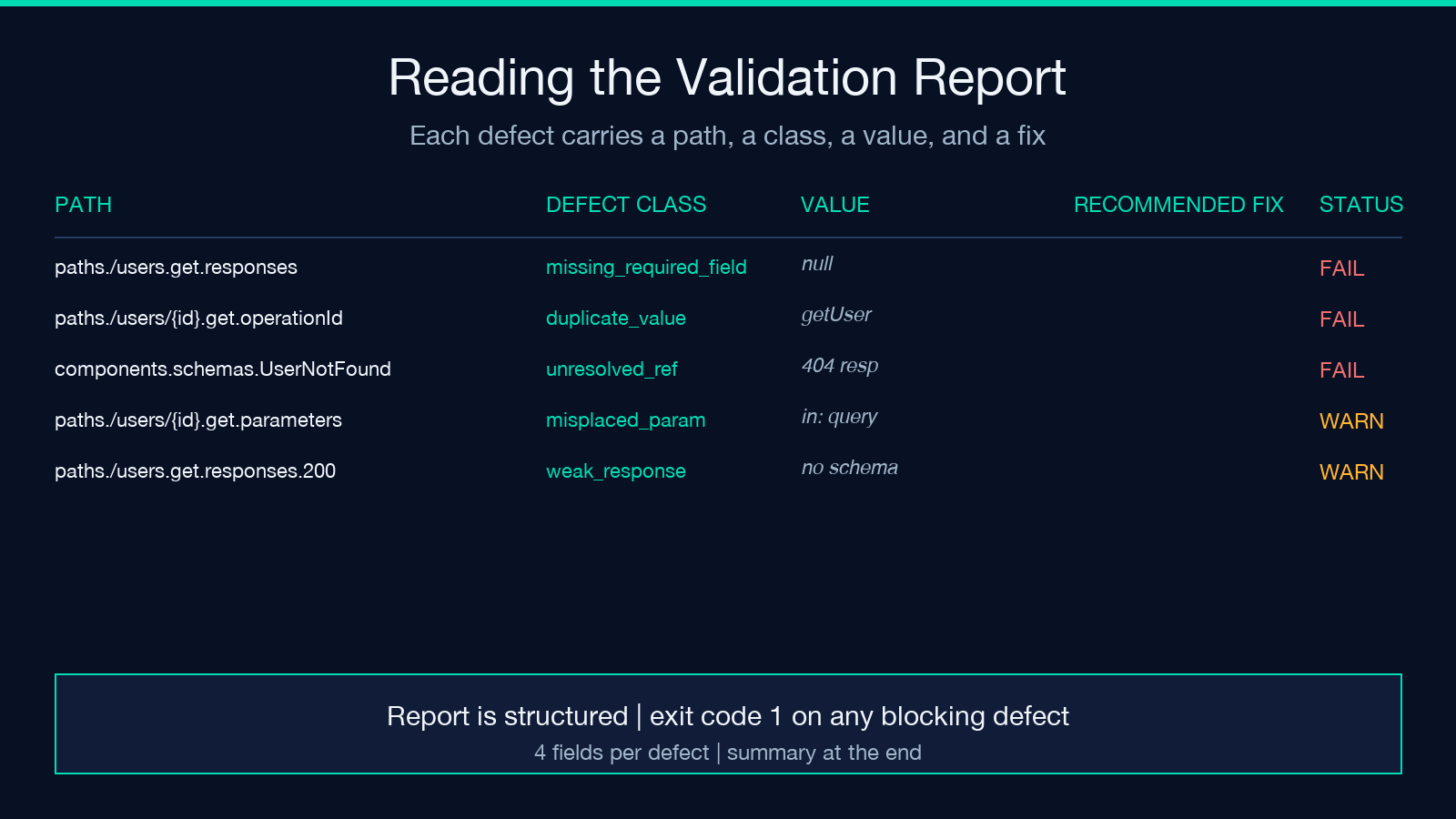
The validator produces a structured report that lists every defect with the path, the defect class, and a recommended fix. Each defect entry has four fields: the path in the spec (e.g., paths./users.get.responses), the defect class (e.g., missing_required_field), the failing value (e.g., null), and the recommended fix (e.g., add a responses object with at least one response code).
For example, a typical report might look like:
paths./users.get.responses— missing required field —null— add a responses object with at least one response codepaths./users/{id}.get.operationId— duplicate value —getUser— rename one of the conflicting operations to a unique identifiercomponents.schemas.UserNotFound— unresolved $ref —paths./users/{id}.get.responses.404.content.application/json.schema— add the referenced schema to components/schemas or update the $ref path
The report ends with a summary block that counts the defects by class and path. This is useful for tracking spec quality over time — a spec that has 10 missing fields today and 2 missing fields next week is moving in the right direction.
What the validator does NOT check
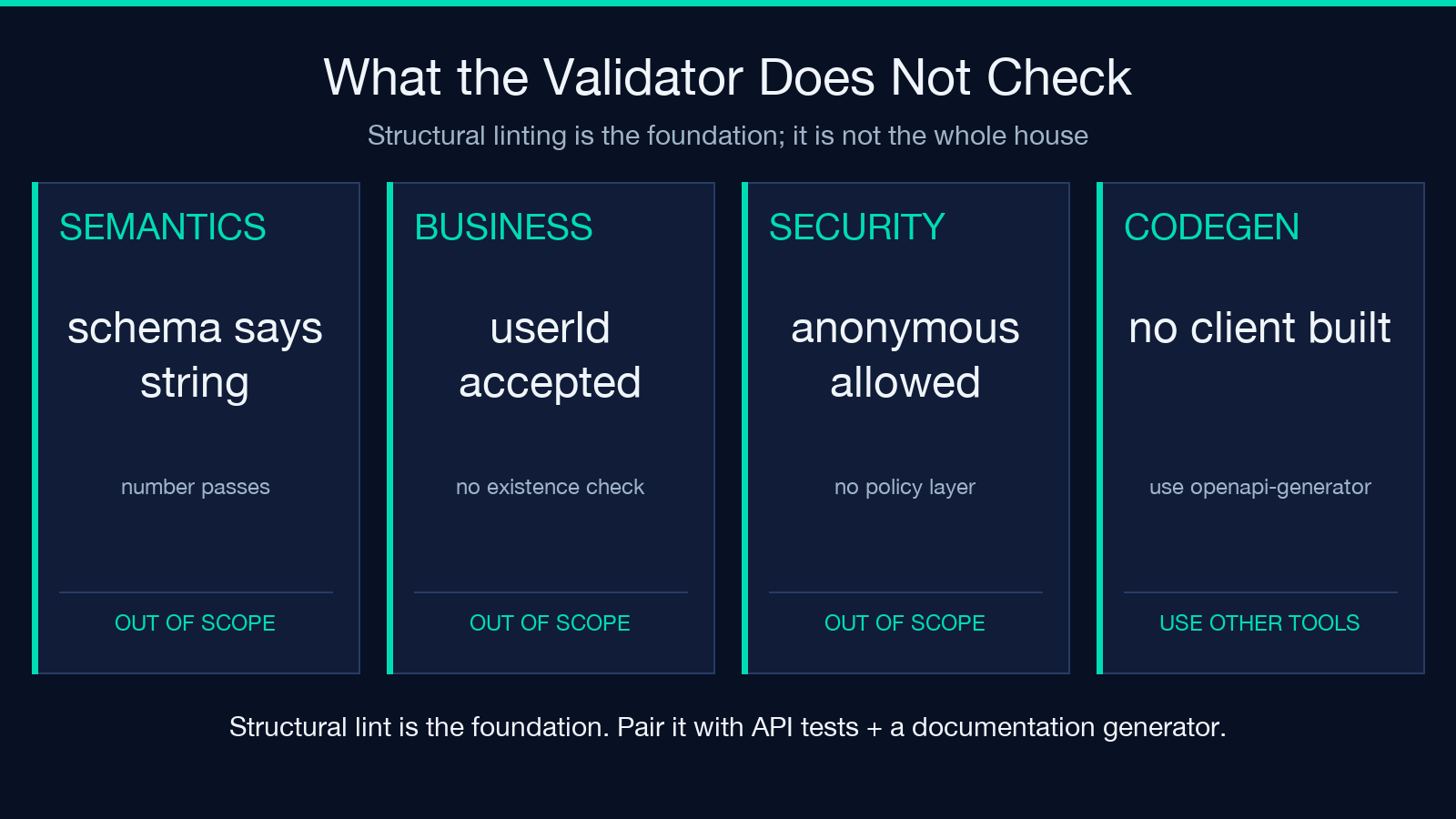
The validator is a structural linter. It does not check semantic correctness — a schema that says type: string but accepts a number will pass the validator. It does not check business logic — a path that accepts a userId but does not enforce that the user exists will pass. It does not check security — a path that allows anonymous access to a sensitive resource will pass. For these checks, you need a separate tool that understands the API’s domain.
The validator also does not generate client code. It produces a report, not a library. To generate client code, you need a separate codegen tool like openapi-generator, swagger-codegen, or fern. The validator’s role is to ensure the spec is structurally valid before the codegen step runs, so the codegen output is reliable.
A practical workflow for spec hygiene
The most effective workflow I have seen combines three tools: the OpenAPI / Swagger Validator for structural checks, an API testing tool for behavioral checks, and a documentation generation tool for human-readable docs. The structural check runs on every commit. The behavioral check runs on every pull request. The documentation check runs on every release.
The structural check is the cheapest and fastest. It runs in a few hundred milliseconds and produces a precise report. The behavioral check is more expensive — it requires a running API and a set of test cases. The documentation check is the most expensive — it requires a rendering step and a visual review.
The order matters. If the structural check fails, the behavioral check is likely to fail too, because the spec is invalid. Running the structural check first saves the time of running the behavioral check on a broken spec.
Where to take this next
The OpenAPI / Swagger Validator is one tool in a larger ecosystem of API quality tools. If you are building a new API, start with the validator to make sure the spec is structurally sound. If you are maintaining an existing API, run the validator periodically to catch spec drift. If you are auditing a third-party API, run the validator on their spec to see what they are doing well and what they are doing poorly.
For a deeper dive into the validator’s behavior, try the tool directly with one of your own specs — paste the YAML, run the validator, and read the report. If you want to compare the validator against the artifacts your spec produces, the API Response Contract Validator checks the response of a live API against your spec, and the API Breaking Changes Detector & Migration Planner catches the breaking changes between two versions of the same spec. Both are useful complements to the structural validator.
If you are working with JSON Schema in particular, the JSON Schema Generator produces draft-2020-12 schemas from sample payloads, and the API Mock Server serves a mock implementation directly from your spec — useful for parallel frontend development while the real API is still being built.
For a broader look at the validation category, browse the other validation tools on Elysia Tools, or explore the full collection of API utilities to find the right tool for the rest of your workflow. The four checks above — required fields, path/operation completeness, response codes, $ref resolution — are the foundation of any spec hygiene workflow. The rest is repetition and discipline.
