
A Unicode escape sequence isn’t a string; it’s a code point with a backslash costume. When you see héllo, what your editor renders as one character is actually two distinct bytes in UTF-8, plus a normalization variant that can shift the entire visual representation. The Unicode Escape Converter is the field tool for stripping that costume on either side: convert text to uXXXX, u{XXXXXX}, surrogate pairs, or U+XXXX hex, then reverse it back, with NFC/NFD/NFKC/NFKD normalization in the same workflow.
Why Unicode escape sequences aren’t just a JSON convenience
Most developers first meet uXXXX inside JavaScript string literals or JSON.stringify output. JSON mandates the uXXXX form for non-ASCII, and JavaScript mirrors it. So the obvious assumption is that Unicode escape sequences are a transport encoding — useful in transit, invisible otherwise.
That assumption breaks the moment you cross a boundary where code points exceed the Basic Multilingual Plane (BMP, U+0000–U+FFFF). A character like 🎉 (U+1F389) can’t be written as a single uXXXX because BMP stops at U+FFFF. You need either u{XXXXXX} (ES6-style code point escape) or a UTF-16 surrogate pair (uD83CuDF89). JavaScript engines, Python, JSON, regex engines, and shell scripts each handle those three forms differently — and that’s before you count C++ universal character names, Python source encoding declarations, or Rust 'u{1F4A9}' literals.
The tool exists because choosing the wrong one is silent. A TypeScript backend serializing 🎉 as uD83CuDF89 and a Python parser reading u{1F389} from a log file will disagree on which character the sequence means — even though both are correct in their own context.
What the converter actually does
Three operations, four escape styles, four normalization forms, one ASCII-only toggle. The control surface is small enough to reason about, large enough to cover real workflows.
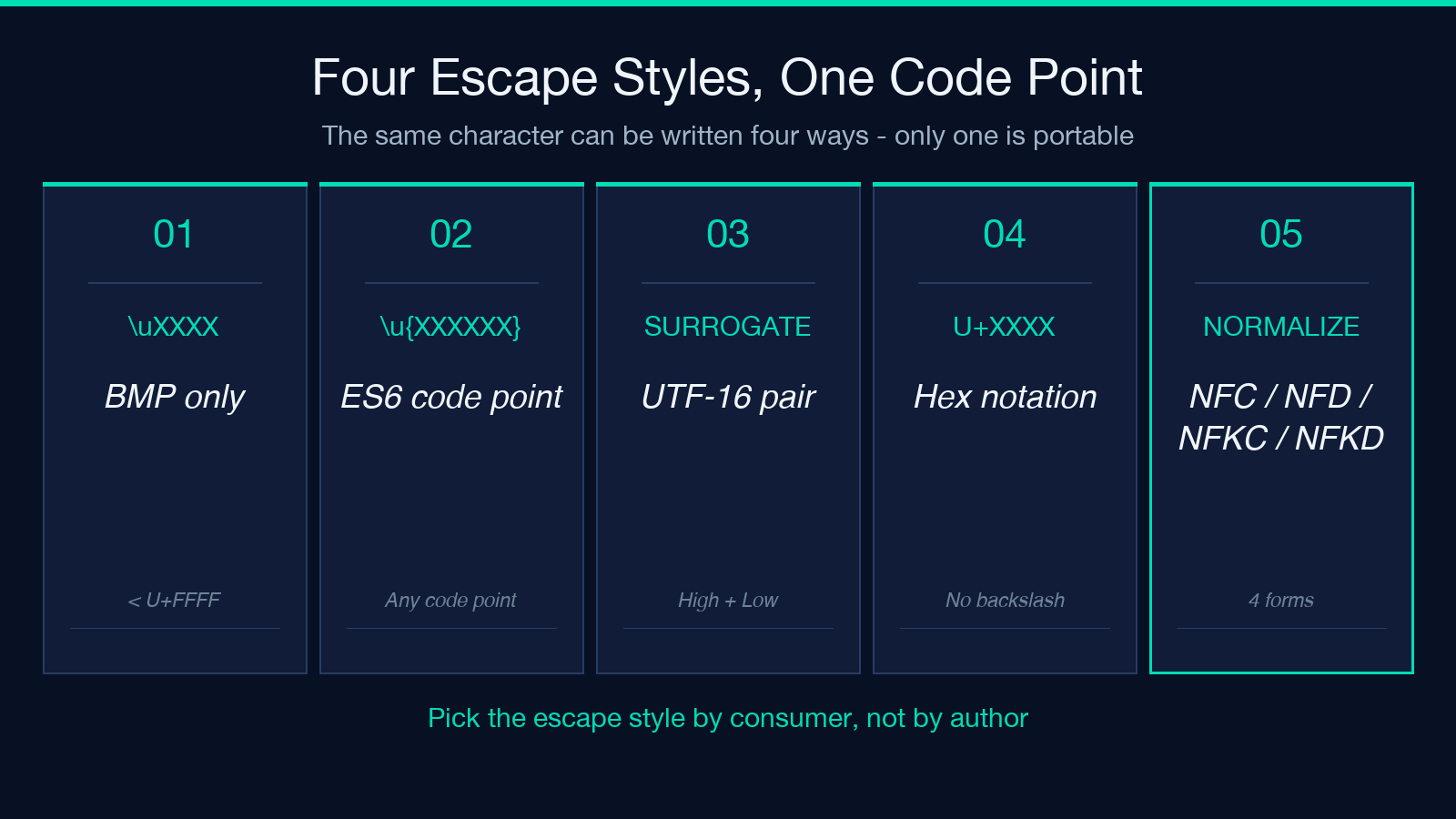
Operations. escape turns the input text into escape sequences; unescape parses escape sequences back into text; normalize applies one of the four Unicode normalization forms without rewriting as escapes. The escape operation supports four styles: uXXXX (BMP, with automatic fallback to u{XXXXXX} for supplementary characters), uXXXX-surrogate (always splits non-BMP into two surrogate code units), u{XXXXXX} (ES6-style code point escape, always one sequence per character), and hex (U+XXXX, a human-readable notation, not a backslash escape). The unescape operation accepts all four input forms plus xXX hex bytes, and parses them via a JSON-decoded round-trip so it handles surrogate pairs correctly without manual string slicing.
Normalization forms. NFC composes decomposed sequences into precomposed characters (é + combining acute → é). NFD decomposes precomposed characters into base + combining marks. NFKC and NFKD add compatibility decomposition, which collapses typographic variants like fi ligature, fullwidth digits, and superscripts to their canonical equivalents. The interesting one is NFKC: a search index built over NFKC-normalized text treats fire and fire as the same string, which is usually what you want and occasionally exactly what you don’t.
Try it on any string with combining marks at Elysia Tools — paste the precomposed é, switch between NFC and NFD, and watch the byte count change.
Reading the four escape styles side by side
A single character, four notations. The character 🎉 (U+1F389 PARTY POPPER) is a useful example because it sits above the BMP, forcing every style to behave differently.
In uXXXX BMP-only mode, the tool refuses to truncate: it emits u{1F389} as a single ES6-style sequence because uXXXX can’t hold code points above U+FFFF. In surrogate-pair mode, you get uD83CuDF89 — the UTF-16 encoding that JavaScript and JSON use internally for the same character. In u{XXXXXX} mode, you also get u{1F389} — visually identical to the BMP-mode fallback, but produced unconditionally. In hex mode, you get U+1F389 — readable, but no longer a valid backslash escape in any language.
The point is that two of the four styles produce identical output for this character. The distinction matters for characters inside the BMP, where u00E9 (BMP, precomposed é) is one sequence in uXXXX mode and three bytes u0065u0301 (e + combining acute) in NFD-then-escape mode.
The normalization trap most teams walk into
Here is the field guide version of the trap: pick a database, store strings, query strings, get wrong results.
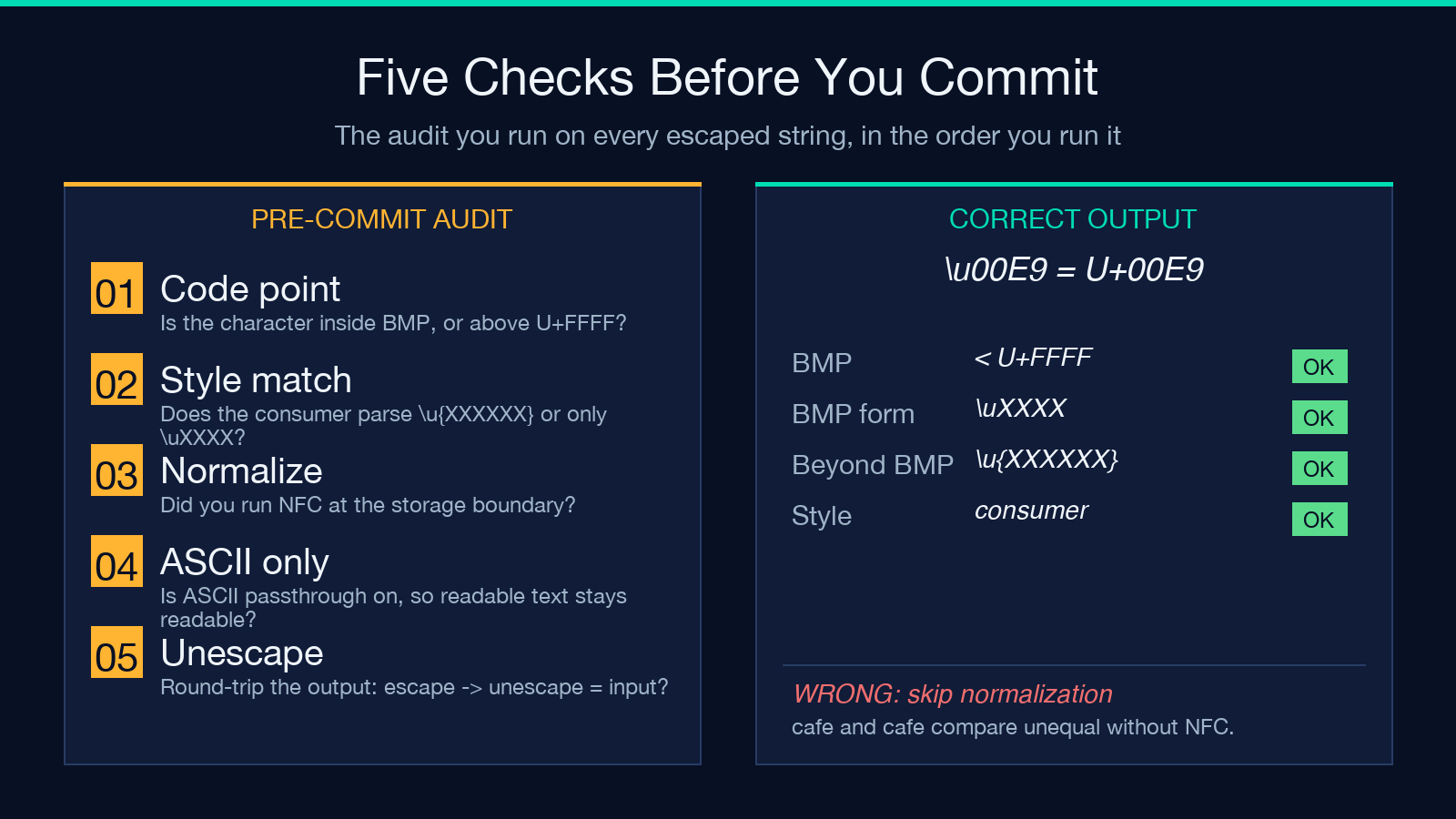
Two users type café. One’s IME inserts NFC (é = U+00E9, one code unit). The other’s IME inserts NFD (e + combining acute U+0301, two code units). Both look identical on screen. Both round-trip through UTF-8 byte-for-byte losslessly. Both compare unequal under == in most languages. A search for café finds one row and misses the other.
The fix is not ‘always store NFC’ or ‘always store NFD’. The fix is to choose one and apply it consistently at every boundary: input validation, database column collation (utf8mb4_unicode_ci in MySQL applies it for you), URL encoding, search indexing, log shipping. The Unicode Escape Converter is what you reach for when the boundary is unclear: paste the suspect string, switch the operation from escape to normalize, set NFC or NFKC, and see whether the result length changes. A length change means you’ve found a decomposed sequence worth normalizing.
For search and matching specifically, it’s worth using NFKC rather than NFC: NFKC also folds fullwidth digits (1 → 1), ligatures (fi → fi), and superscripts (² → 2) to their ASCII equivalents, which makes token-level search dramatically more forgiving. The cost is that stylistic distinctions disappear — ℍ (script H, U+210D) becomes plain H, which is fine for a search index and wrong for a math paper. Choose based on whether your corpus cares about the distinction.
How the four normalization forms differ in practice
The four normalization forms are not interchangeable, and the choice changes what your strings mean — not just how they look.
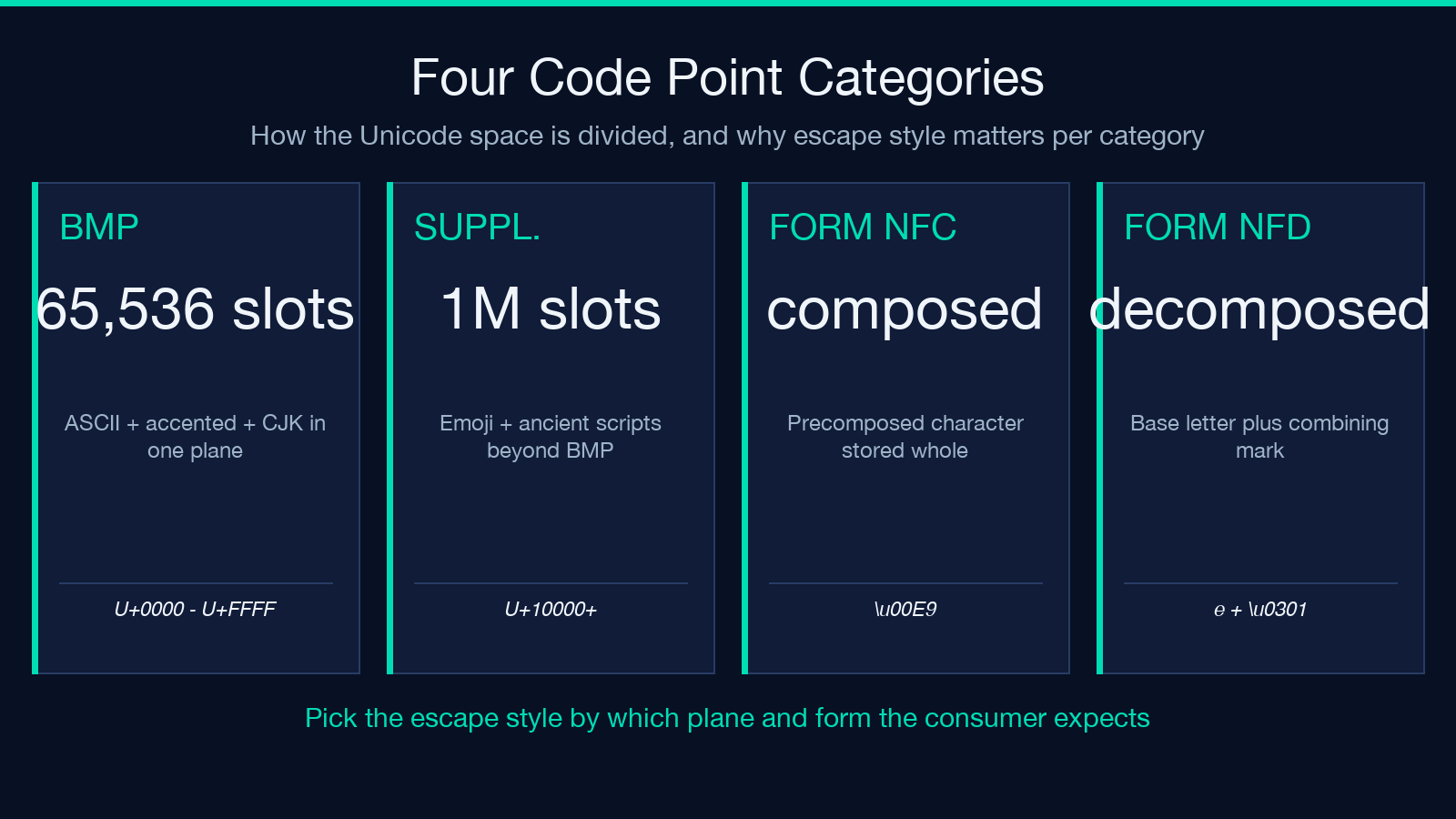
NFC and NFD are inverses of each other in terms of equivalence class. Two strings that compare equal under NFC also compare equal under NFD. The difference is byte count: NFC maximizes precomposed characters (é = U+00E9, one code unit), NFD maximizes decomposed sequences (e + U+0301, two code units). For storage, NFC is usually cheaper. For diff tools that operate on grapheme clusters, NFD is friendlier.
NFKC and NFKD add a second axis: compatibility decomposition. They fold characters that are not canonically equivalent but are ‘the same for practical purposes’: fullwidth digits to ASCII digits, ligatures to their component letters, superscripts to regular digits, mathematical alphanumeric symbols to plain letters. NFKC is the form most search engines normalize to. NFKD is what you want when stripping typography for a tokenizer.
A concrete example. The string ℍello ² fire ١٢٣ looks reasonable, but it’s six different characters that read as ‘. Under NFKC normalization, it becomes Hello 2 fire 123 — the script H collapses, the superscript 2 collapses, the ligature collapses, and the Arabic-Indic digits ١٢٣ collapse to ASCII 123. A search index built over NFKC-normalized text treats all four variants as the same query. Run the same input through NFD and you get the decomposed but compatibility-preserving form, which still differs from NFKC output.
The practical rule: NFC for storage in databases with Unicode-aware collation; NFKC for search indexes and any text that flows through user-facing search; NFD only when you specifically need to expose combining marks (linguistic analysis, font fallbacks). NFKD is rare in production but useful when the difference between math symbols and plain text matters.
Surrogate pairs are not a style choice
When you see uD83CuDF89 in a JavaScript string literal, those are surrogate pairs — a UTF-16 encoding artifact, not a notation preference. JavaScript strings are sequences of UTF-16 code units, and code points above U+FFFF have to be split into a high surrogate (U+D800–U+DBFF) and a low surrogate (U+DC00–U+DFFF). The two halves have no meaning on their own; together they encode U+1F389.
This matters because some parsers handle them correctly and some don’t. A regex written as u{1F389} in JavaScript matches the single code point. A regex written as uD83CuDF89 matches the same code point but only if the engine understands surrogate pairs as a unit. Some older regex engines see the two halves as independent ranges and let a stray uD83C slip through as an unpaired surrogate — a string that is technically invalid UTF-16 but still parses without error.
The converter’s uXXXX-surrogate style is the one to pick when you’re generating JavaScript source or JSON output that will be consumed by a tool you don’t fully trust. The u{XXXXXX} style is the one to pick when you control the entire pipeline and want each code point to be one escape. The hex style (U+1F389) is documentation, not code — keep it in comments and READMEs, never in string literals.
A practical walk-through
Paste this into the tool:
héllo 🎉 — café №1 fire ²With Operation: escape, Escape Style: uXXXX-surrogate, ASCII Only: false, the output is a single long string of uXXXX sequences — each base character as a 4-digit escape, the party popper split into a surrogate pair, and the combining acute on the first é preserved as a separate u0301 because the input is in NFD form. Toggle ASCII Only to true, and the Latin letters pass through untouched; only the accented characters, emoji, and special symbols get escaped. The output is shorter and more readable when you don’t need every byte escaped.
Switch the operation to normalize and select NFKC. The fi ligature collapses to fi. The fullwidth or precomposed variants get folded. The string is now NFKC-normalized, ready for storage in a search index. Apply the same operation to the escaped output and you get a normalized-then-escaped string — useful when you want to escape a normalized form for a downstream system that doesn’t run normalization itself.
The reverse direction is where the unescape operation earns its keep. Paste a JSON string with embedded uXXXX sequences — even mixed with u{XXXXXX} and U+XXXX in the same string — and the unescape path uses a JSON round-trip to decode them correctly, including surrogate pairs. The fallback path covers xXX hex bytes. Any combination works.
When not to escape
Unicode escapes are a serialization format. They make strings safe for transport through systems that don’t understand UTF-8 — old log shippers, certain CSV dialects, mail headers before MIME, URL percent-encoding contexts that prefer backslash over percent.
They are not a security boundary. Zero-width characters, RTL overrides, and homoglyphs survive Unicode escaping unchanged; the escape sequence preserves the code point, not the rendering. If you need to strip those, you need explicit filtering on top of normalization, not escape sequences. They are also not a compression format — escaped text is typically two to six times longer than the original UTF-8 bytes, which is the opposite of what you want for storage.
Use escapes for what they’re good at: making strings safe to embed in source files that travel through systems with different defaults, and making the exact code points visible when debugging. Don’t use them as a substitute for actual normalization, validation, or encoding handling.
For a deeper dive into character encoding pitfalls, the Unicode Escape Converter is the right starting point. Explore more tools at elysiatools.com.
