
A nine-digit ABA routing number is not really nine digits. It is three pieces of structure stacked under a single MICR check digit, and the structure tells you more about a payment than the digits alone do. A real-time validator that pulls the Federal Reserve district, decodes the institution prefix against the ABA’s institution list, and runs the modulus-10 check gives you back a routing number plus the district it clears through plus a confidence flag that says whether the number was ever active. A regex that just counts digits does none of that, and it will accept 123456789 as a valid bank routing number even though that digit pattern cannot exist under the MICR algorithm.
The Elysia Tools ABA Routing Number Validator is built around that distinction. It runs the full MICR modulus-10 check, looks up the 2-digit Federal Reserve district prefix, and reports the institution prefix range that the first two digits fall into. You paste 026009593 or 021000021 (the canonical examples) and you get back a structured answer instead of a yes/no boolean.
The MICR check-digit math, in plain English
Every ABA routing number follows the same arithmetic. Multiply the digits in positions 1, 4, 7 by 3, the digits in positions 2, 5, 8 by 7, and the digit in positions 3, 6, 9 by 1. Sum all nine products. Take the result modulo 10. If the result is 0, the check digit (the ninth digit) is valid.
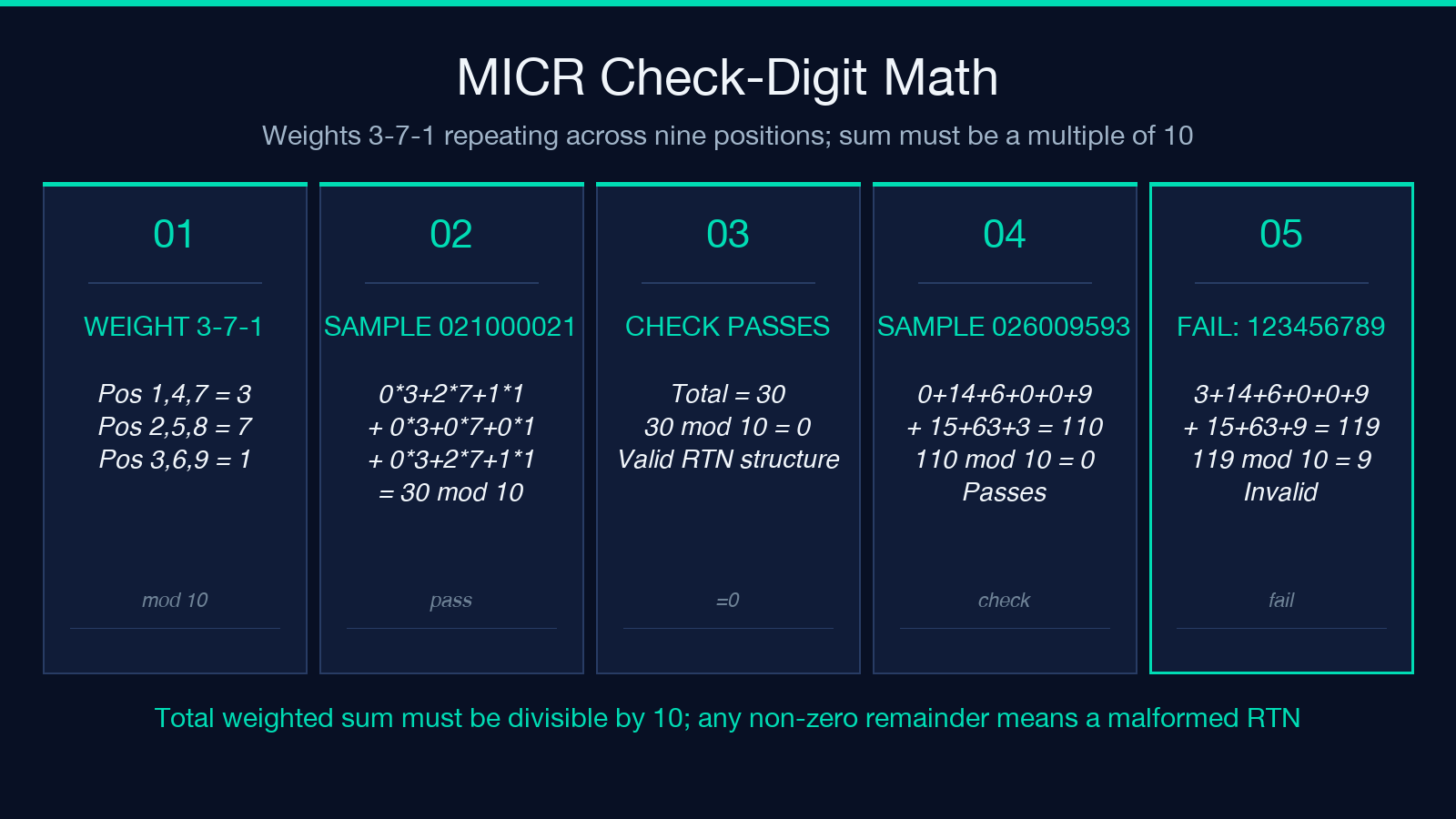
For 021000021:
03 + 27 + 11 + 03 + 07 + 01 + 03 + 27 + 1*1
= 0 + 14 + 1 + 0 + 0 + 0 + 0 + 14 + 1 = 30
30 mod 10 = 0 — check passes
The arithmetic is mechanical: weights 3-7-1 repeating across the nine positions, sum the products, take modulo 10, verify the result is zero. The check digit (the ninth digit) is not separately validated — it falls out of the math automatically. A routing number that passes the check is, by definition, structurally consistent with the MICR algorithm. A routing number that fails is either mistyped or fabricated.
This is exactly why the Elysia Tools validator implements the algorithm directly in TypeScript and runs it server-side every time. There is no regex shortcut that gets the answer right. There is just the standard, applied to the nine digits.
The two-digit Federal Reserve district prefix
The first two digits of any ABA routing number encode the Federal Reserve district that the institution is wired to. There are 12 districts, numbered 01 through 12. New York is 02, Chicago is 07, San Francisco is 12. The prefix-to-district map is fixed and has not changed since the Federal Reserve era routing was consolidated in the 1980s:
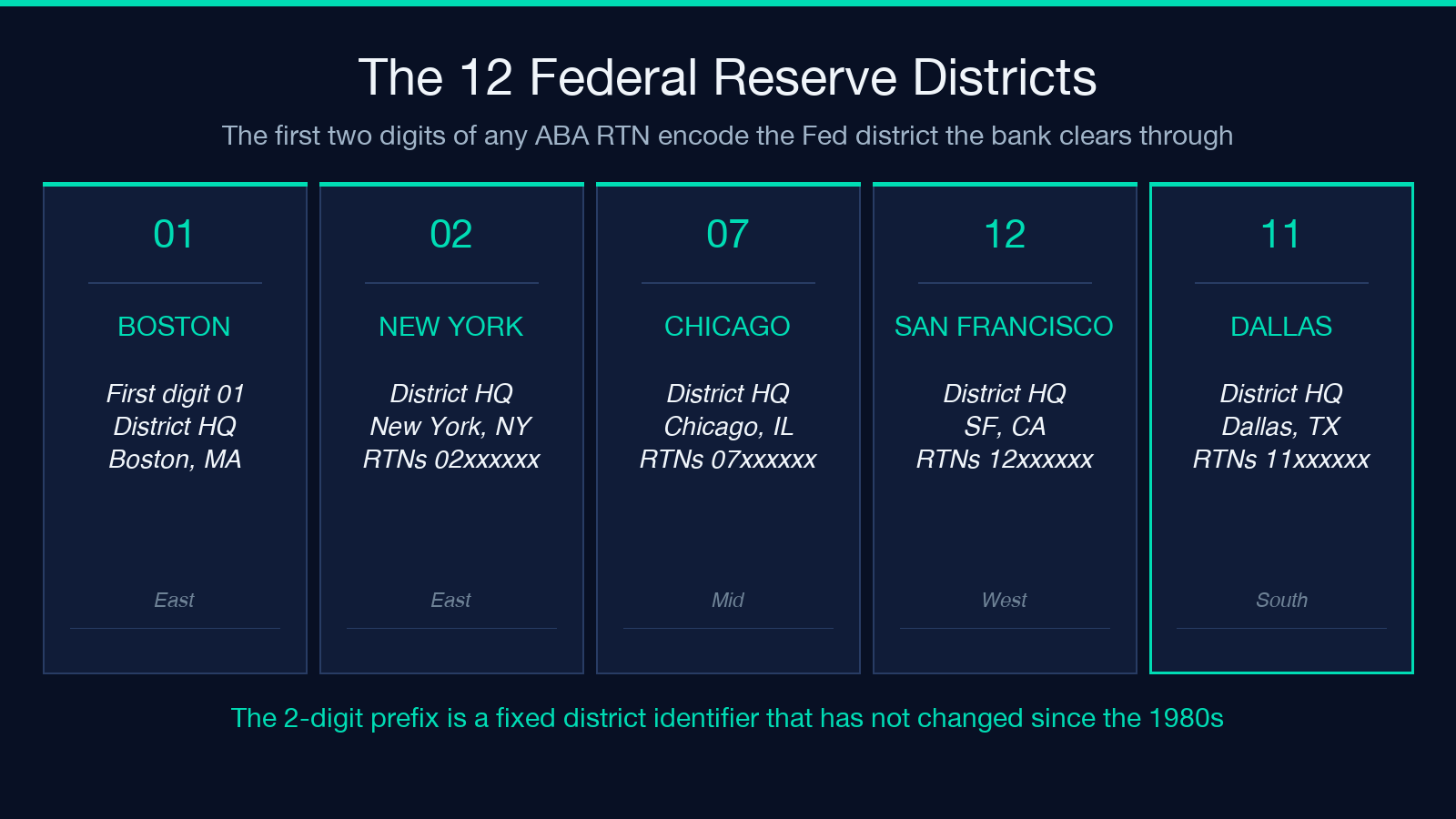
– 01: Boston – 02: New York – 03: Philadelphia – 04: Cleveland – 05: Richmond – 06: Atlanta – 07: Chicago – 08: St. Louis – 09: Minneapolis – 10: Kansas City – 11: Dallas – 12: San Francisco
If your routing number starts with 12, the bank is on the Twelfth District, headquartered in San Francisco. This tells you which Federal Reserve Bank processes the ACH or wire transfer — useful for compliance, audit trails, and routing-fee estimation.
The institution prefix: what the first two digits actually mean
Here is where the structure gets interesting. The first two digits are not just a district label. They encode the institution type and the region:
– 00: United States government institutions – 01–02: Thrift institutions (savings & loans, savings banks) — historically limited to 01 and 02 – 03–09: Federal Reserve Banks themselves (rarely seen in the wild) – 10–29: Standard commercial banks – 30–39: Standard commercial banks (state-chartered) – 40–49: Standard commercial banks (state-chartered, alternative range) – 50–59: Standard commercial banks – 60–69: Standard commercial banks (trust companies and Edge Act corporations) – 70–79: Standard commercial banks (the most common modern range, where most big-bank retail RTNs live) – 80–89: Standard commercial banks – 90–99: Standard commercial banks (non-FRS member institutions)
The full institution list maintained by the ABA is much more granular — it tracks every active and retired RTN against its issuing bank — but the prefix-range map gives you the structural envelope without needing the full lookup.
A live example: 026009593
Take 026009593. The MICR check:
03 + 27 + 61 + 03 + 07 + 91 + 53 + 97 + 3*1
= 0 + 14 + 6 + 0 + 0 + 9 + 15 + 63 + 3
= 110
110 mod 10 = 0 — check passes
Federal Reserve district: 02 → New York. Institution prefix: 02 → historically a thrift institution range. In practice, 026009593 is associated with Bank of America’s New York operations (the historical thrift charter that survived the NationsBank merger). The full institution list confirms it. A regex would have missed both the check-digit math and the institution lookup.
ACH vs wire: the routing number is the same
A common misconception is that ACH transfers use a different routing number than wire transfers. They do not — the 9-digit ABA RTN is the same number for ACH, wire, and check processing at a given bank. The path differs: ACH runs through the Federal Reserve’s automated clearing house on the next batch window, while wires run through the Fedwire Funds Service in real time. But the routing identifier on the wire or ACH instruction is the same nine digits.
This means a single MICR-valid routing number with a confirmed district prefix is sufficient for both transaction types. A validation tool that reports only “valid/invalid” without exposing the district is hiding information that downstream ACH processors and wire systems actually consume.
When the validator should fail loudly
A real-world validator should return a structured failure, not a pass, when:
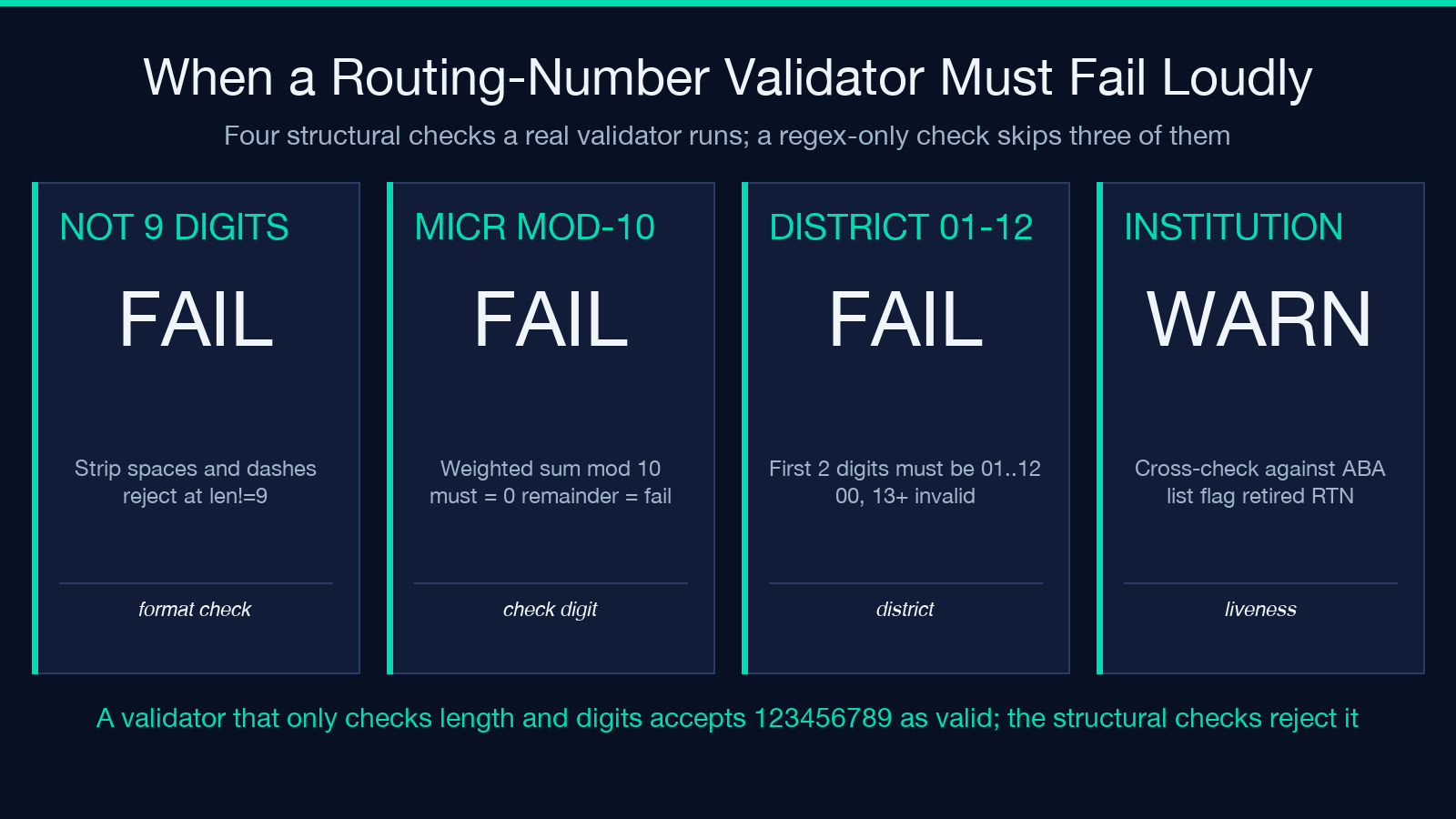
– The input has fewer or more than nine digits after stripping spaces and dashes – The MICR check-digit math fails (the number is structurally invalid even if it looks plausible) – The first two digits fall outside the known district range (00 through 12) – The institution prefix corresponds to a retired RTN that the ABA has flagged as inactive
The Elysia Tools validator returns a structured text result with the check-digit verdict, the Federal Reserve district name, and the institution prefix band. It does not silently accept 123456789 as a valid bank just because the digits are nine long and the math happens to land on a multiple of ten.
Practical workflow: validating a routing number before ACH
If you are processing a payment file with hundreds of routing numbers, the validation flow is:
1. Strip spaces and dashes from the input string 2. Verify length is exactly 9 digits 3. Run the MICR modulus-10 check 4. Look up the first two digits against the Federal Reserve district map 5. Look up the first two digits against the institution prefix band 6. Optionally cross-check against the ABA’s institution list for an active/inactive flag
Steps 1–5 run in microseconds. Step 6 requires the full institution list (about 30,000 active entries) and is appropriate for batch validation, not for inline form validation.
Try it on three canonical RTNs
021000021 — Bank of America, New York 026009593 — Bank of America (historical thrift), New York 011000015 — Federal Reserve Bank, Boston (special-case institution)
Each one should pass the MICR check and report its district correctly. 123456789 should fail on the check digit. 999999999 should fail on the institution prefix (no real institution has been issued a 99-prefix RTN in the modern era).
The validator lives at Elysia Tools and runs the full check in a single paste-and-go. No login, no upload, no regex shortcut — just the nine digits and the standard.
Explore more banking and finance validators at elysiatools.com.
