
A four-axis voice print is the only thing that catches a chatbot reply drifting into “We” while the brand guideline says “I”. Most copy audits grade the same paragraph twice and call it done.
A voice auditor walks four axes at once — Formal↔Casual, Confident↔Cautious, Optimistic↔Concerned, Playful↔Serious — using a curated lexicon and punctuation/structure heuristics. Pair that print with a 50-word brand reference and the gap between “what we wrote” and “what we say” becomes a single number per axis, plus an overall drift score. The catch is knowing what each axis actually measures, when a high score is a feature, and which thresholds force a rewrite.
The four axes form a 2D scatter, not a single bar. A draft can score Casual and Serious at the same time; that is a register clash, not a bug. The reference math is straightforward: per-axis scores land 0–100 with 50 as neutral, deviations ≥30 mark a real mismatch, and overall drift >30 should send the copy back. Anything below 15 is on-brand.
This field guide walks the inputs, the four output bands, the brand-reference comparison, the failure modes (lexicon gaps, sarcasm, register shifts), and the three cases where the auditor catches defects a human editor misses.
The Four Output Bands The Auditor Prints On Every Row
Every audit returns four scores, one per axis, plus a composite drift when a brand reference is supplied. Each axis runs 0–100 with 50 as the neutral midpoint.
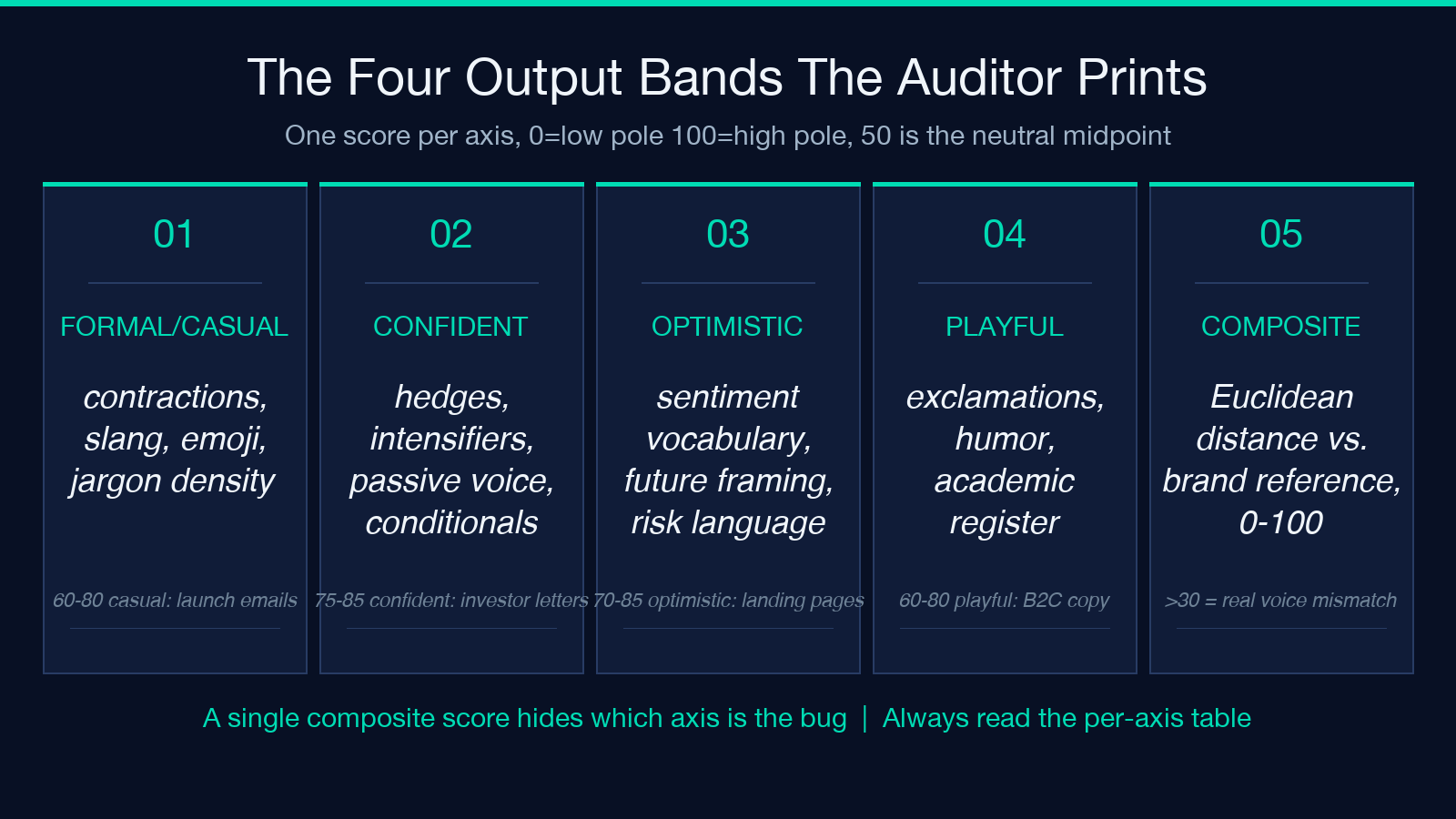
- Formal↔Casual (0 = formal, 100 = casual). Contractions, slang, emoji, first-person vs. third-person, jargon density. A launch email typically scores 60–80 casual; a regulatory disclosure sits at 15–25.
- Confident↔Cautious (0 = cautious, 100 = confident). Hedges (“maybe”, “might”, “perhaps”), intensifiers (“definitely”, “certainly”), passive voice, conditional framing. Investor letters sit at 75–85 confident; product disclaimers land at 25–40.
- Optimistic↔Concerned (0 = concerned, 100 = optimistic). Positive vs. negative sentiment vocabulary, future framing, risk language. Growth-stage landing pages run 70–85 optimistic; incident postmortems run 20–35.
- Playful↔Serious (0 = serious, 100 = playful). Exclamation marks, humor markers, conversational openers, puns vs. measured academic register. B2C consumer copy sits at 60–80 playful; legal contracts sit at 5–15.
The composite drift score is the Euclidean distance between the draft’s 4D vector and the reference’s 4D vector, normalized to 0–100. A drift under 15 reads as on-brand; 15–30 is a stylistic nudge worth reviewing; over 30 is a real voice mismatch.
Where The 1500-Marker Lexicon Actually Helps
The auditor’s core is a hand-curated lexicon of roughly 1500 markers — hedges, intensifiers, contractions, fillers, sentiment-bearing words, formality cues. Each marker has an axis weight; matching words get normalized by word count and projected onto each axis.
The lexicon covers English with full density and supports other languages with reduced coverage. Three classes of input benefit most:
- Marketing copy with dense intensifiers and exclamation marks. The Playful↔Serious axis catches emoji-laden tweets that “feel off” but no human can name the defect.
- Customer support macros that drift over quarters. A support team that started “We’ll get this sorted for you” can quietly migrate to “Unfortunately, this issue is outside our policy” — the Formal↔Casual axis shifts 30 points over six months without anyone noticing.
- Long-form content (whitepapers, blog posts) where a single paragraph drifts. The Optimistic↔Concerned axis catches the third paragraph of a launch announcement that quietly pivots from “we’re shipping the upgrade” to “users may experience intermittent failures”.
The engine is fast and offline. No LLM calls, no data leaves the browser. A 2,000-word audit finishes in well under a second.
The Brand Reference Is The Differentiator
Without a brand reference, the auditor prints four absolute scores. With a 50-word reference pasted into the comparison slot, it computes the reference’s own 4D voice print and reports the draft’s per-axis deviation (0–100) plus an overall drift score.
The reference math is the value. A draft can score 70 casual in absolute terms and still deviate 35 points from a brand whose reference is at 30. The absolute score is misleading; the deviation is what matters.
Three rules make the reference reliable:
- Paste 50–200 words of canonical copy. A single sentence is too noisy; a 5,000-word manifesto over-weights the auditor toward that document’s quirks.
- Pick the reference from the channel you are auditing. If the draft is for an email, paste last quarter’s best-performing email. If the draft is for in-app copy, paste the onboarding sequence.
- Re-baseline quarterly. Voice drift accumulates; the reference that was on-brand in Q1 drifts off-brand by Q3 unless someone refreshes it.
A drift <15 is on-brand; >30 suggests a voice mismatch worth revisiting. Anything between 15 and 30 is the band where a human editor’s judgment beats the auditor’s number.
How The Per-Axis Score Maps To A Rewrite Decision
The auditor’s per-axis deviation is what triggers a rewrite, not the composite drift. Three threshold bands structure the decision.
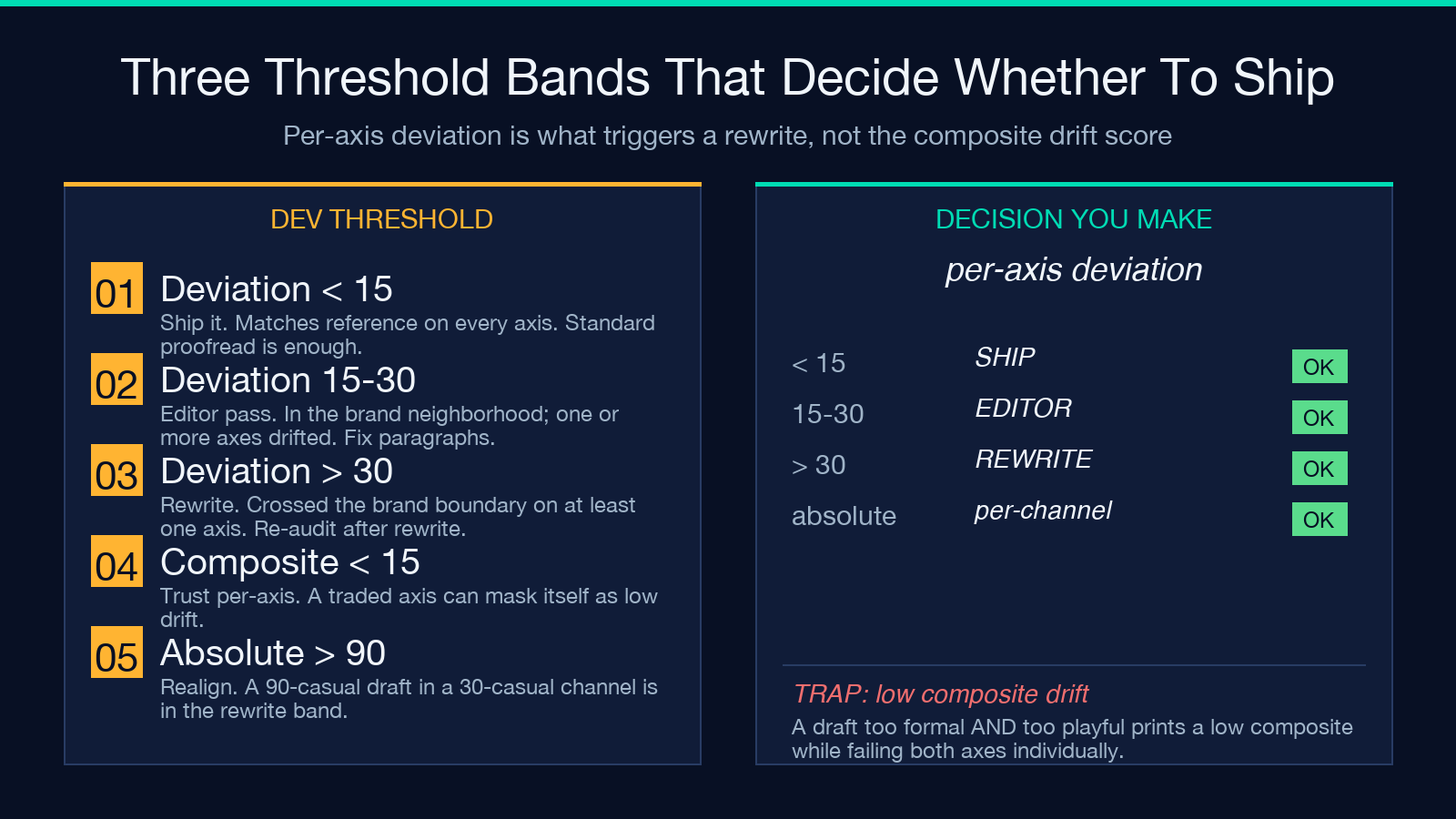
- Deviation <15: ship it. The draft matches the reference closely enough on every axis. No human review needed beyond a standard proofread.
- Deviation 15–30: editor pass. The draft is in the brand’s neighborhood but one or more axes have drifted. A skilled editor can usually fix the offending paragraphs without touching the rest. Send these drafts to a human before send.
- Deviation >30: rewrite. The draft has crossed the brand boundary on at least one axis. Per-paragraph patches will leave structural mismatches. Rewrite the affected sections against the reference, then re-audit.
The same thresholds apply to the absolute per-axis scores (when no brand reference is supplied). A draft that scores 90 casual when the channel expects 30 is in the same “rewrite” band as one that deviates 60 from a 30-casual reference.
The Three Failure Modes The Lexicon Cannot Catch
Lexicon-based scoring is approximate. Three classes of input produce numbers that look right but mean nothing.
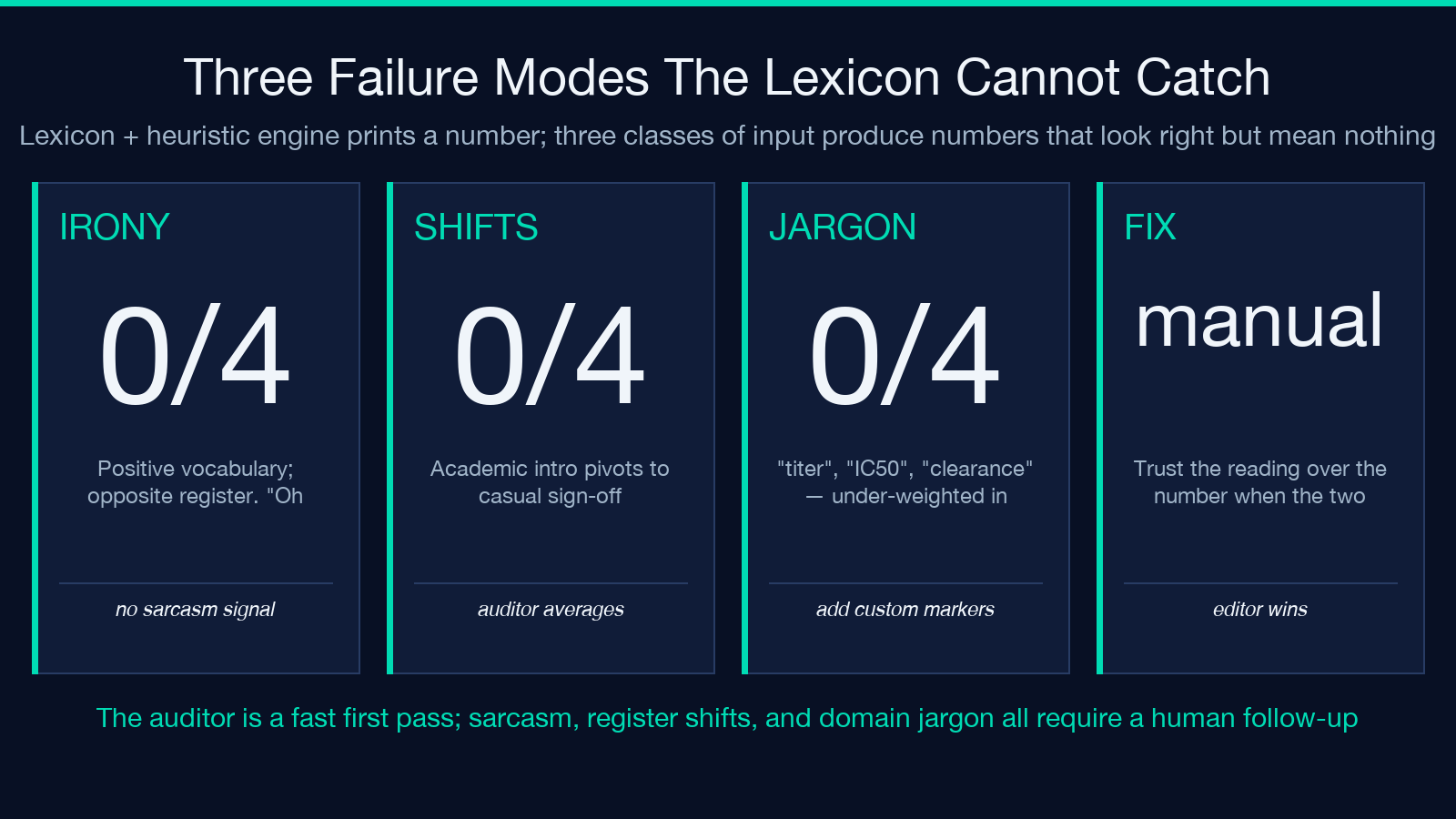
- Irony and sarcasm. “Oh great, another deployment at 5pm on Friday” scores high on Optimistic↔Concerned because the surface vocabulary is positive. The intended register is the opposite. The auditor has no signal here; a human editor still wins.
- Register shifts mid-text. A draft that opens with measured academic prose and pivots to a casual sign-off will print mid-band scores on every axis. The auditor averages; the reader experiences the shift.
- Domain-specific jargon that the lexicon doesn’t recognize. A biotech postmortem uses “titer”, “IC50”, “clearance” — none are in the curated lexicon, so the Formal↔Casual axis under-weights the actual density. Add custom markers or run a manual review pass for any domain with heavy specialized vocabulary.
The auditor does not claim to detect these. It prints a number, you interpret the number, and when the number says “neutral” but the draft reads “off”, trust your reading.
When The Drift Score Forces A Rewrite
Three patterns in the output band force a rewrite rather than a polish.
- One axis deviates >30 while the other three stay under 15. That single axis is the bug. The draft is on-brand except for one trait — too casual, too confident, too playful. Fix the specific axis; do not rewrite the whole draft.
- Two adjacent axes deviate >20 in the same direction. Formal↔Casual and Playful↔Serious moving together suggests the register has shifted uniformly — the writer is using a different voice, not just different words. A rewrite to match the reference’s register is faster than per-sentence patches.
- The composite drift is under 15 but a per-axis deviation is over 40. The Euclidean average masks an axis that has been traded for another. A draft that goes too formal but compensates by going too playful will print a low composite while failing both axes individually. Always read the per-axis table; never trust the composite alone.
The auditor catches these because it prints all four axes plus the composite. A reader who only sees “drift: 12, looks fine” misses the per-axis defects.
Pairing With A Human Editor Pass
The auditor is a fast first pass, not a replacement for an editor. Three workflows pair the two cleanly.
- Pre-submit gate. Paste every outbound email, blog post, or support macro through the auditor before send. Reject any draft with composite drift >30 or any per-axis deviation >40.
- Style-guide enforcement. Run the auditor against the style guide itself; the per-axis scores should match the guide’s prescribed voice. If they don’t, the guide is the artifact that needs rewriting.
- Drift dashboard. Audit the last 30 published pieces and chart the four-axis scores over time. The dashboard catches the slow drift that no individual edit reveals — the support team’s formal drift, the blog’s optimism creep, the launch copy’s intensifier inflation.
The auditor is offline, fast, and runs in the browser. Run it on every draft; trust the per-axis numbers over the composite; send a human editor anything that scores between 15 and 30 on any axis.
Where The Tool Fits In A Content Stack
Three integrations make the auditor more useful than a standalone page.
- CMS plugin. Wire the audit into the publish workflow so every draft is scored before it goes live. The pre-submit gate becomes automatic; the editor only sees drafts that pass the per-axis thresholds.
- Style-guide linter. Run the auditor against the style guide document itself. If the guide scores 65 casual and the brand wants 30, the guide is the artifact that needs a voice pass.
- Quarterly brand audit. Score the last quarter’s published copy against the brand reference. The dashboard reveals which channels drift fastest and which writers hold the line.
The tool’s core — lexicon + heuristics + 4D projection + brand-reference deviation — stays the same in every integration. What changes is who reads the output: a writer, an editor, a content lead, or a CMO.
For a deeper walk through the math and a hands-on audit pass against a sample brand reference, see the Voice / Tone of Voice Auditor. For a comparison view against related text-processing tools, browse the Text Processing category on Elysia Tools. The auditor prints its four-axis score plus deviation on every run; the rest is interpretation.
