
The IGC file your logger writes is not a flight log — it is a witness statement. Every A, H, C, B, F, L, and G record is a signed fact, and the badge secretary is the one who decides which facts survive audit. When the file lands on the badge chair’s desk, the question is not whether you flew — your barograph already proved that — but whether the record can prove you flew it cleanly under FAI Sporting Code Section 3.
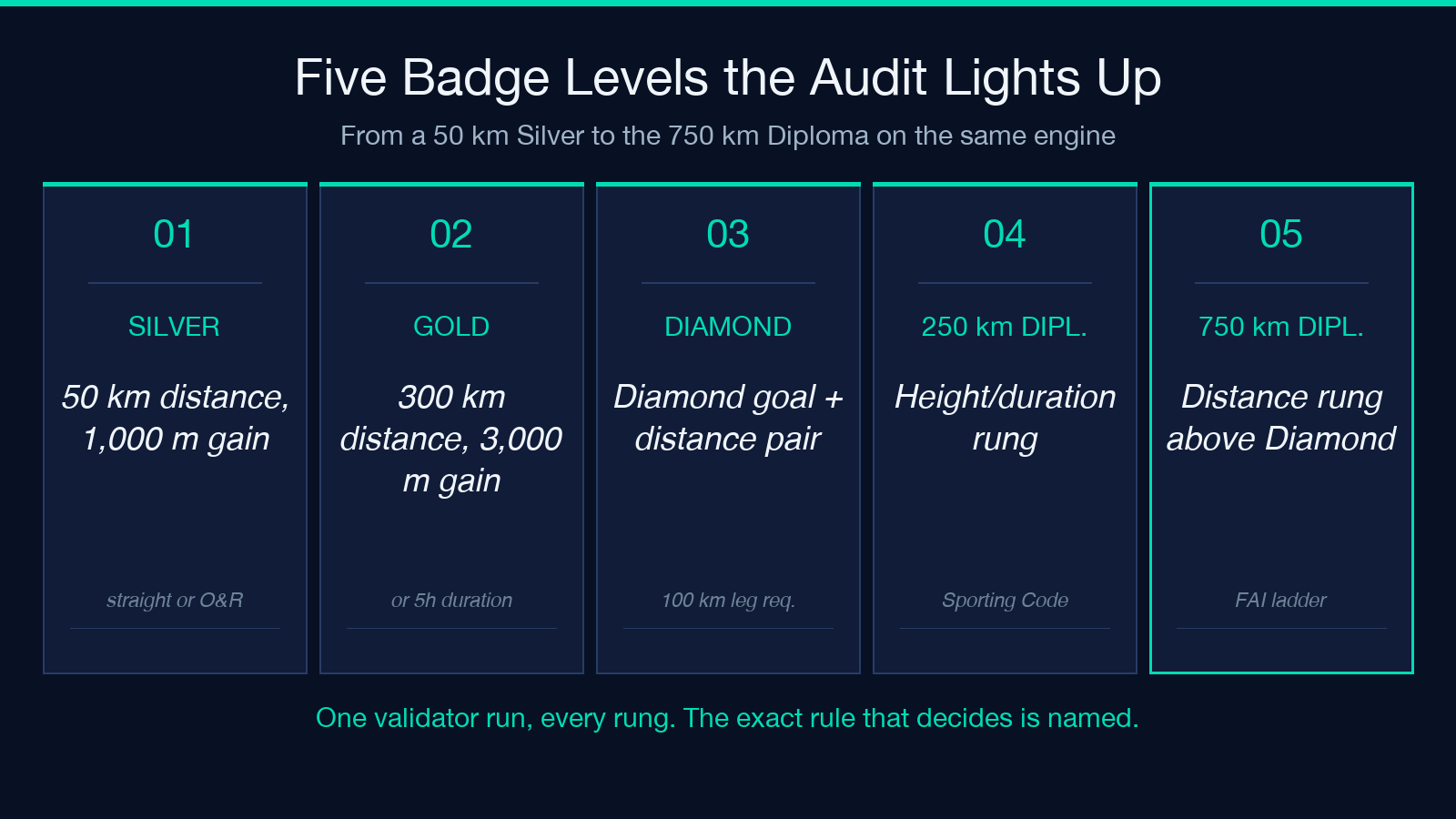
The validator walks an IGC file the same way a Soaring Society of America official observer walks a Silver or Gold claim: declared task reconstructed from the C-record chain, takeoff detected by ENL engine-noise envelope or tow kinematics, total altitude gain summed across every climb, free distance solved as a convex hull over the track, and the G-record security envelope verified against the manufacturer key so the file cannot be silently rewritten after landing. Silver is a 50 km straight or out-and-return with a 1,000 m gain; Gold is a 300 km distance or a 5 hour duration with a 3,000 m gain; Diamond is the full set, with the 750 km + 250 km diploma ladder sitting one rung above the Diamond goal.
The output is structured for the badge secretary, not the cockpit. A pass file lights up Silver / Gold / Diamond / 750 km Diploma / 250 km Diploma badges with the supporting numbers; a borderline file flags the exact rule that almost failed (28% shortest-side, loss-of-height, declared-vs-actual task shape) so the pilot knows what to fix on the next flight before the next claim.
What the Validator Walks, Record by Record
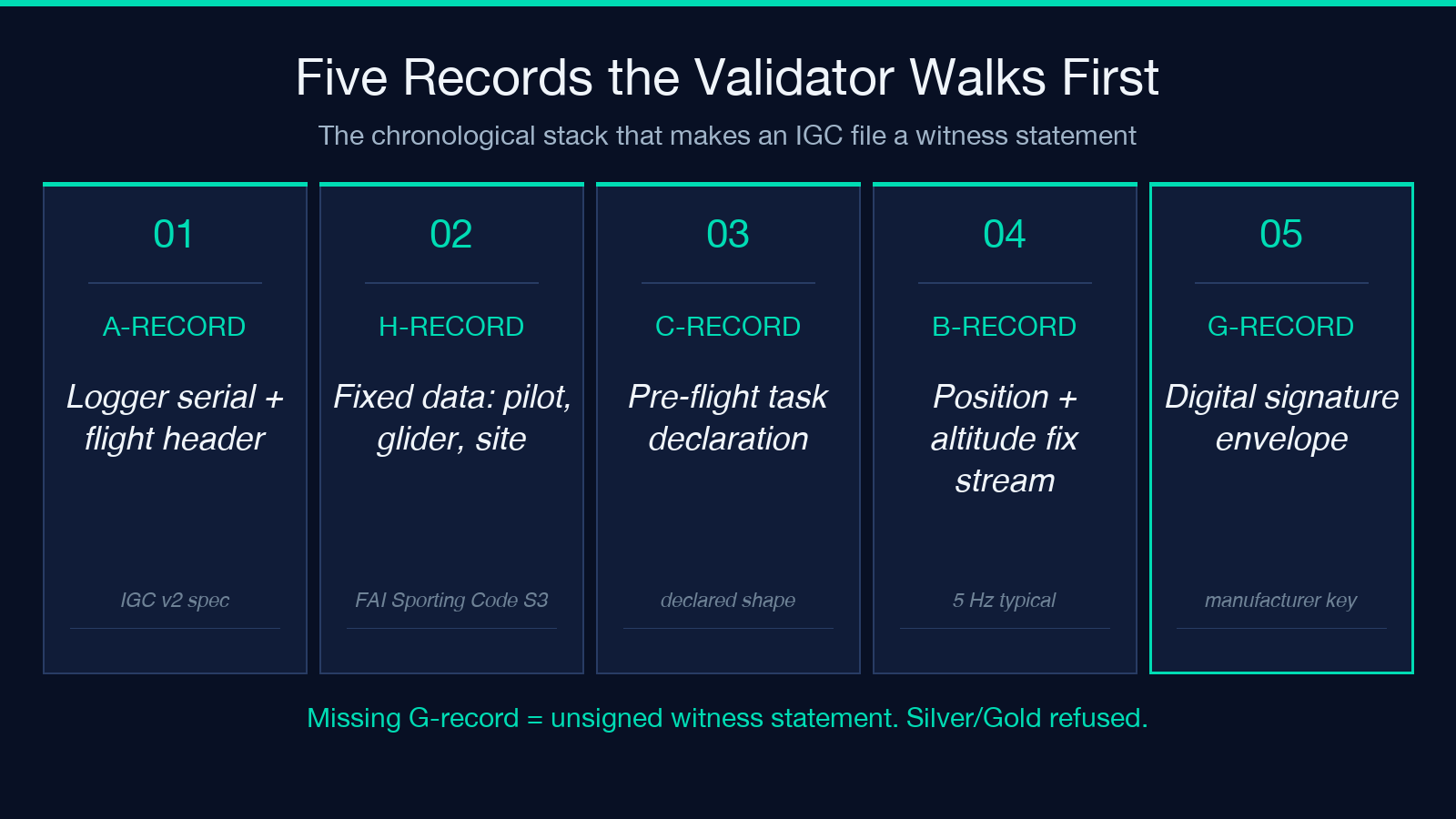
An IGC file is a chronological stack. The A-record opens the file with the logger serial, the H-record declares the fixed data (pilot, glider type, site), and the B-record stream is the position fix (lat / lon / pressure altitude / GPS altitude) sampled at the logger’s nominal rate. Every minute or so the logger emits an I-record event marker; the K-record seals each hourly block with a 32-bit cumulative fix count.
The C-record chain declares the task before takeoff — task shape, turnpoints, observation zones — and the validator checks that the actual track fits inside the declared geometry. The F-record marks the finish; the L-record logs security events; the G-record is the digital signature.
Takeoff and Landing Detection
The validator accepts any of the four accepted takeoff detection modes: ENL engine-noise envelope below the threshold (the electric or low-noise two-stroke case), the tow-kinematic climb (low forward speed + high altitude rate above 1 m/s for at least 30 s after release), the explicit release record, or the manual marker. Landing is detected as the first sustained zero-velocity or low-altitude interval after the last climb.
If the takeoff or landing is missing, the validator flags the file as incomplete and refuses to evaluate distance — a Silver claim with no detected landing is a Silver claim with no finish line. This is the same gate a badge secretary applies: a flight without a finish is a practice flight, not a claim.
The Free Distance Math, in One Paragraph
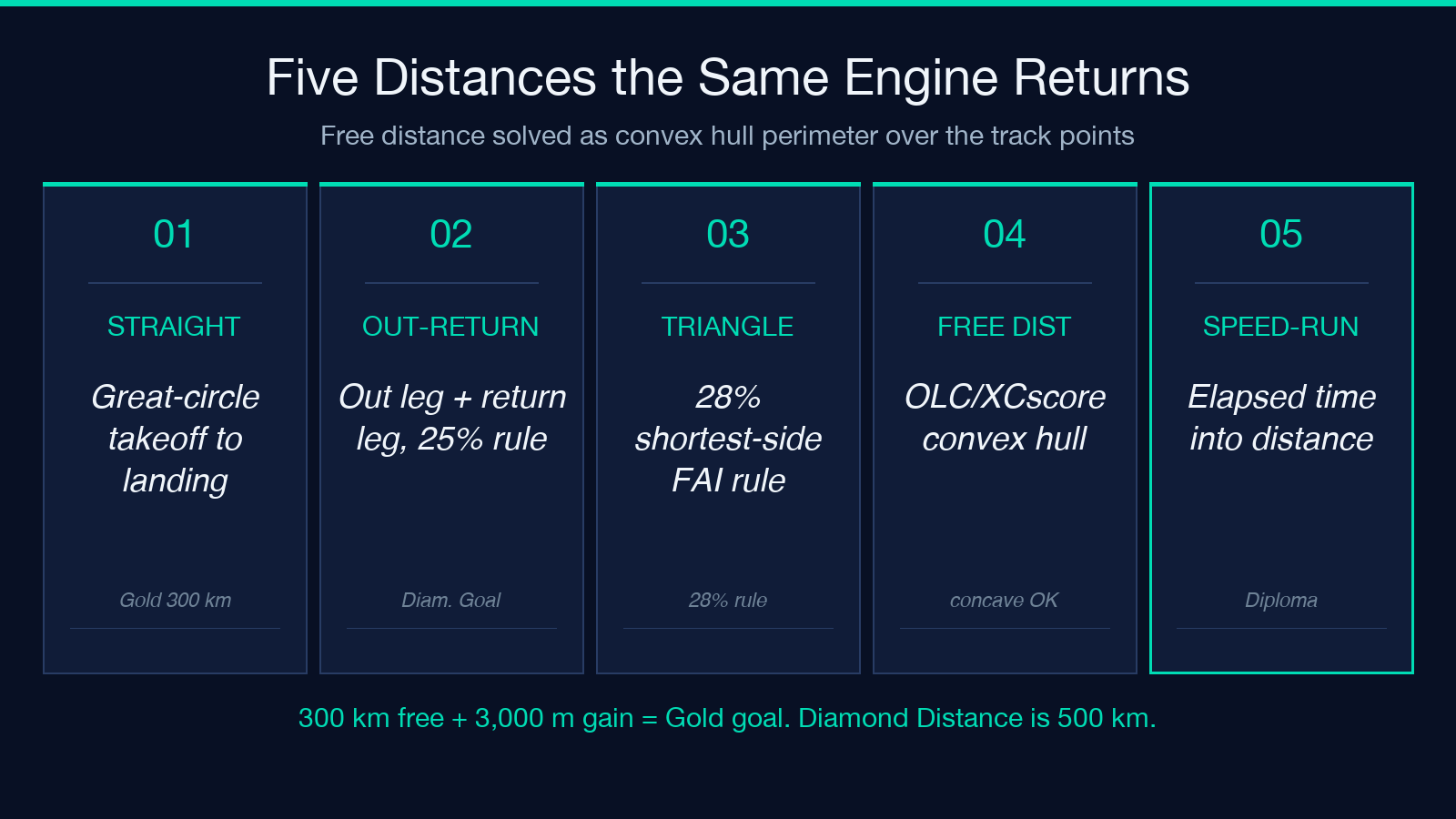
Once the takeoff, finish, and turnpoints are extracted, the validator computes five distances from the same point cloud: straight distance is the great-circle between takeoff and landing; out-and-return is the out leg plus the return leg, awarded when the return-to-takeoff leg exceeds 25% of the out leg; triangle is the largest isosceles or scalene triangle inscribed in the track, validated against FAI’s 28% shortest-side rule (the shortest side must be at least 28% of the longest); free distance is the longest great-circle path the pilot could have flown between takeoff and landing, computed as the convex hull perimeter over the track points (the OLC / XCscore optimal); and speed-to-distance is the elapsed time divided into distance for the FAI Diploma speed runs.
The same engine returns the convex hull vertices so the pilot can see exactly which fixes the engine picked as the corners. This is the math that turns a 6-hour wave flight into either a 300 km Gold or a “nice flight, no badge” email — and the answer depends entirely on whether the convex hull finds a 300 km perimeter or only a 240 km one.
Total Altitude Gain and the Climb Sums
Total altitude gain is not “highest altitude minus takeoff altitude.” It is the sum of every positive altitude delta across every climb, with the convention that any descent between two climbs resets the running baseline. A wave flight that rides from 1,500 m AGL to 4,500 m AGL in a single lift registers as 3,000 m of gain, not 0 m because the wave did not start from the takeoff elevation. The validator sums across the full B-record stream and reports the per-climb breakdown so the pilot can see how the day’s flying tallied up.
For Silver, the 1,000 m requirement is the easy part of any ridge or wave flight; for Gold, the 3,000 m requirement usually means two or three solid climbs plus a wave; for Diamond, the 3,000 m is the minimum bar — well below what a real Diamond flight accumulates.
What a Silver / Gold / Diamond Claim Needs
The Silver badge is a 50 km straight distance (or out-and-return) with at least 1,000 m total altitude gain. The Gold badge is a 300 km distance (or 5 hour duration, or Diamond goal) with at least 3,000 m gain. The Diamond goal is a 300 km free distance completed with at least a 3,000 m total gain and a 100 km leg. The Diamond distance is a 500 km free distance.
The 750 km Diploma is the next rung above Diamond Distance; the 250 km Diploma is the corresponding height-and-duration rung. Every claim requires a G-record digital signature that the validator can reconstruct against the manufacturer’s published key; a file with a tampered B-record stream or a missing G-record is refused outright, because the Sporting Code treats an unsigned IGC as an unsigned witness statement.
Loss-of-height rules apply between turnpoints: between any two consecutive declared turnpoints (or between finish and last turnpoint) the glider must not lose more altitude than the declared task altitude bonus unless the rule explicitly waives it. The validator flags each loss-of-height violation with the start time, end time, and altitude delta so the badge secretary can decide whether the flight still qualifies under the local rule variation.
Why the Declaration Chain Matters
The C-record declaration chain is what separates a flight from a claim. The validator reconstructs the declared task from the C-records and compares it to the actual track: did the pilot declare the task before takeoff, did the declared task shape (triangle / out-and-return / free) match the actual flown shape, did the turnpoints sit inside the declared observation zones, and did the FAI triangle 28% rule hold.
A flight that flies a 350 km triangle but did not declare a triangle is scored as a 350 km free flight, not a 350 km triangle — and a free flight of 350 km does not qualify for the Diamond goal triangle bonus even if the geometry is identical. The validator’s audit report is the pilot’s defense on appeal: declared task, actual flown shape, distance per category, altitude gain, G-record signature verification status, and the exact rule that made the claim succeed or fail.
What a Bad IGC File Looks Like
The validator’s most common failures are mechanical, not athletic: a logger with the wrong date (a fresh battery reset that landed on 2014 instead of 2026 invalidates the whole flight because the C-record chain becomes chronologically impossible); a G-record from a manufacturer key the validator does not have (rare with major logger brands, common with off-brand devices); a B-record stream with a gap longer than 60 seconds (the fix-count cumulative K-record does not match, and the validator refuses to compute the convex hull over a discontinuous track); and a C-record declared task that was uploaded after takeoff (which fails the declared-before-takeoff rule outright).
These are the failures a clean IGC file does not have. The validator’s audit tells the pilot which gate they tripped and where to look — a five-minute fix on the logger’s clock saves a five-week delay on the badge claim.
Pairing With a Sample Flight
The tool pairs naturally with the US Sailplane IGC Validator page on Elysia Tools, where a real-world IGC file walks through the same five-record walk — A-record metadata, B-record position stream, C-record declared task, G-record signature verification, and the final badge evaluation. The same page hosts the convex-hull diagram for the free distance and the FAI triangle 28% check, so a pilot submitting a claim can match the validator’s output to the visual before mailing the file to the badge secretary.
For cross-tool workflows, pair the IGC validator with the Great Circle Distance Calculator to verify any great-circle distance the validator surfaces, and with the Bearing Calculator when a leg crosses the antimeridian and the convex hull vertex pair needs an explicit initial-bearing check.
The validator does not score the flight for the pilot; it scores the IGC file. The difference matters when the claim is appealed, when the logger serial is questioned, or when a G-record signature fails on a freshly downloaded file. A clean pass on the validator is the minimum evidence a badge secretary will accept in 2026 — the file walks the audit, the G-record matches the manufacturer key, the convex hull is reproducible, and the rule that decided the badge is named in the report.
