# 8 Free Health Calculators That Turn Your Body Into Data
Most people who care about their health track one number: steps. Maybe weight on a scale. But steps don’t tell you how many calories you’re actually burning. The scale doesn’t distinguish between fat loss from muscle loss. You can run three times a week and still have no idea whether your cardiovascular fitness is improving.
The real picture requires real data. And for most of those numbers, you don’t need a gym membership or a $200 wearable. You need the right calculators.
Here are eight free tools from ElysiaTools that give you the measurements most fitness apps charge for — no signup, no subscription, no fluff.
1. BMR Calculator — Your Baseline Burn
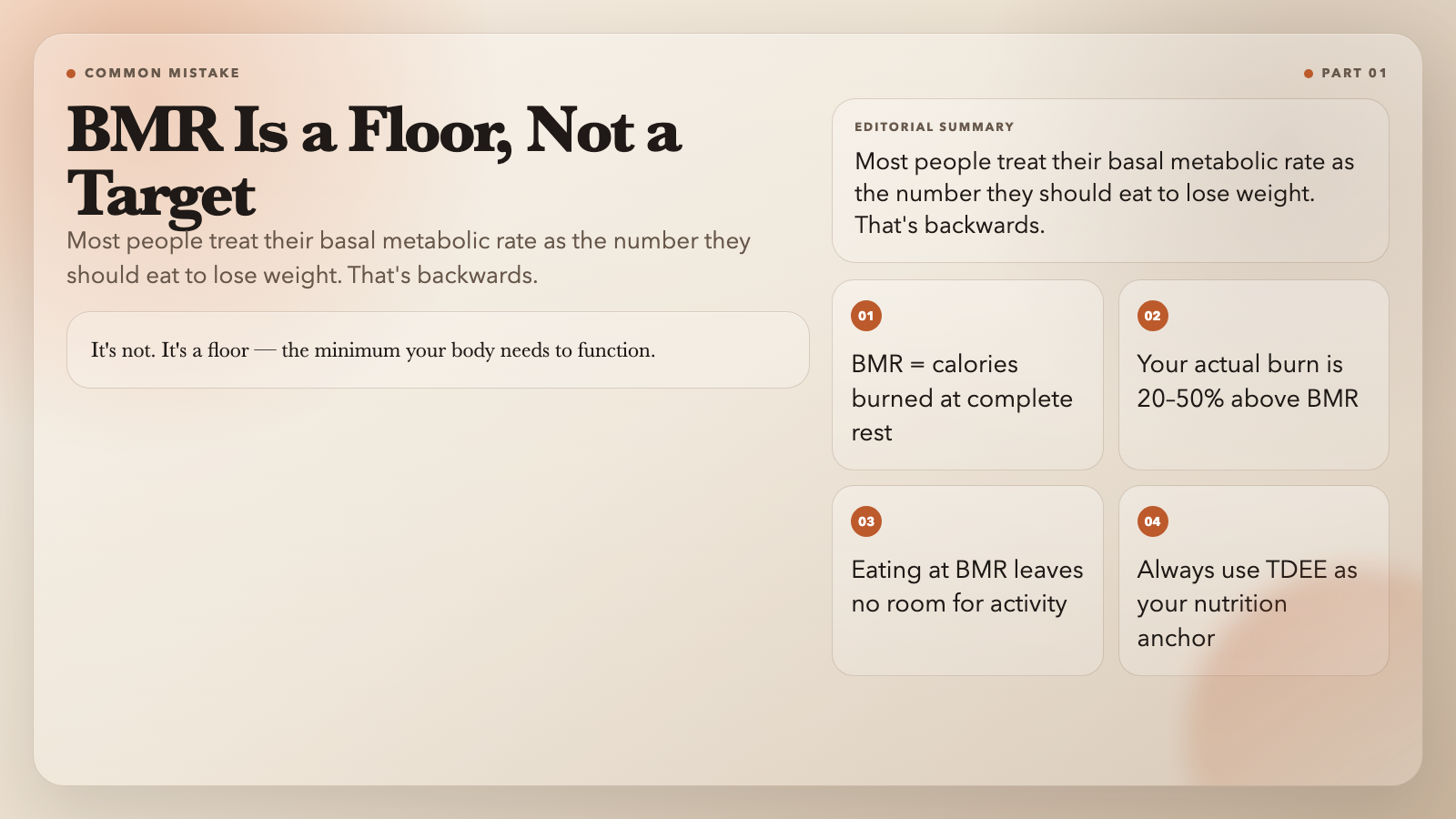
Your Basal Metabolic Rate is the number of calories your body burns at complete rest. Not exercising. Not walking to the kitchen. Just keeping your organs running, your lungs breathing, your brain thinking.
For a 30-year-old male at 75kg and 178cm, that number sits around 1,700 calories per day — before you factor in walking to work, climbing stairs, or anything else. If you’re eating 2,200 calories a day and wondering why you’re not losing weight, your BMR is probably the missing variable.
The BMR Calculator uses three formulas: Mifflin-St Jeor (the most accurate for most people), Harris-Benedict (revised), and Katch-McArdle (for when you already know your body fat percentage). Pick the one that fits your situation. Input your weight, height, age, and gender. The tool returns your BMR and a plain-English explanation of what it means.
The biggest mistake people make with BMR is treating it as a calorie target. It’s not. It’s a floor — the minimum your body needs to function. Most people’s actual daily burn is 20–50% above their BMR depending on activity level.
2. Body Fat Calculator (US Navy) — The Number Scales Can’t Give You
Your bathroom scale tells you your weight. It doesn’t tell you your body fat percentage. These are completely different things, and a 75kg person at 25% body fat looks and performs very differently from a 75kg person at 12%.
The US Navy developed a body fat estimation method that uses just four measurements: height, neck circumference, waist circumference, and hip circumference (for females). No calipers. No underwater weighing. Just a tape measure and this calculator.
The tool places your result into one of five categories — Essential Fat, Athletes, Fitness, Average, or Obese — based on your gender. It also gives you fat mass and lean mass estimates. For a 75kg male reading 20% body fat, that breaks down to roughly 15kg of fat and 60kg of everything else.
Why does this matter? Because tracking weight alone while training can be demoralizing even when you’re getting leaner. If you’re gaining muscle and losing fat simultaneously, the scale might not move at all. Body fat percentage tells you what’s actually happening under the skin.
3. TDEE Calculator — The Number That Changes How You Eat
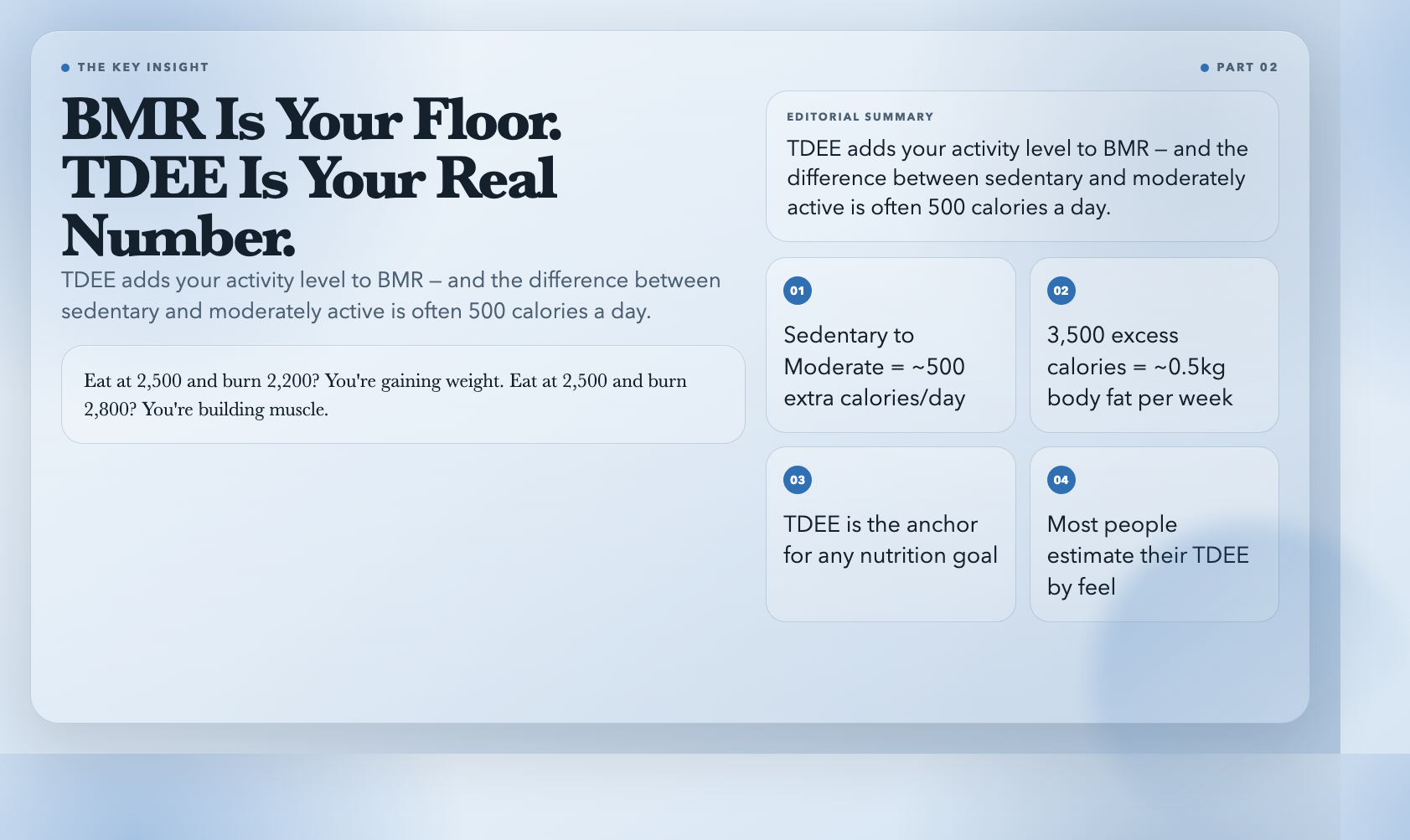
BMR is your floor. TDEE — Total Daily Energy Expenditure — is your real number. TDEE adds your activity level to your BMR, giving you the actual calories you burn on an average day.
This is the most useful number in nutrition planning, and most people never calculate it. Eat at 2,500 calories and burn 2,200? You’re gaining weight regardless of how “clean” your diet looks. Eat at 2,500 and burn 2,800? You’re building muscle without even trying.
The TDEE Calculator takes your weight, height, age, gender, and activity level — from Sedentary (desk job, minimal movement) to Very Active (hard training every day or a physical job). Each step in activity level adds roughly 200–300 calories to your daily burn. The difference between Sedentary and Moderate exercise habits is often 500 calories a day, which compounds to 3,500 calories per week — the equivalent of burning off half a kilogram of body fat.
Use your TDEE as the anchor for any nutrition goal. Eat below it to lose fat. Eat above it to build muscle. Eat at it to maintain. Everything else is details.
4. Calorie Burned Calculator — Know What the Workout Actually Costs
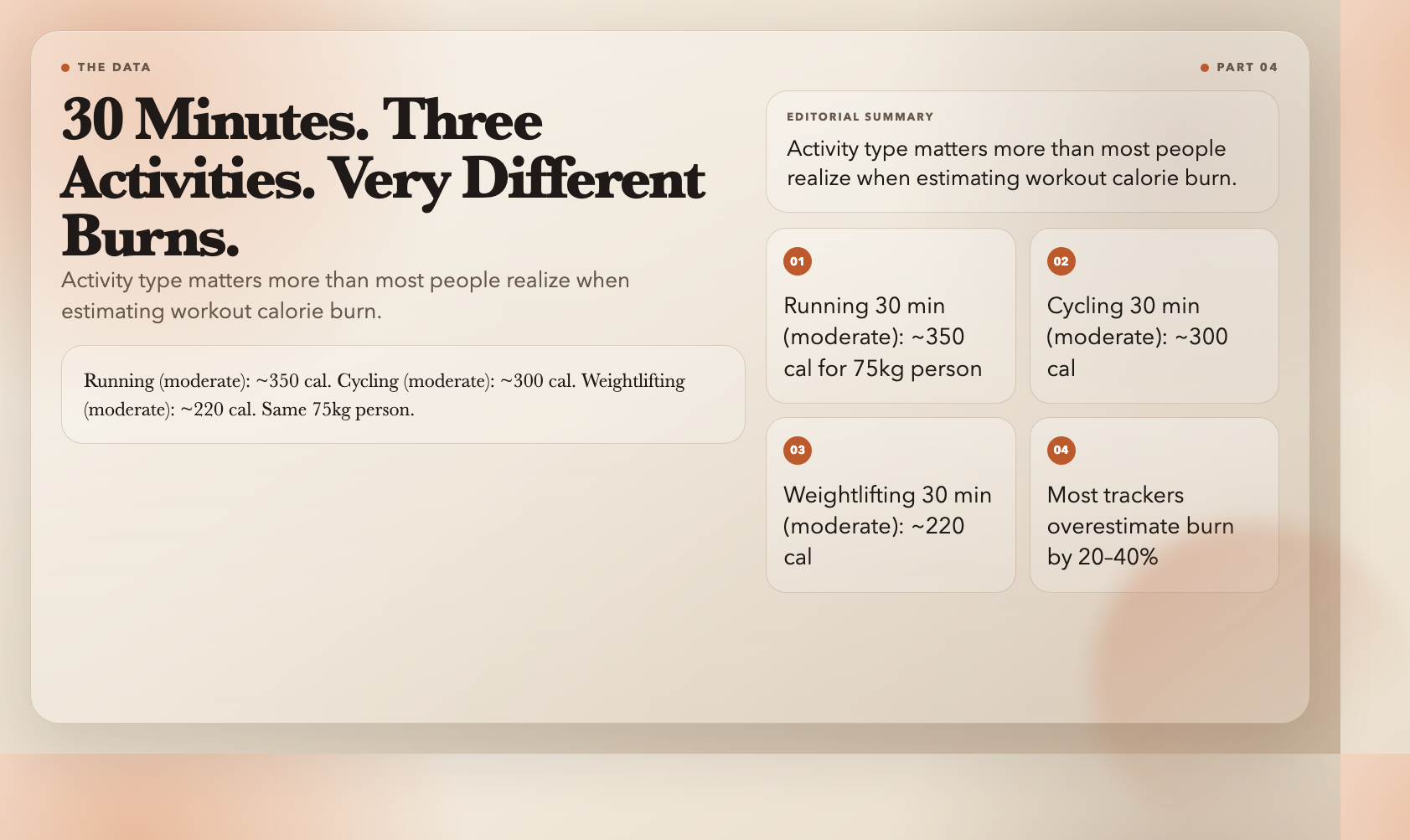
Here’s a number most fitness trackers get wrong: how many calories did that workout actually burn? Many wearables overestimate by 20–40%, partly because they don’t know your actual metabolism, only estimates.
The Calorie Burned Calculator uses MET values (Metabolic Equivalent of Task) — a science-backed system that estimates energy expenditure based on activity type, duration, and intensity. Choose your activity (12 options including running, swimming, weightlifting, hiking, and dancing), set your weight and duration, and pick your intensity level.
A 75kg person running at moderate intensity for 30 minutes burns roughly 350 calories. The same person cycling at moderate intensity for 30 minutes burns around 300. Weightlifting for 30 minutes at moderate intensity? About 220 calories. That’s not a small difference when you’re building a weekly calorie deficit.
The tool also shows equivalent activities — so you can see that the 350 calories from your run is roughly equal to 60 minutes of brisk walking. It gives a health note based on intensity. And it supports both metric and imperial units.
5. One Rep Max Calculator — The Foundation of Smart Strength Training
If you’re lifting weights and using the same weight for every set, you’re leaving strength gains on the table. Periodized training — varying intensity and volume across weeks and months — produces significantly better results than steady-state lifting. And periodization requires knowing your One Rep Maximum (1RM): the maximum weight you can lift for a single rep on any given exercise.
The One Rep Max Calculator estimates your 1RM from a submaximal lift. If you can bench press 100kg for 5 reps, what’s your theoretical maximum? The tool uses three validated formulas — Epley, Brzycki, and Lander — and gives you results from each so you can cross-reference.
More practically, it returns a full percentage table: your working weights at 95%, 90%, 85%, down to 50% of your max. This is the backbone of most effective strength programs. 85–90% for 3–5 reps builds strength. 65–75% for 8–12 reps builds muscle mass. 50–60% for 15–20 reps builds muscular endurance. Without the 1RM as an anchor, you’re guessing.
6. Sleep Cycle Calculator — Wake Up Without the Fog
You went to bed at 11 PM and woke up at 7 AM. That’s eight hours. You should feel great. Instead, you feel like you got hit by a truck.
The problem is almost certainly your sleep stage. A full sleep cycle — light sleep, deep sleep, REM — takes roughly 90 minutes. Waking up during deep sleep leaves you with sleep inertia: that groggy, disoriented fog that can last 30 minutes or more. Waking up at the end of a cycle, during light sleep, you feel alert almost immediately.
The Sleep Cycle Calculator works in both directions. Tell it when you’re going to bed, and it shows you the optimal wake-up times based on 4, 5, or 6 complete cycles. Tell it when you need to wake up, and it calculates the bedtimes that align with full cycles.
It factors in time to fall asleep (defaulted to 14 minutes, which is realistic for most adults). Results show each option labeled by cycle count and sleep quality: 4 cycles (6 hours) as minimum recommended, 5 cycles (7.5 hours) as optimal for most adults, 6 cycles (9 hours) as ideal for athletes or recovery periods.
Sleep quality affects hunger hormones, muscle recovery, and cognitive performance. Getting the timing right costs nothing and takes 30 seconds to calculate.
7. VO2 Max Calculator — Your Cardiovascular Fitness Score
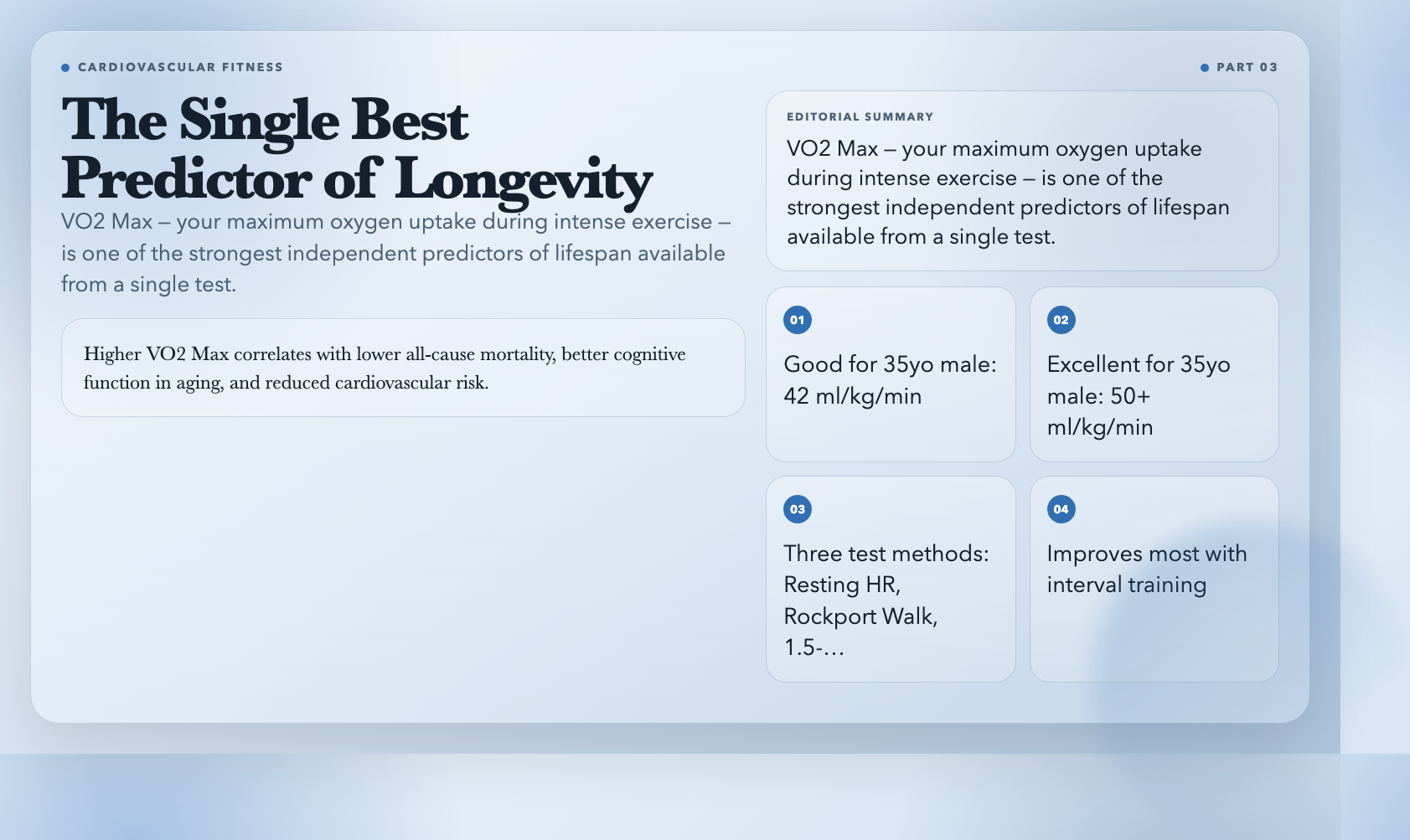
If there is one number that predicts long-term health outcomes better than almost any other fitness metric, it is VO2 Max — your maximum rate of oxygen consumption during intense exercise. Higher VO2 Max correlates with lower all-cause mortality, better cognitive function in aging, and reduced risk of cardiovascular disease. It is, in many ways, the single best snapshot of your cardiorespiratory fitness.
The VO2 Max Calculator offers three testing methods depending on what data you have available. The Resting Heart Rate method uses the Uth-Sørensen formula: input your age, gender, and resting heart rate (measure it first thing in the morning before you get out of bed). The Rockport 1-Mile Walk test is for those who can walk a mile but not run. The 1.5-Mile Run test is for people who can run — it gives the most accurate estimate.
The tool returns your VO2 Max alongside a fitness level rating (Low, Fair, Good, Excellent, Elite) and age/gender comparisons. For a 35-year-old male, “Good” starts around 42 ml/kg/min; “Excellent” begins around 50.
Critically, it gives personalized recommendations based on where you land. If your VO2 Max is below 35, the advice focuses on starting with low-impact activities and building consistency. If you’re already in the Good range, the recommendations shift toward interval training and sport-specific development.
8. Water Intake Calculator — The Most Overlooked Variable
Dehydration reduces exercise performance by up to 25%. It impairs cognitive function, increases perceived effort during workouts, and disrupts recovery between sessions. And most people walk around mildly dehydrated without realizing it.
The Water Intake Calculator estimates your daily hydration needs based on three factors: body weight, activity level, and climate. It uses a base formula (30–45ml per kilogram of body weight depending on activity) adjusted for environmental conditions. A 75kg sedentary person in a moderate climate needs around 2.6 liters per day. The same person training hard in hot conditions may need 3.5 liters or more.
The output includes a full hourly drinking schedule — how much to drink at 7 AM, 8 AM, and so on through 10 PM. It also lists hydration tips and warning signs of dehydration (dark urine, fatigue, headaches, muscle cramps). The tool supports both metric and imperial units.
One practical application: if you’re training in the afternoon, front-loading your water intake in the morning and early afternoon is more effective than trying to catch up in the evening. The hourly schedule makes this easy to follow.
What You Do With the Numbers Is the Real Work
None of these tools are diagnostic. They don’t replace blood tests, medical assessments, or professional coaching. What they do is give you a baseline — a set of numbers to track over weeks and months so you can see what’s actually changing.
The runner who tracks their VO2 Max every three months knows whether their endurance training is working. The lifter who recalculates their 1RM after a strength block knows when to push weights and when to focus on volume. The person tracking TDEE and body fat together sees the full picture of what their nutrition program is actually doing.
The data doesn’t lie. It just waits for you to collect it. And once you have it, the question becomes simple: what are you going to do with it?