8 Free Astronomy Tools That Help You Read the Sky
Twice a day, every day, there’s a 20-minute window when the sky turns cobalt blue and the sun sits just below the horizon. Photographers call it magic. Physicists call it Rayleigh scattering. Most people miss it entirely—then wonder why their sunset photos look like every other sunset photo.
Getting the timing right used to require either a $500 GPS unit or a notebook full of solar declination formulas. That was the barrier. Now it isn’t.
Here are 8 free tools that translate celestial mechanics into something you can actually use.

1. Blue Hour Calculator
The blue hour isn’t a metaphor. It’s a specific window: the sun sits between 4° and 8° below the horizon, and the sky shifts into that deep cobalt photographers fly across time zones to catch.
The Blue Hour Calculator gives you exact start and end times for any location and any date. Feed it your latitude-longitude pair and a date, and it returns two windows—morning (typically 30–60 minutes before sunrise) and evening (30–60 minutes after sunset).
The physics is clean: at those solar depths, short blue wavelengths dominate the scattered light, cool light fills shadows evenly, and contrast drops to nearly nothing. Architecture looks rendered. Skin looks polished. This is what photographers are chasing when they schedule shoots for “magic hour.”
2. Golden Hour Calculator
The Golden Hour Calculator finds the window when the sun sits between 0° and 6° above or below the horizon. At those angles, light punches through maximum atmosphere, scatters blue, and delivers amber at ground level.
Shadows stretch long. Contrast softens. Portrait photographers who schedule shoots at noon and then complain about harsh light are arguing with physics. Golden hour eliminates that argument.
3. Sunrise & Sunset Calculator
The Sunrise & Sunset Calculator goes further than weather apps. It computes civil, nautical, and astronomical twilight alongside solar times. It handles polar regions where the sun may vanish for months. It shows solar noon and day length to the minute.
Solar noon is the worst time for outdoor portraits—sun overhead, shadows at your feet, contrast at maximum. Knowing your location’s specific solar noon (which drifts from clock noon due to the equation of time) lets you plan around the worst hour.
4. Daylight Calculator
How many hours of daylight does Reykjavik get on the winter solstice? What about Singapore on the equinox? The Daylight Calculator answers questions most apps can’t.
The numbers reveal patterns that surprise:
At the equator, day length stays within minutes of 12 hours year-round. At 45° latitude (Denver, Montreal, Paris), you get roughly 15 hours in summer, 9 in winter. Above 66.5° latitude—the Arctic Circle—you enter polar day or polar night territory, where the sun either doesn’t set or doesn’t rise for weeks.
The counterintuitive part: in the Northern Hemisphere, days lengthen faster in spring than they shorten in autumn.
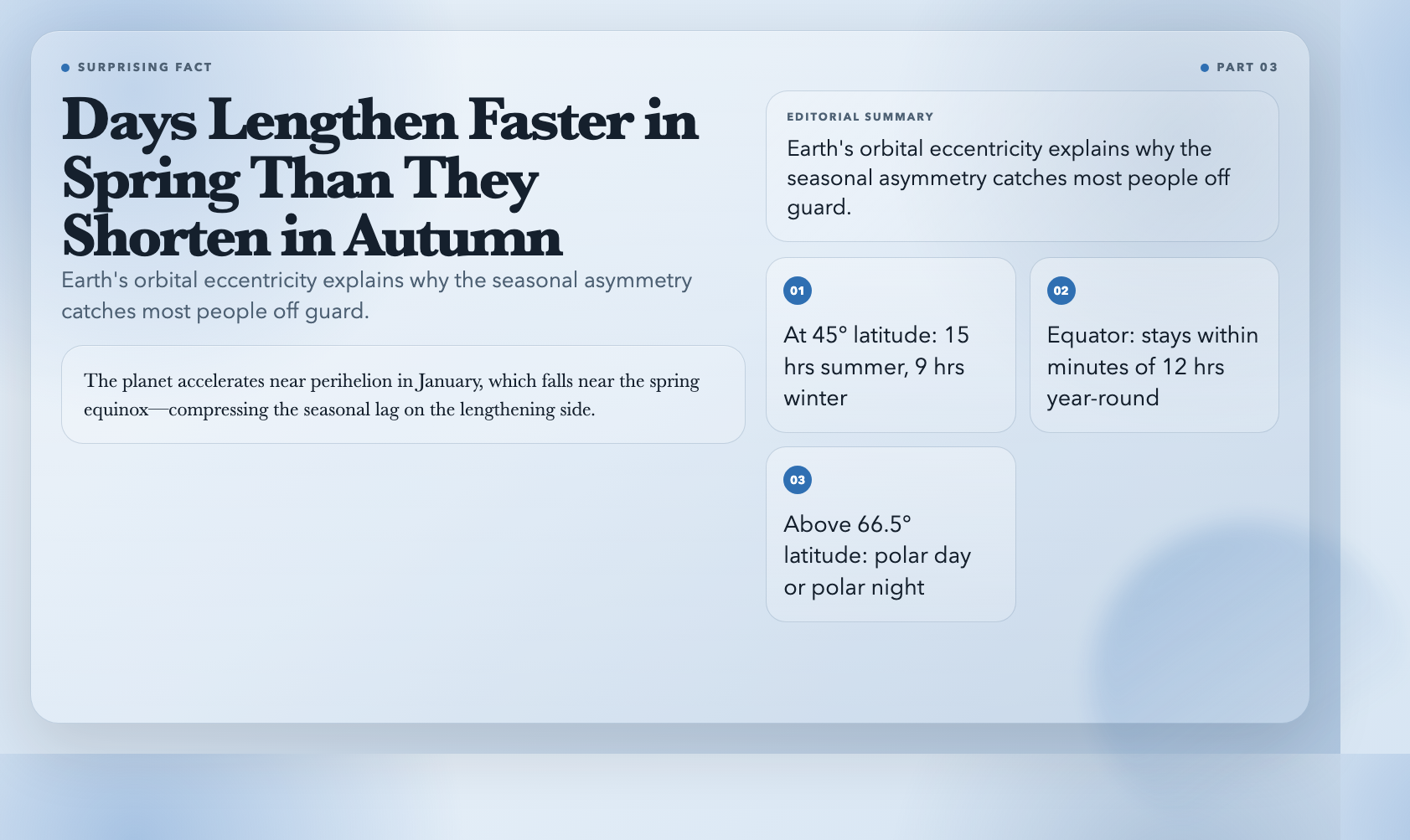 Earth’s orbital eccentricity causes this—the planet accelerates near perihelion in January, which falls near the spring equinox, compressing the seasonal lag on the lengthening side.
5. Moon Phase Calculator
The Moon Phase Calculator returns the current lunar phase, illumination percentage, and days into the 29.53-day synodic month.
A 50%-illuminated moon isn’t half as bright as a full moon. It’s about 23% as bright—human vision responds logarithmically to luminance, not linearly.
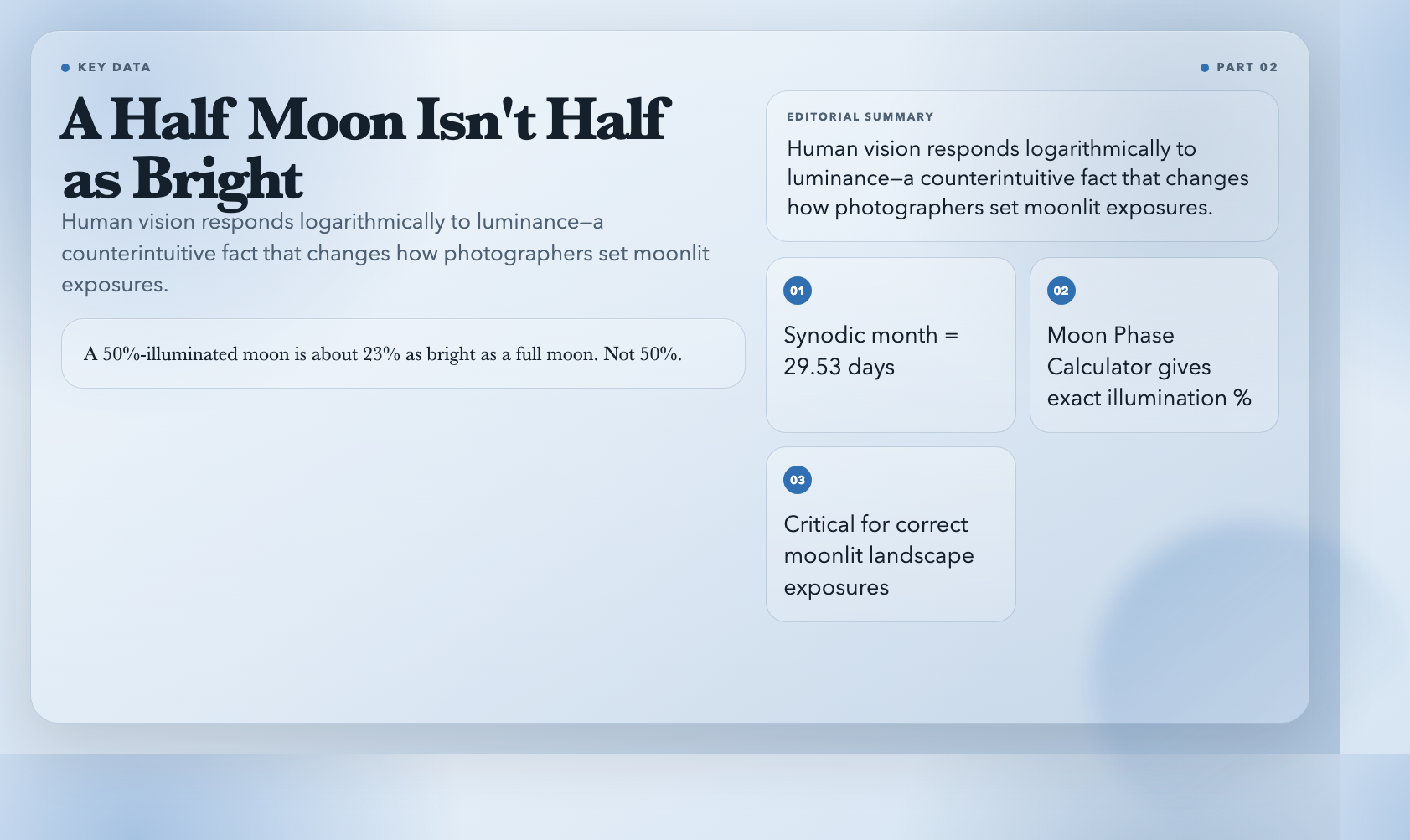 Knowing exact illumination lets photographers set correct exposures for moonlit landscapes and helps astronomers estimate sky glow at dark sites.
The calculator anchors to a known new moon reference and computes forward. Accuracy holds to within a few hours for any date in the near term.
6. Planet Position Calculator
Most planet apps are graphical and require holding your phone to the sky. The Planet Position Calculator is data-first—it tells you which constellation each planet occupies, its right ascension, declination, and apparent magnitude.
Apparent magnitude is the useful number. Lower or negative values mean brighter:
– Venus reaches −4.5 at its brightest—visible in daylight with careful averted vision
– Jupiter typically sits around −2.5 at opposition
– Mars swings between −2.0 and +2.0 depending on Earth-Mars orbital geometry
If you’re standing in a light-polluted city and wondering whether binoculars are necessary for tonight’s Saturn view, magnitude answers that immediately.
7. Meteor Shower Tracker
Meteor showers are entirely predictable. People still miss them. The Meteor Shower tool documents major annual showers with peak dates, ZHR (zenithal hourly rate—the theoretical maximum under perfect conditions), parent bodies, and viewing windows.
Benchmarks worth knowing:
– Perseids (August 11–13): ~100 meteors/hour, reliable every year, Northern Hemisphere dominant
– Quadrantids (January 3–4): up to 120/hour, narrow peak window of a few hours only
– Eta Aquariids (May 5–6): ~50/hour, debris from Halley’s Comet, Southern Hemisphere preferred
ZHR is a ceiling under ideal conditions. Actual observed rates run 20–40% lower because the radiant point is rarely directly overhead and meteors trail at angles that reduce visible counts.
8. Constellation Finder
The Constellation Finder covers major constellations with viewing season, brightest star, and sky area. It solves the beginner’s core problem: “Where do I even look?”
The seasonal pattern is straightforward. Orion dominates Northern Hemisphere winters. Scorpius owns summers. Cassiopeia traces its W across autumn evenings. The Big Dipper (Ursa Major) anchors spring and points to Polaris—draw a line upward from the two end stars of the bowl and you land on the North Star.
The tool covers Orion (winter, Betelgeuse), Ursa Major (spring, contains the Big Dipper), Ursa Minor (all year, contains Polaris), Cassiopeia (autumn, W-shape), and Scorpius (summer, Antares).
The Sky Keeps Its Own Schedule
Weather apps give you sunrise times. Astronomy apps give you moon phases. Neither tells you the exact blue hour window for your location, compares day length across cities for a specific date, or shows which planets are actually worth chasing tonight based on magnitude.
The sky isn’t random. It’s just doing math faster than most people can compute by hand. These 8 tools close that gap—use them before your next shoot, your next stargazing night, or your next excuse to look up.