8 Free JSON Tools That Close the Gap Between Your API Design and Your Code
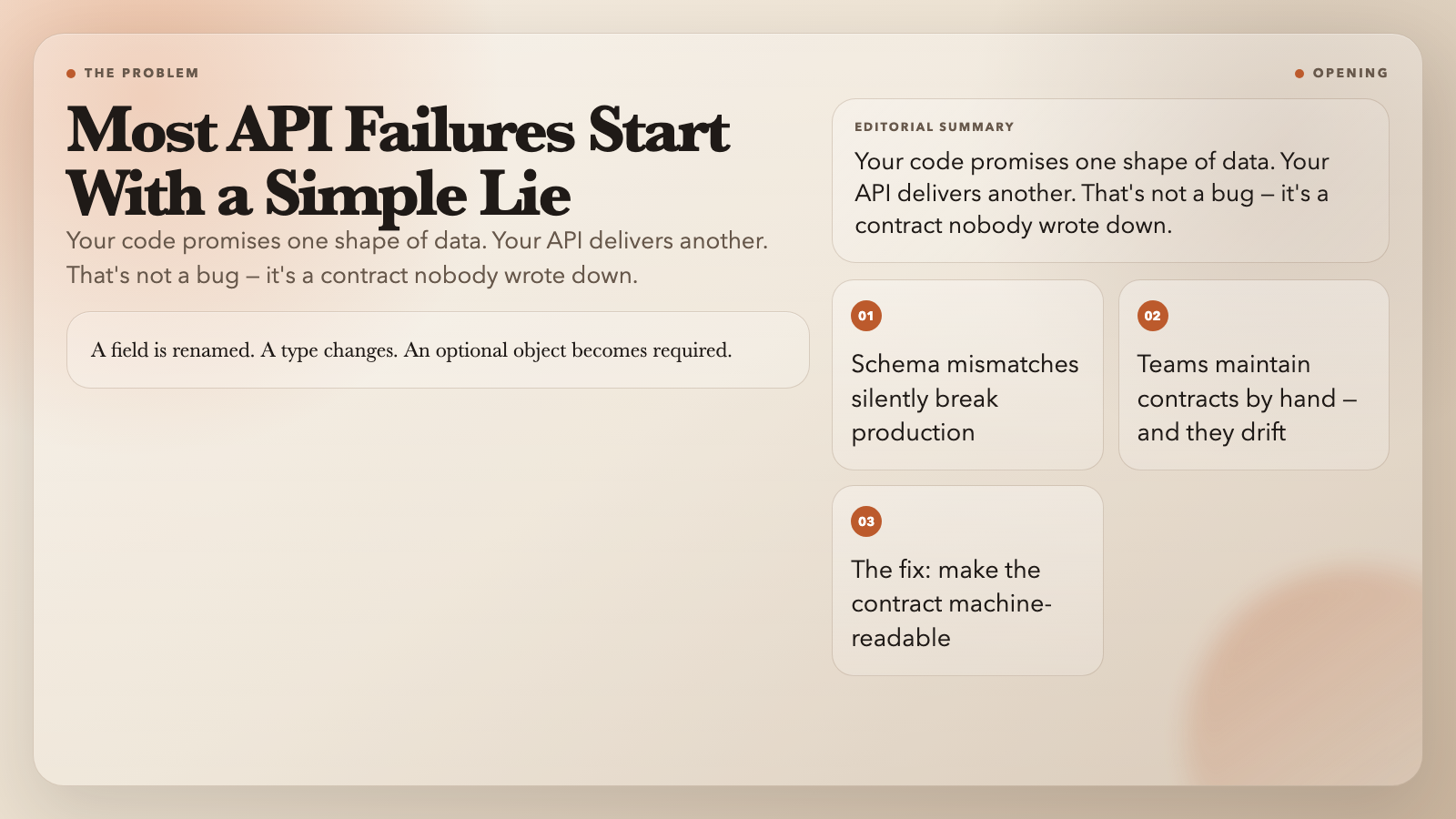
Most production API failures share one root cause: the data that arrives doesn’t match what the code expects. A field is renamed. A type changes. An optional object becomes required. The fix isn’t better testing — it’s making the contract between producer and consumer machine-readable from the start.
These eight tools build that contract pipeline: infer schemas from samples, validate data against them, convert schemas to type-safe code, and catch breaking changes before they reach production.
#
1. JSON Schema Generator — Build a Schema From Your Data
Most developers write JSON Schema by hand, referencing the spec, guessing at syntax. That’s backward.
JSON Schema Generator infers a schema from any sample JSON payload. Paste in an API response from your staging environment, and it generates a complete, draft-7 compliant schema with inferred types, formats, required fields, and enum candidates.
The real value: you get a starting point that reflects what your data actually looks like, not what you think it looks like. From there you can tighten constraints, add descriptions, and lock down optional fields. The tool also lets you merge manual edits on top of the inferred schema, so you can refine without losing your changes.
This is the entry point to the rest of the pipeline. No schema, nothing to validate.
#
2. JSON Schema Validator — Stop Bad Data Before It Reaches Your Users
You have a schema. Now enforce it.
JSON Schema Validator takes any JSON payload and a JSON Schema (draft-4 through draft-2020-12), runs the AJV validator engine, and returns a clear list of every violation: which field failed, what the rule was, and what value broke it. It runs `allErrors: true` by default — you see every problem in a single pass, not just the first one.
This is the gatekeeper you drop into any workflow where data crosses a trust boundary: API request validation, webhook processing, ETL pipelines, test assertions. One line of schema, and you’re no longer guessing whether the payload matches your expectations.
#
3. JSON Schema to Zod Schema Converter — From Static Validation to Runtime Safety
JSON Schema validates structure. Zod validates structure and infers TypeScript types at runtime. They’re not competitors — Zod consumes JSON Schema and produces a Zod schema with full type inference.
JSON Schema to Zod Schema Converter bridges this gap. Feed it a JSON Schema (or YAML), choose your naming style (camelCase, PascalCase, original), and it generates a complete Zod schema you can paste directly into a TypeScript project. It handles nested objects, arrays, enums, optional fields, and custom formats — without manual translation.
The output is production-ready. Paste it into your project and your tests get stricter validation AND your editor gets auto-complete. When the schema changes, regenerate and the types update everywhere.
Try JSON Schema to Zod Schema Converter →
#
4. OpenAPI to TypeScript Generator — Your API Contract, in Your Type System
OpenAPI specs define what your API does. TypeScript types define what your code expects. For too long, developers maintained both by hand — and they drifted apart, silently.
OpenAPI to TypeScript Generator takes an OpenAPI 3.x specification and generates complete TypeScript type definitions: request parameters, response bodies, all of it. It supports both `interface` and `type` declaration styles, flat or namespaced output, and multi-language labels if you’re documenting the schema itself.
Paste the output into your API client. When the OpenAPI spec and your code don’t match, the TypeScript compiler catches it before deployment — not after a client files a bug report.
Try OpenAPI to TypeScript Generator →
#
5. API Request Code Snippet Generator — Stop Hand-Copying cURL Commands
You have an API. You need to test it. You open Postman, fill in the fields, click Send, copy the cURL command into Slack, and someone else rebuilds it in their language of choice — badly.
API Request Code Snippet Generator skips the middlemen. Give it a URL, HTTP method, headers, query parameters, and request body. It generates ready-to-use cURL commands, Python `requests`, JavaScript `fetch`, and PHP code simultaneously. Copy the one you need.
For teams that document APIs or build SDKs, this is a friction reducer. You write the request once, in a structured form, and get production-quality code in every language.
Try API Request Code Snippet Generator →
#
6. OpenAPI Diff / Breaking Changes Detector — Catch Schema Drift Before It Breaks Production
Your API evolves. So does your OpenAPI spec. The problem: when the spec changes in ways that break existing clients — removing a field, changing a type, tightening an enum — nobody notices until a client breaks.
OpenAPI Diff Breach Detector compares two OpenAPI schemas (old vs. new) and flags every breaking change with severity ratings (high, medium, low), field locations, and impact descriptions. It supports both OpenAPI and GraphQL schemas, and can include a client impact analysis that tells you which endpoints and response fields are affected.
The workflow: run this in CI before merging any schema change. If it flags a high-severity change, you know before deployment — not after.
Try OpenAPI Diff Breach Detector →
#
7. API Response Contract Validator — Make Sure Your Backend Keeps Its Promises
Your OpenAPI spec says the `/users` endpoint returns a `user` object with a `createdAt` ISO8601 timestamp. But someone merged a refactor that changed it to a Unix epoch integer. Clients are now crashing.
API Response Contract Validator is a runtime哨兵 — it validates that your actual API responses match the schema declared in your OpenAPI spec. You feed it a live response and the OpenAPI spec, and it tells you exactly where the response deviates from the contract: missing fields, wrong types, unexpected additions.
This runs in integration tests, in staging environments, or as a monitoring check against production traffic. It’s the difference between discovering a broken contract in a user report and catching it in your test suite.
Try API Response Contract Validator →
#
8. JSONPath Query Tool — Extract What You Need From Complex Payloads
You have a 50KB JSON response. You need three fields nested twelve levels deep. You could write throwaway code that breaks when the structure changes — or you could write a JSONPath expression and get the result instantly.
JSONPath Query Tool runs JSONPath queries against any JSON document in your browser. It supports wildcards, filters, recursive descent, and function expressions. Save query templates, switch between JSON/table/markdown output, and preview results before embedding the expression into production code.
For debugging, data extraction, and building transformation pipelines, this is the most direct way to pull structured data out of complex documents.
#
The Pipeline, Assembled
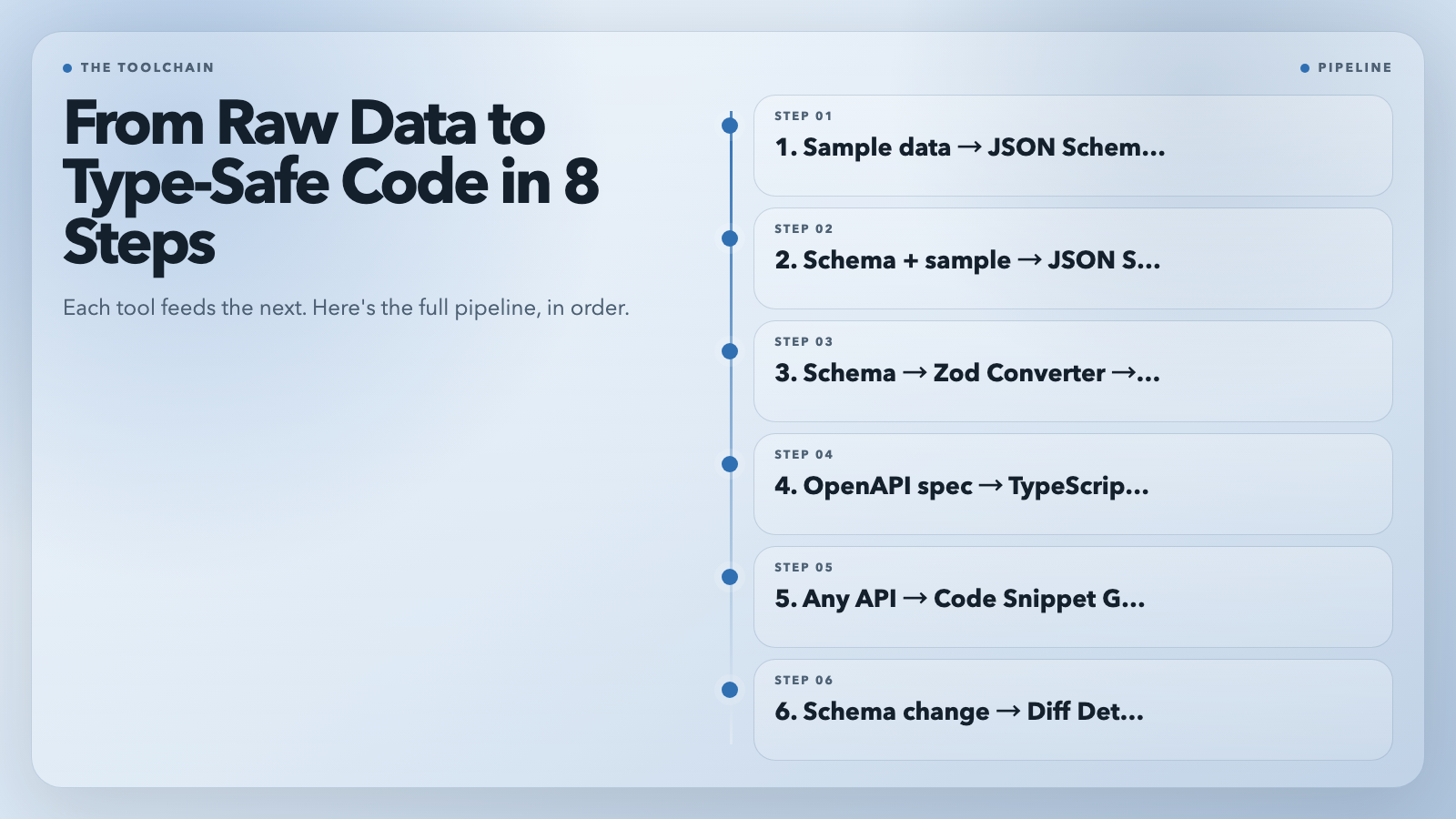
Here’s how these eight tools connect:
1. Sample data → JSON Schema Generator → inferred schema 2. Schema + sample → JSON Schema Validator → enforced validation 3. Schema → JSON Schema to Zod Schema Converter → type-safe runtime validation 4. OpenAPI spec → OpenAPI to TypeScript Generator → client-side types 5. Any API call → API Request Code Snippet Generator → tested code 6. Schema change → OpenAPI Diff Breach Detector → caught before deployment 7. Live response → API Response Contract Validator → runtime guarantee 8. Complex JSON → JSONPath Query Tool → targeted extraction
None of these require an account, a credit card, or a complex setup. Each runs in a browser tab, takes seconds, and produces output you can use immediately.
The real problem these tools solve isn’t technical — it’s organizational. Schema contracts are a communication agreement between the team that builds an API and the team that consumes it. These tools make that agreement explicit, enforceable, and impossible to ignore.
The pipeline pays off the moment someone makes a change. Run JSON Schema Generator on your next payload. You’ll know in 30 seconds whether your schema is holding up.