
Card numbers travel everywhere. They cross payment gateways, sign-up forms, reconciliation pipelines, fraud screens, and ETL jobs that never get a human’s eyes. Most teams treat validation as algorithm: luhn plus a network prefix table — and miss the cases that actually matter: stripped digits, ambiguous issuers, partial PANs, and UnionPay co-branded BINs that don’t fit Western list assumptions. A small credit card validator that runs entirely in the browser and returns not just valid / invalid but also card type, length, and checksum status lands somewhere between “throwaway regex” and “PSP webhook” — and that gap is where most lookup-table mistakes happen.
This article walks through the logic a generic credit card validator actually performs, why issuer identification is harder than the public BIN lists suggest, and how to wire the free, in-browser tool at Elysia Tools’ Credit Card Validator into a one-off check workflow without exposing cardholder data to a server.
What a Credit Card Validator Should Actually Return
A credit card number is structurally simple. Sixteen or so digits (13–19 depending on issuer), the first 6 of which are the Issuer Identification Number (IIN/BIN), the last digit of which is a Luhn check sum, and the rest is the account identifier. So a credit card validator should at minimum surface four pieces of information — and only four:
- Pass / fail on the Luhn checksum — a mod-10 algorithm that catches any single-digit transcription error and most adjacent transpositions.
- Card type / scheme — which network the IIN maps to (Visa, MasterCard, Amex, Discover, JCB, UnionPay, Diners, Maestro).
- Length sanity — Amex is 15, Diners is 14, Visa/MasterCard/Discover are 16 (with 13/19 expansions), UnionPay is 16–19. A 14-digit “Amex” should fail before checksum.
- Brand-level sanity — a card claiming to be Visa should start with
4, MasterCard with51–55or2221–2720, etc.
Anything beyond that — name check, CVV match, address verification, 3-D Secure enrollment — is a payment authorization call, not a “validation” tool’s job. A clean separation here is what makes the cheap, runnable pattern viable.
The Luhn Checksum in 30 Seconds
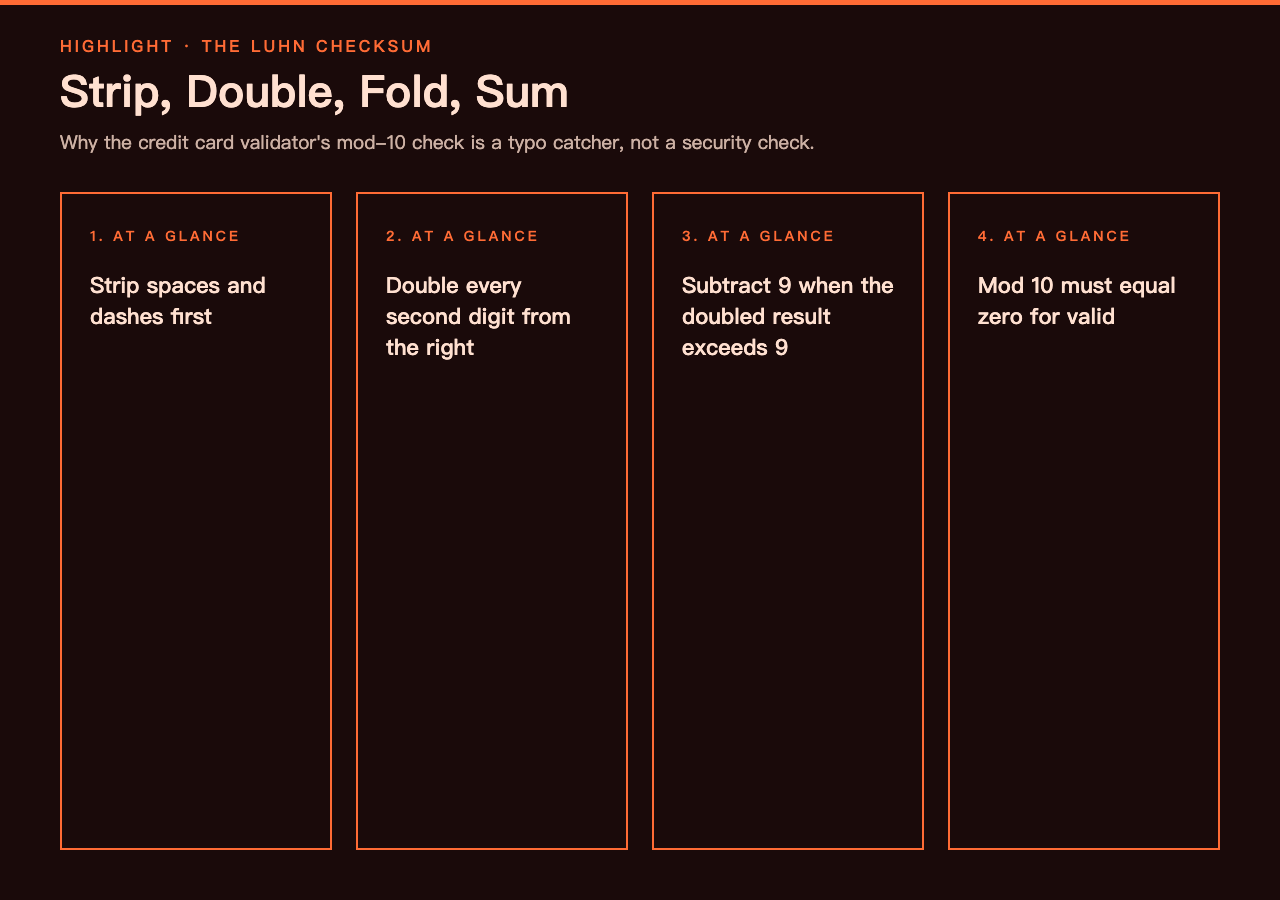
The Luhn algorithm doubles every second digit from the right (or every first digit from the right, depending on convention), folds any result above 9 back to a single digit by subtracting 9, and checks whether the total mod 10 equals 0. Concretely, for the input 4111 1111 1111 1111:
digits:           4 1 1 1  1 1 1 1  1 1 1 1  1 1 1 1
double-from-right: 4 2 1 2  1 2 1 2  1 2 1 2  1 2 1 2
folded:           4 2 1 2  1 2 1 2  1 2 1 2  1 2 1 2
sum:                                       30
30 mod 10 = 0  →  valid
The 4111…1111 pattern is the canonical “Visa test card” because it walks through the algorithm cleanly and the IIN 411111 is a Visa test BIN that will never appear in production cardholder data. Worth remembering: Luhn is only a checksum, not a security check. It is a typo-detector. A real adversary can trivially generate numbers that pass Luhn while routing to no real account. Anything beyond that requires a BIN range lookup against an authoritative source.
Why Issuer Identification Is Trickier Than It Looks
Pubic BIN tables list ranges like “Visa starts with 4” and “MasterCard starts with 51–55.” Both statements are correct and both are dangerously incomplete:
- Visa starts with
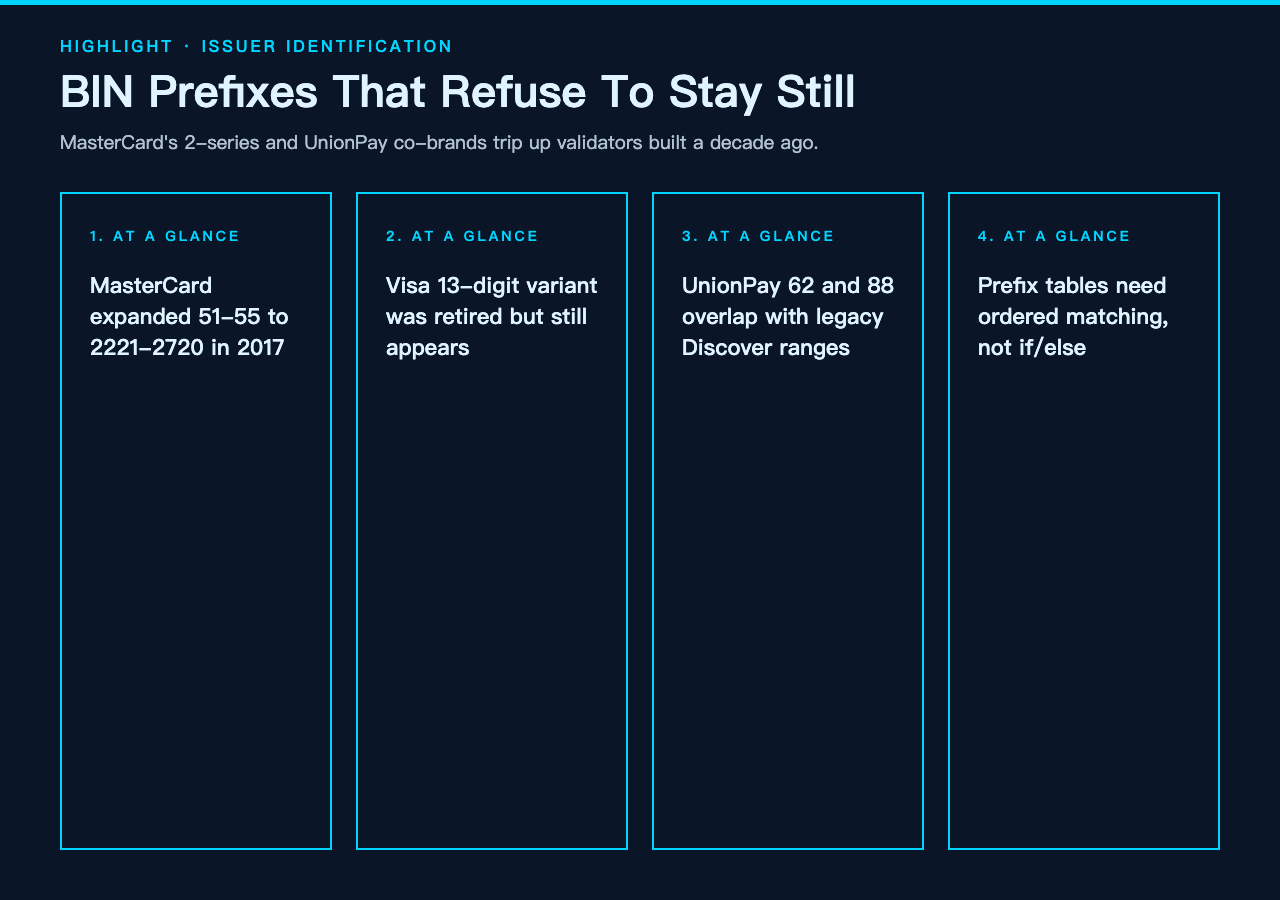
4— but the 13-digit variant (4XXXXXXXXXX?) was phased out in 2017 and is now rare in the wild; a 13-digit input flagged as “Visa” by an old validator is more often a typo or an internal tokenized PAN. - MasterCard was
51–55historically but expanded to2221–2720in 2017 to extend the BIN space. Validators that pre-date this update will label every MasterCard 2-series card as “unknown.” - Amex is always 15 digits and starts with
34or37. A 16-digit Amex is impossible — flag it as malformed, not as some exotic variant. - UnionPay is the world’s largest card network by volume but the smallest in Western tooling. Its BIN range (
62, often also88) overlaps with Discover in some legacy lists, and UnionPay co-branded cards carry a Visa or MasterCard prefix with a UnionPay sub-suffix — which any naive prefix-based validator will mislabel as Western.
A practical credit card validator therefore needs an ordered prefix table — not a chain of if/else. Visa’s 4 has to match before UnionPay’s 62 in the rare case of a co-branded card. The browser-side tool at Elysia Tools’ Credit Card Validator bakes in these ranges plus the 2-series MasterCard expansion, so the call lands on the right network without a refresher.
Length and Format Pre-checks (the Cheap Wins)
Before checksum, do length and digit-only checks. These reject ninety percent of obviously broken input without exercising any heavy logic:
// Browser-side: drop spaces and dashes, then length-check
const digits = input.replace(/[^d]/g, "");
if (digits.length < 13 || digits.length > 19) return invalid_length;

// Reject early if not pure digits after stripping
if (!/^d+$/.test(digits)) return invalid_format;
This catches the common pitfalls: 4111-1111-1111-1111 (dashes), 4111 1111 1111 1111 (spaces), 4111111111111111a (typo), and the impossible-input case where someone pasted a phone number into the card field. Doing this strip-and-check before Luhn means a 20-digit input gets rejected before it runs through the mod-10 loop — and before it ties up a worker thread if the validation is server-side.
A Walk-through: Three Real Inputs
Three inputs, three outcomes, each illustrating a different category of failure:
4111-1111-1111-1111— strip dashes → 16 digits → Luhn valid → IIN411111is Visa → “Visa, valid.” This is the textbook pass: an honest test card, well-formed, network correctly identified.5500 0000 0000 0004— strip spaces → 16 digits → Luhn valid → IIN550000is MasterCard 51–55 series → “MasterCard, valid.” Also a famous test card (MasterCard’s official test BIN).6011 0000 9901 0015— strip spaces → 16 digits → Luhn valid → IIN601100is Discover (Discover starts6011,644–649,65) → “Discover, valid.” Note that6011is also commonly seen in a Discover test BIN context.
The shared property of all three: they pass Luhn, fall inside a real IIN range, and have known length. None of them corresponds to a live cardholder account because they are public test PANs. This is exactly what a one-off credit card validator should accept and precisely what it should not treat as proof of an authorized payment.
Where a Browser-Side Validator Earns Its Keep
Because the whole check is digits + prefix table + Luhn, it runs entirely client-side with no API call, no server log, no PII transit. That opens a few useful workflows:
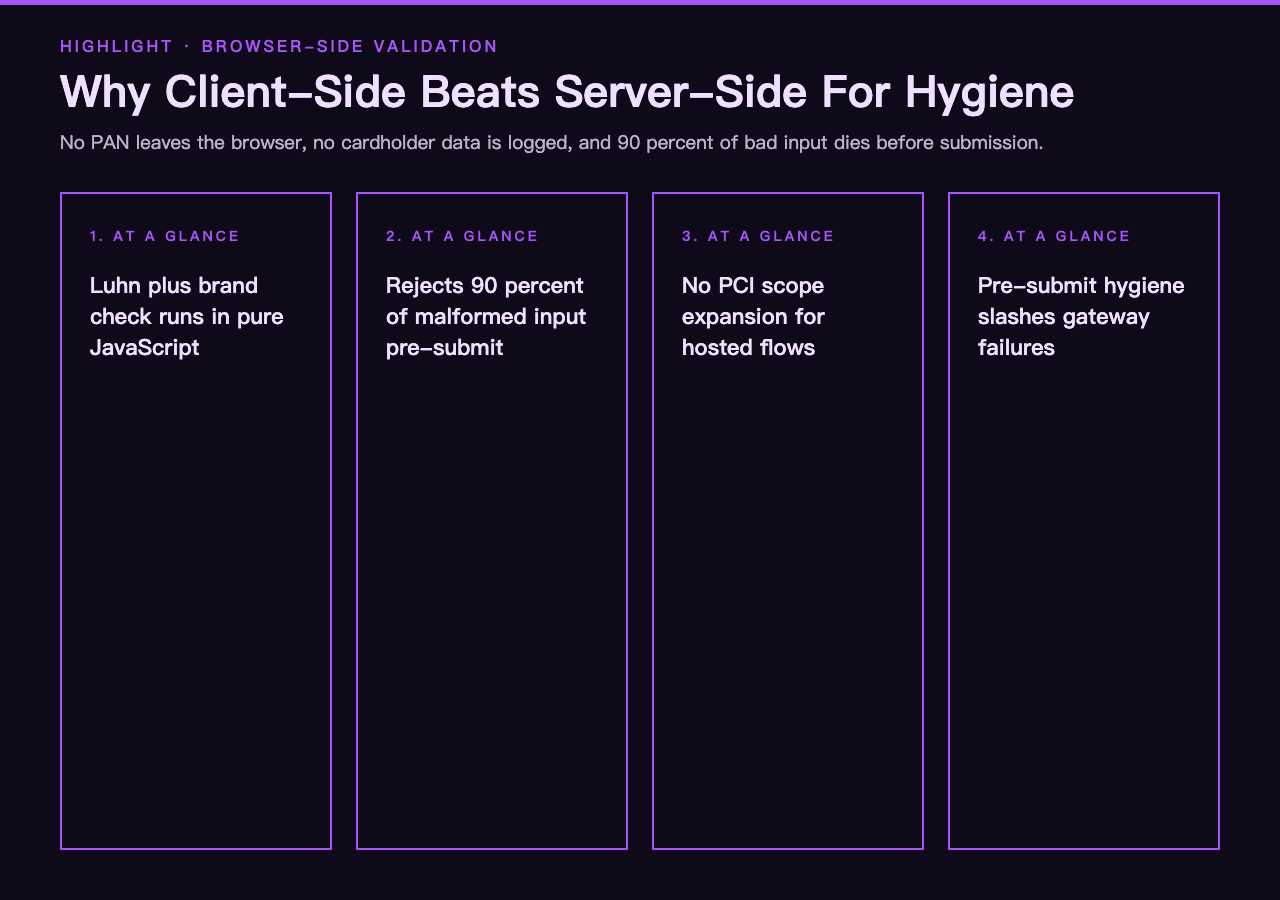
- Form pre-submit hygiene. A React/Angular/Svelte form that does the Luhn + brand check before submit cuts payment-failure rates from “random typo” to “real-time machine-readable error.” The customer types
4222 2222 2222 2222and you flag the typo before the gateway round-trip. - QA fixture sanity. A QA engineer pasting test PANs into a staging sandbox wants a sanity pass that says “yep, this is a valid Visa test BIN” before the test suite runs.
- Manual look-up. Customer support reads a card number off a fax or PDF, wants to confirm it’s at least the right network before reading it back: “I’m seeing a Visa — let me double-check that.”
The Elysia Tools Credit Card Validator serves all three use cases without ever writing a card number to disk or a log — useful when you’re handling a number you shouldn’t be persisting.
What the Validator Is Not For
A few things the lightweight validator is structurally not designed to do, and that you shouldn’t try to bolt on:
- Authorization. Issuing an auth hold requires a PSP / acquirer / scheme tokenization round-trip. The validator cannot tell you whether the card is funded or whether the customer owns it.
- CVV validation. The CVV2 is intentionally not derivable from the PAN. You need a payment form for that.
- Cross-region coverage checks. Some networks are regional (JCB is Japan-heavy, UnionPay is China-heavy). A “this card claims to be JCB” check is structural, not behavioral — a JCB BIN can appear anywhere if the card was issued under a global program.
- PCI scope reduction by itself. Running a validator client-side doesn’t let you claim out-of-scope PCI compliance. The validator is a sandboxed hygiene tool, not a substitute for the full PCI-DSS posture.
Treat it as a structural gate. Anything that requires real-world state — funds, identity, fraud, chargebacks — goes through the payment processor.
Putting It Together
A modern credit card validator’s value isn’t that Luhn is hard (it is thirty lines of JavaScript) but that the prefix table is up to date and the length checks happen in the right order. The free validator at Elysia Tools implements both cleanly, runs entirely in the browser, and returns brand + length + checksum in one pass. For sample card numbers that you can paste straight in to see each branch of the logic in action, browse the credit card sample collection, the global phone sample data for nearby validation patterns, and the text-with-sensitive-data fixtures for full PAN-in-text scenarios. For more one-off validators and a full list of in-browser tools, visit elysiatools.com.

Your blog post was fantastic. Thanks for the great content. You may wish to check out a great credit building workbook at: https://voti1.com/The-48-Hour-Credit-Reset-Workbook