Most teams discover an old credential in the worst possible way: during an outage, a security review, or a rushed handoff between engineers. The secret is sitting in a familiar .env file, surrounded by harmless ports and feature flags, so it looks like configuration. Operationally, however, it is a queue of future security work.
The hard part is not spotting that a value looks sensitive. The hard part is deciding what happens next without breaking every service that consumes it. A database URL may need a dual-key overlap. A payment key may require a provider-side cutover. A JWT secret can have a blast radius that is invisible from the line where it is defined. Rotation is a systems problem disguised as text editing.
The inventory is already hiding in the file
Start with an inventory pass, not a calendar. The Env File Secret Rotation Planner reads a pasted .env and looks for families that commonly carry operational risk: database URLs, API keys, authentication tokens, private keys, cloud credentials, payment keys, and encryption secrets. It also separates those findings from non-secret configuration such as hosts, ports, and feature flags.
That distinction matters because a flat list creates false urgency. If every line is labelled “secret,” teams either rotate everything at once or ignore the list entirely. A useful inventory gives each item a type, an exposure signal, an age signal, and a reason for its place in the queue. In other words, it turns a blob of configuration into a set of decisions that can be reviewed.
For a realistic test, use the tool’s documented mixed example: a database URL, a Stripe live key, a JWT secret, a GitHub token, and ordinary non-secret settings on a 90-day cadence. The result is more useful than a generic warning because it shows how different credentials can share a file while demanding different treatment.
Age is a risk signal, not the whole policy
Rotation schedules often fail in one of two directions. A team picks a universal 30-day deadline and creates needless churn, or it picks 365 days and forgets that exposure can change long before the date arrives. The planner supports 30-, 90-, 180-, and 365-day cadences so the schedule can reflect the environment instead of pretending every value has the same lifecycle.
Age should be combined with exposure. A credential committed to a private repository is not automatically safe; a token copied into a build log may be more urgent than an older value that has stayed inside a controlled secret manager. A production payment key and a local development token should not receive the same priority simply because they were created on the same day.
This is where a dated inventory becomes operationally valuable. “Rotate the secrets” is a vague task. “Rotate the payment credential this week, confirm the consumer list, and retain the old value only through the verification window” is a sequence someone can execute and audit.
Week one: classify before you touch production
The first week should produce clarity, not outages. Confirm which values are genuinely secret, where each one is consumed, who owns the integration, and whether the provider supports overlapping credentials. Record the last-rotated date when it is known; for unknown dates, mark the uncertainty rather than inventing precision.
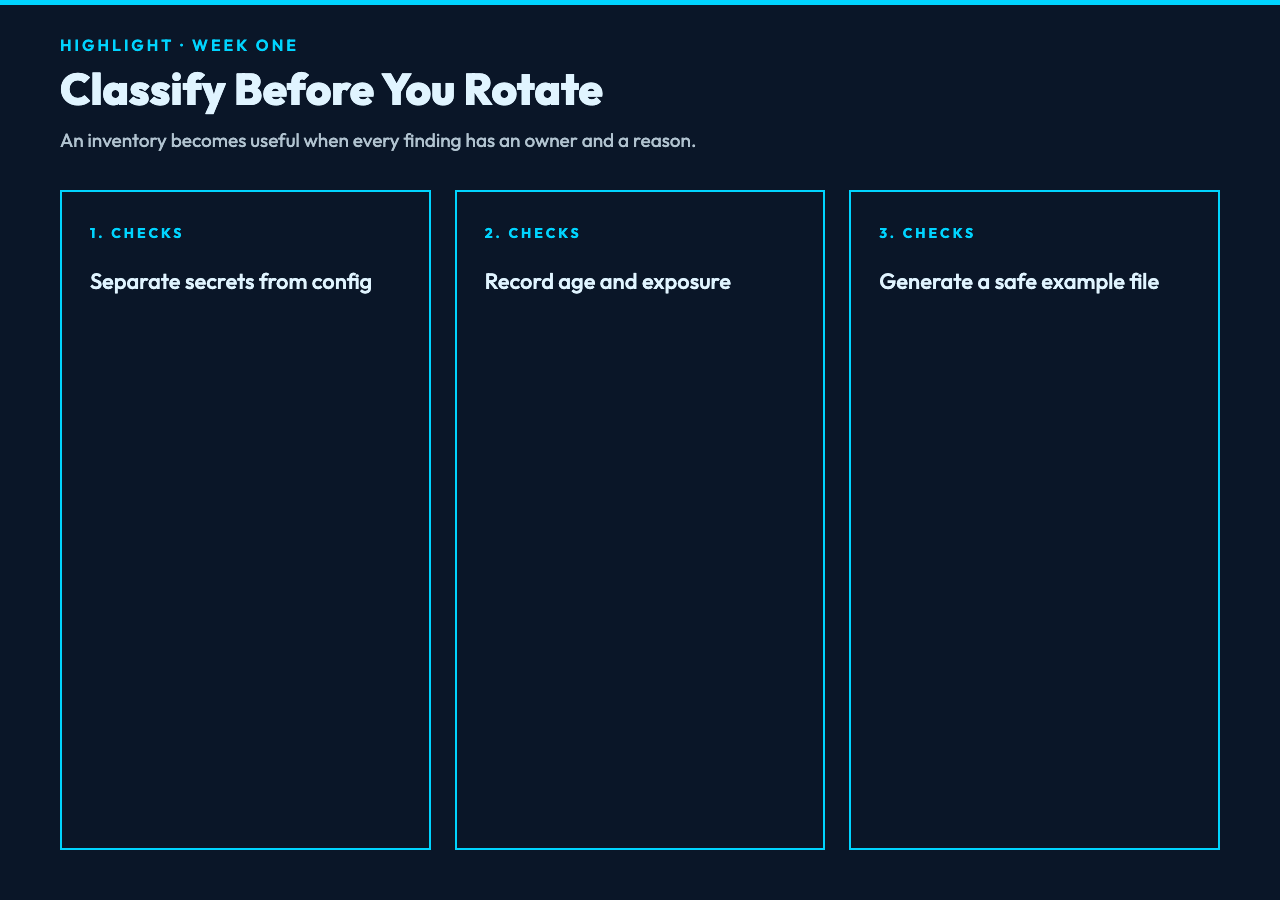
Keep the source file readable during this phase. A generated .env.example is helpful because it preserves the shape of the configuration without carrying live values. It gives developers a safe contract for required names while the actual secrets move into the deployment or secret-management path that owns them.
Do not confuse detection with proof of compromise. A string that resembles an API key deserves review; it does not prove that the key is active, exposed, or still used. The planner is a triage and scheduling aid. Provider dashboards, repository history, CI logs, and application configuration remain the places to confirm scope.
Week two: design the handoff, not just the replacement
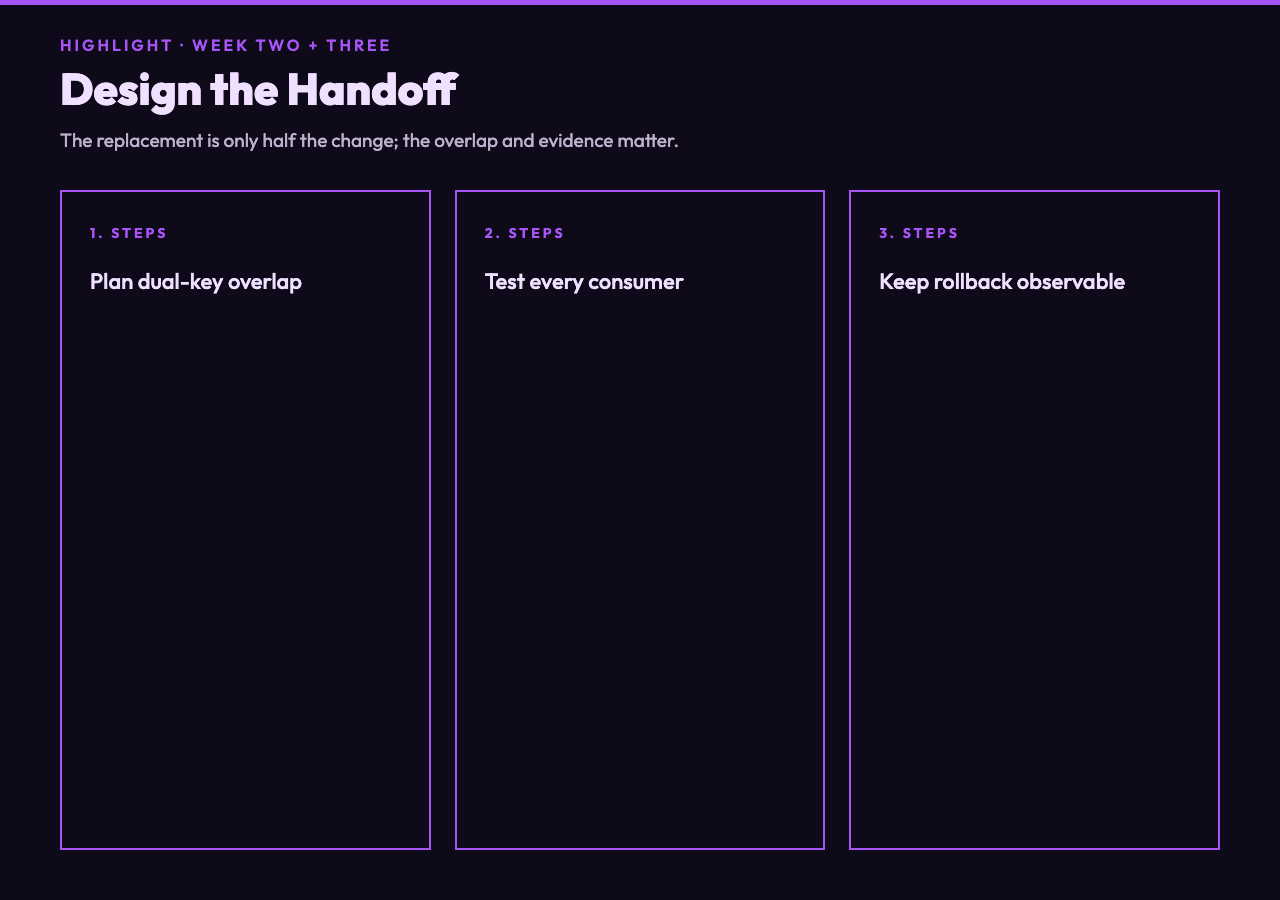
A rotation is a handoff between an old value and a new value. If the consumer cannot accept both during a short overlap, the change becomes a coordinated outage. The planner’s dual-key checklist is a reminder to answer the questions that are easy to skip: where is the new value introduced, when do consumers reload it, how is the old value revoked, and what signal proves the cutover worked?
For a database URL, the work may involve a connection pool restart and a rollback plan. For a webhook secret, it may mean accepting two signatures briefly while the sender is updated. For a cloud credential, it may mean creating a replacement with the same least-privilege scope, deploying it, checking access logs, then disabling the original. The line in .env is only the last visible step.
Use the environment-variable samples as a safe way to think about configuration shapes: which names are required, which values are placeholders, and which settings belong in an example file rather than a live one. The goal is to make the replacement predictable before it reaches production.
Week three: rotate with evidence
During the third week, change one ownership group or application boundary at a time. Capture the before-and-after status: the new credential was accepted, the expected request succeeded, error rates stayed within the normal range, and the old credential has not been needed for rollback longer than planned.
Evidence also makes the security conversation more precise. If a token is used by three services, a successful smoke test in one service is not enough. If a credential has no known consumer, do not leave it active merely because nobody has complained. Search deployment manifests, CI variables, scheduled jobs, and service configuration before deciding whether to revoke or quarantine it.
When secrets management is part of the architecture, a reference such as the Vault samples can help frame the difference between storing a value and operating a lifecycle around it. The important idea is not a particular vendor. It is that access control, rotation, auditability, and recovery are separate responsibilities that should be visible in the design.
Week four: revoke, document, and lower the next cost
The final week closes the loop. Revoke the old credential when the verification window ends, remove stale copies from local files and CI settings, and update the last-rotated record. If revocation is delayed, record the reason and a new date; an exception is safer when it is explicit than when it disappears into a chat thread.
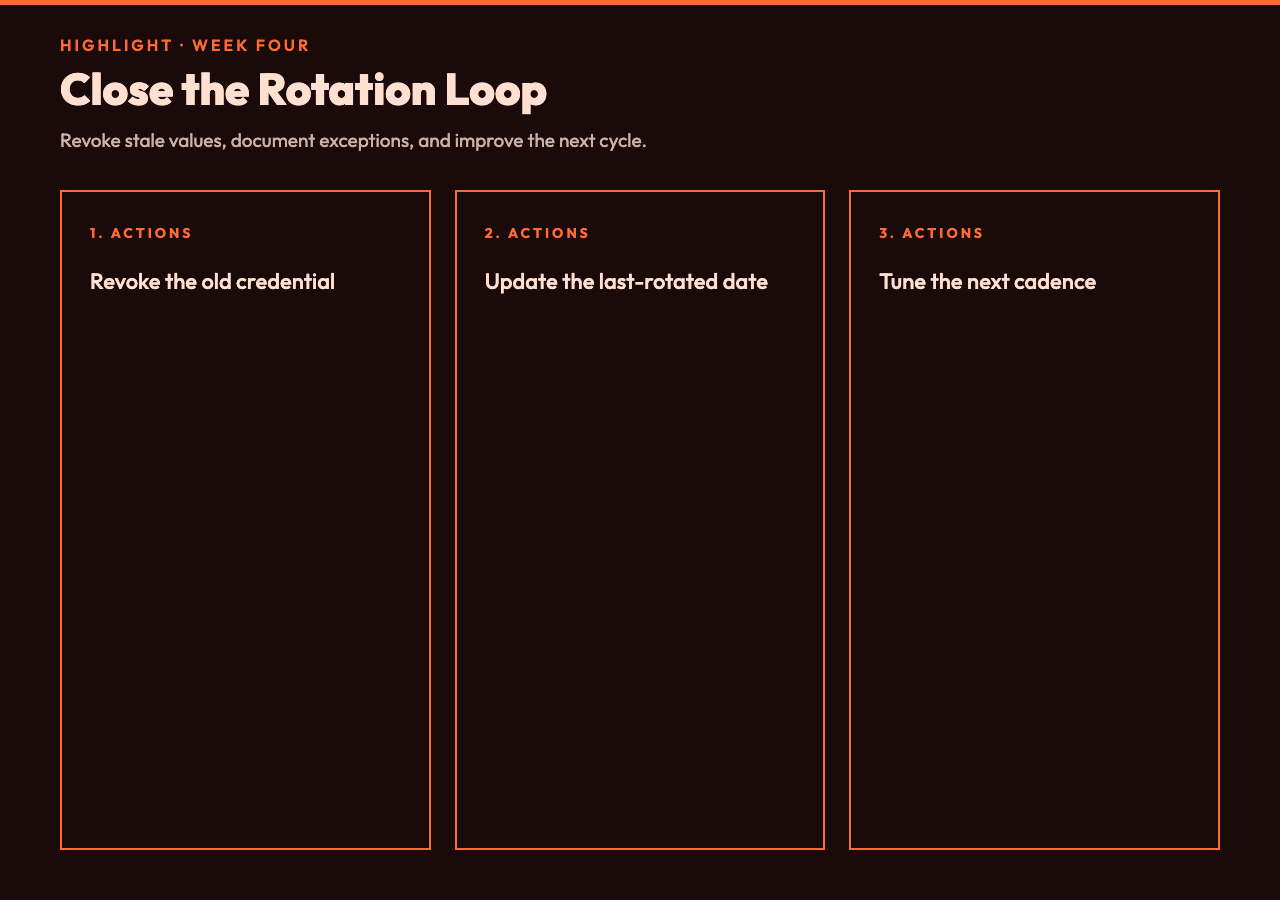
Then review the plan itself. Did the detector confuse a non-secret with a credential? Did an owner discover an undocumented consumer? Did a provider make dual-key rotation impossible? Those answers should change the next cadence or checklist. A rotation system improves when every cycle removes one piece of uncertainty.
The planner’s clean-file example is a useful negative control: a file containing only ports, hosts, and feature flags should produce zero secrets and an on-schedule health result. That is not a trivial case. It confirms that the process can distinguish “nothing to rotate” from “we forgot to look.”
The practical rule: make secrets boring before they become urgent
A secret rotation program is healthy when the work is visible before it is dramatic. The inventory tells you what exists. The cadence tells you when to revisit it. The dual-key checklist protects availability. The generated example file keeps documentation useful without copying live values.
Use the planner as a first pass, then validate its findings against repository history, deployment configuration, provider dashboards, and access logs. For teams exploring stronger secret-management patterns, the Vault sample hub is a relevant next reference. The tool can organize the queue; only the team can confirm ownership and safely execute the handoff.
The point is not to make rotation feel ceremonial. It is to make the next change predictable enough that nobody has to choose between security and uptime under pressure. A useful .env workflow names the secret, records its age, identifies the consumers, and rehearses the handoff before the old value is revoked. The Env File Secret Rotation Planner turns that inventory into a staged queue, but the durable habit is yours: treat configuration as a living dependency graph, not a text file that only matters when production breaks. Rotate the secret while the system is calm, and the incident you prevent may never become a ticket.