The Phone Number Is Not a String: A Global Validator Field Guide
A phone number can be syntactically neat, visually familiar, and still be the wrong number. The problem is that a phone field usually carries three different jobs at once: it must identify a country, preserve a dialable value, and remain readable to a human. Those jobs are related, but they are not interchangeable. Global Phone Validator is built for that boundary: validate phone numbers from multiple countries, return detailed formatting, and expose carrier information instead of treating every input as an opaque string.
This matters anywhere a list crosses borders. A CRM import may contain +1 415 555 0138, 020 7946 0958, and 13800138000 in the same column. A regular expression can tell you that each value contains plausible characters. It cannot, by itself, know which numbering plan applies, whether the country code is present, or whether a local-looking number is meaningful in the workflow that received it.
Phone Numbers Have Two Jobs
The first job is identity. A number has to be interpreted under a numbering plan, which means the same digits can mean different things depending on country context. The second job is presentation. A support agent wants a readable local or national format; an API, import file, and messaging provider usually want a stable international representation.
Those jobs create a deceptively common data-model mistake: storing only the display string. The display string is useful for people, but it is a poor canonical key. Spaces, parentheses, hyphens, trunk prefixes, and local conventions can all change without changing the intended destination.
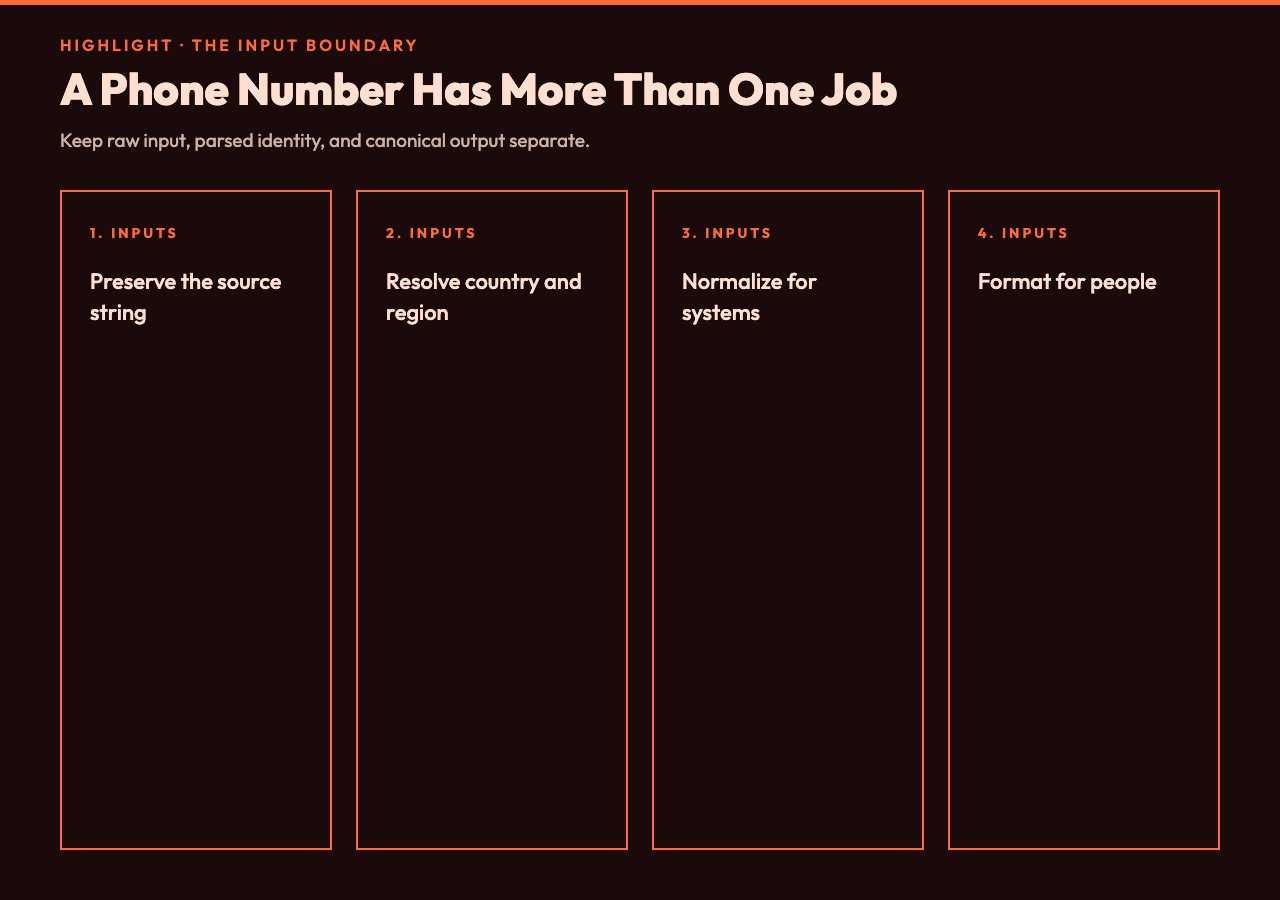
A safer mental model is to keep three layers separate:
- Raw input. Preserve what the user or source system supplied, including the original punctuation.
- Parsed identity. Resolve country, calling code, national number, and any relevant region assumptions.
- Canonical output. Store a normalized value for deduplication, routing, and downstream APIs, while generating a display format when needed.
That separation also makes errors explainable. “Invalid phone number” is not one failure. It could mean an unknown country, an impossible length, an unsupported prefix, a missing country context, or a value that is valid in one region but not the one the customer selected.
The E.164 Core, Without the False Promise
International phone workflows often use the E.164 shape as their canonical target: a plus sign followed by a country calling code and a national significant number, with a maximum of 15 digits. This is a useful storage and transport convention. It is not a promise that the number belongs to a subscriber, answers a call, or accepts messages.
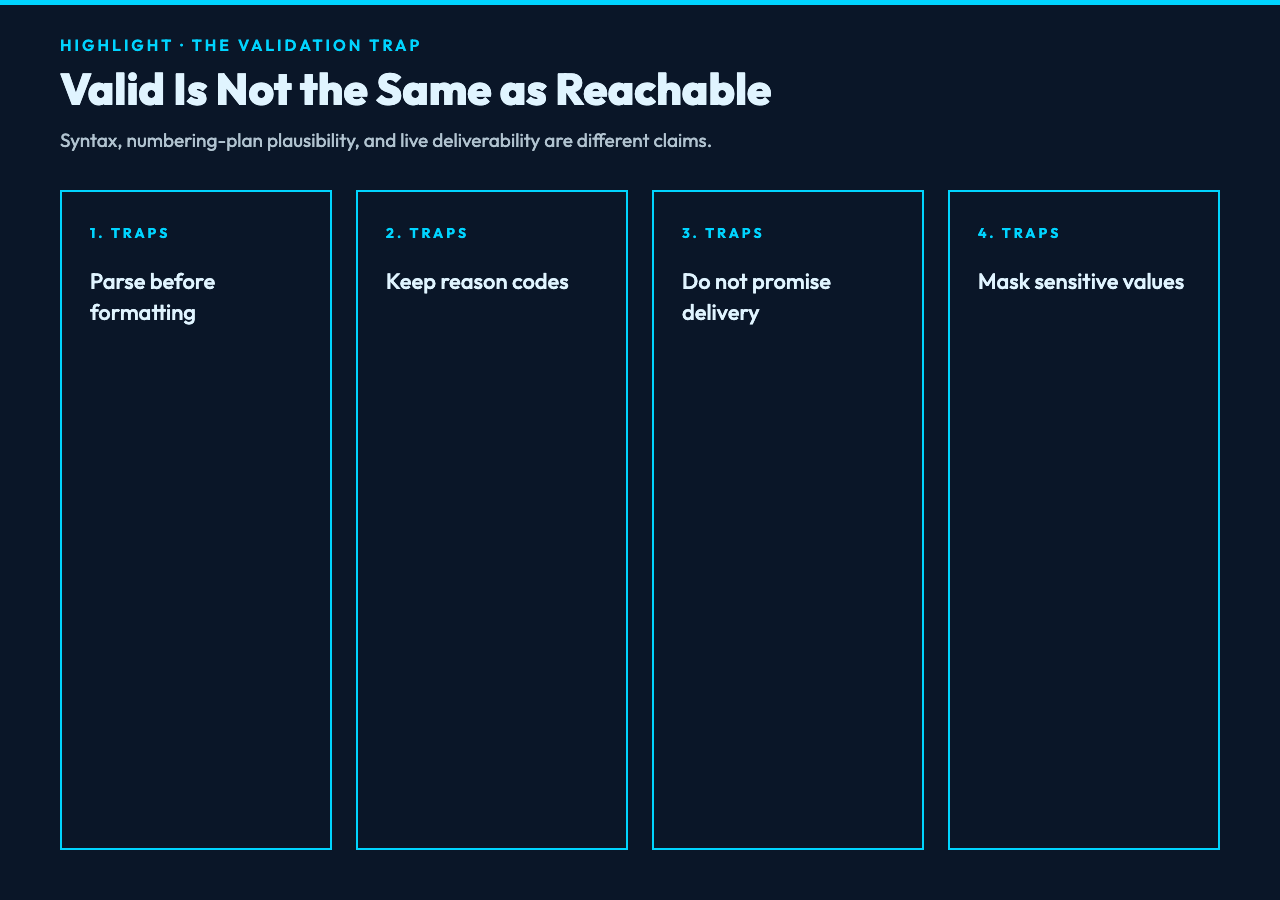
That distinction is the line between syntax checking and validation. A parser can normalize (415) 555-0138 to a country-qualified representation when it has the right context. A validator can then reject values that do not fit the numbering plan. Neither step should be described as live deliverability verification unless the workflow actually performs a call, message, or carrier lookup.
For test data, the manifest-backed Global Phone Number Samples collection is a more useful starting point than inventing a handful of familiar-looking values. Its description identifies it as a collection of numbers from various countries for validation testing. That gives a batch a deliberate spread across country formats instead of letting the United States pattern dominate every test.
When you need to test a parser before a validator, Phone Number Extractor Samples provides mixed text containing phone numbers from various countries. That is a different test shape: the number is not already isolated in a clean field. It lets you separate extraction errors from numbering-plan errors.
raw_value       = "Call us: +44 20 7946 0958"
extracted_value = "+44 20 7946 0958"
canonical_value = "<country-qualified representation>"
display_value   = "<human-readable regional format>"
Why Valid and Displayable Are Different
Formatting is not cosmetic when numbers travel between systems. A display format may include spaces for scanning, while a canonical format must avoid ambiguity. A local format may be perfect for a person in one country and useless to an international service that has no default region.
This is why a validator should return more than a Boolean whenever possible. A useful result can distinguish:
- Whether parsing succeeded.
- Which country or calling code was inferred.
- Which normalized value should be stored.
- Which display formats are safe to show.
- Whether the number is plausible under the selected plan.
- What carrier or network metadata is available.
The Phone Validator is a useful single-value comparison point when a workflow only needs international validation and formatting. The global variant is the better fit when the input set itself spans countries and you want to inspect how the interpretation changes across that set.
There is also a valuable distinction between formatting and normalization. The Phone Number Formatter focuses on turning numbers into standard formats with separators for different countries. That can improve a form or report without claiming that every value has passed a full validation workflow. In production, formatting is often a presentation step after parsing, not a substitute for parsing.
A Better Batch Workflow
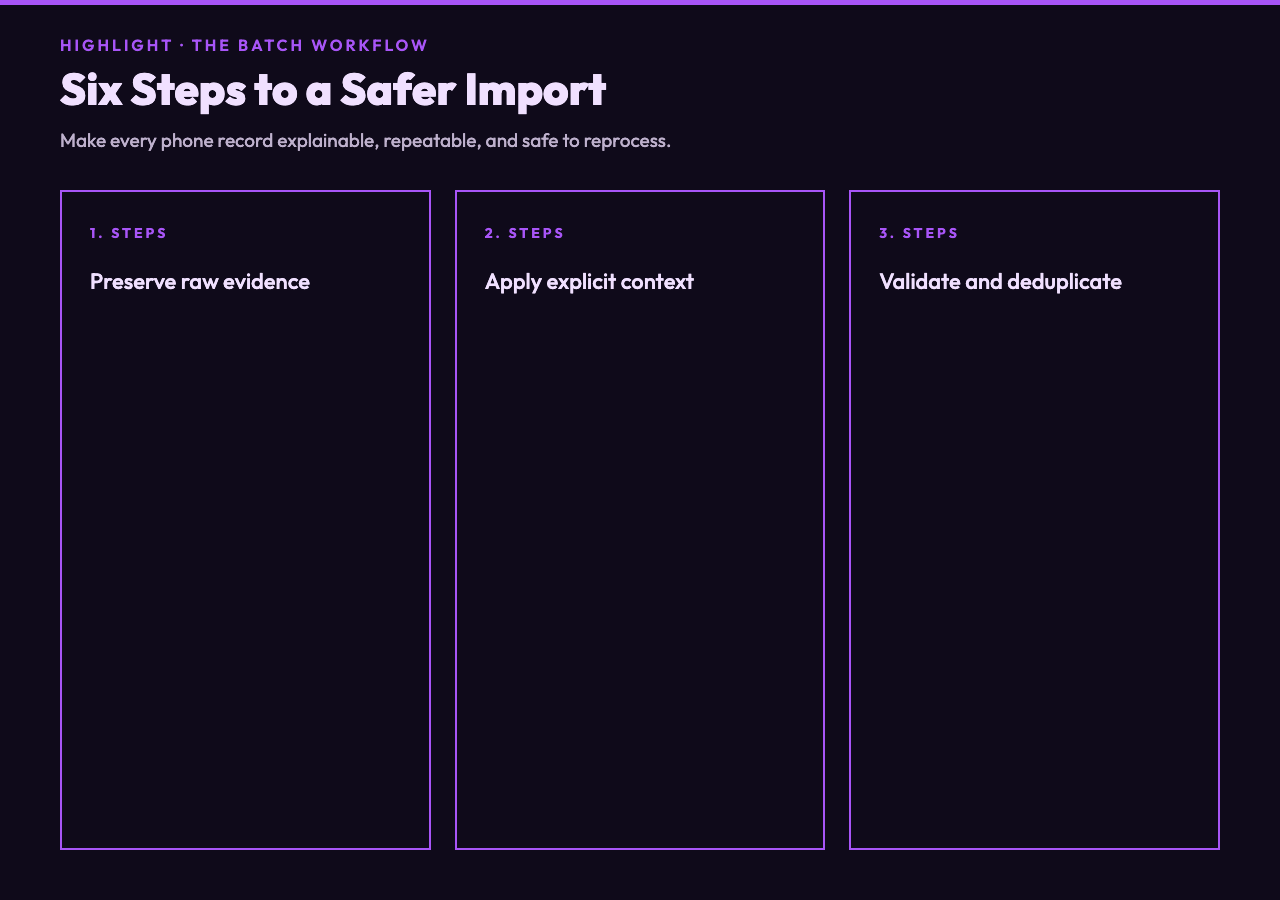
For a spreadsheet, CRM export, or signup backlog, process the data in stages rather than applying one large regular expression. The sequence below keeps the evidence needed for remediation:
- Preserve the source. Copy the original field into a raw column. Never overwrite evidence before the record is accepted.
- Clean transport noise. Remove accidental surrounding whitespace and normalize Unicode punctuation only when the source system has introduced it.
- Apply context. Use an explicit country or region field when one exists. Do not silently guess from a local number if a user-selected country is available.
- Parse before formatting. First decide what the digits mean; then produce a display format from the parsed result.
- Validate with reason codes. Keep a machine-readable reason such as missing country context, invalid length, or unsupported prefix.
- Deduplicate canonically. Compare normalized values, not the strings that users happened to type.
The workflow should be idempotent. Running it twice on an already normalized value should not add another prefix, remove meaningful digits, or switch the country interpretation. Idempotence is especially important when a nightly import and a user-edit flow share the same database column.
For records embedded in support tickets, notes, or logs, the Text with Sensitive Data Samples collection is a useful adjacent fixture. It is described as text containing sensitive data, including phone numbers, for extraction and redaction testing. It helps answer a question that clean CSV validation cannot: did the pipeline identify a phone number without exposing it in logs or copying it into the wrong field?
Five Failure Modes That Look Like Success
1. “It matches the regex.” A regex can enforce a rough shape, but it does not understand country-specific length, prefixes, or regional context. Use it as an early filter, not as the final verdict.
2. “It starts with a plus sign.” The plus sign signals an international-looking form. It does not prove that the calling code, national number, or remaining length is valid.
3. “The formatter made it pretty.” Pretty output can conceal a bad interpretation. Always retain the parse and validation result behind the display string.
4. “The number is valid, so it is reachable.” Numbering-plan validity and live reachability are different claims. Make the product language match the evidence your system actually collected.
5. “The local number is obvious.” In a cross-border workflow, an unqualified local number is ambiguous by design. Require a region, ask the user, or place the record in an explicit review queue.
What a Good Result Should Contain
A production-ready validation result should be useful to both software and people. For software, that means stable fields: accepted or rejected status, normalized value, country or region, reason code, and a confidence or metadata field when the underlying service supports one. For people, it means a message that explains what to fix without leaking more sensitive data than necessary.
It is also worth recording the validator version or ruleset date. Numbering plans change. A result that was correct last year may need re-evaluation after a new area code, carrier allocation, or regional rule appears. Keeping that provenance turns a mysterious future mismatch into an auditable data event.
Finally, treat phone numbers as personal data. Mask them in logs, restrict who can view raw input, and avoid putting complete values into analytics labels or error messages. The right validator improves data quality; it does not remove the need for careful handling.
The Practical Takeaway
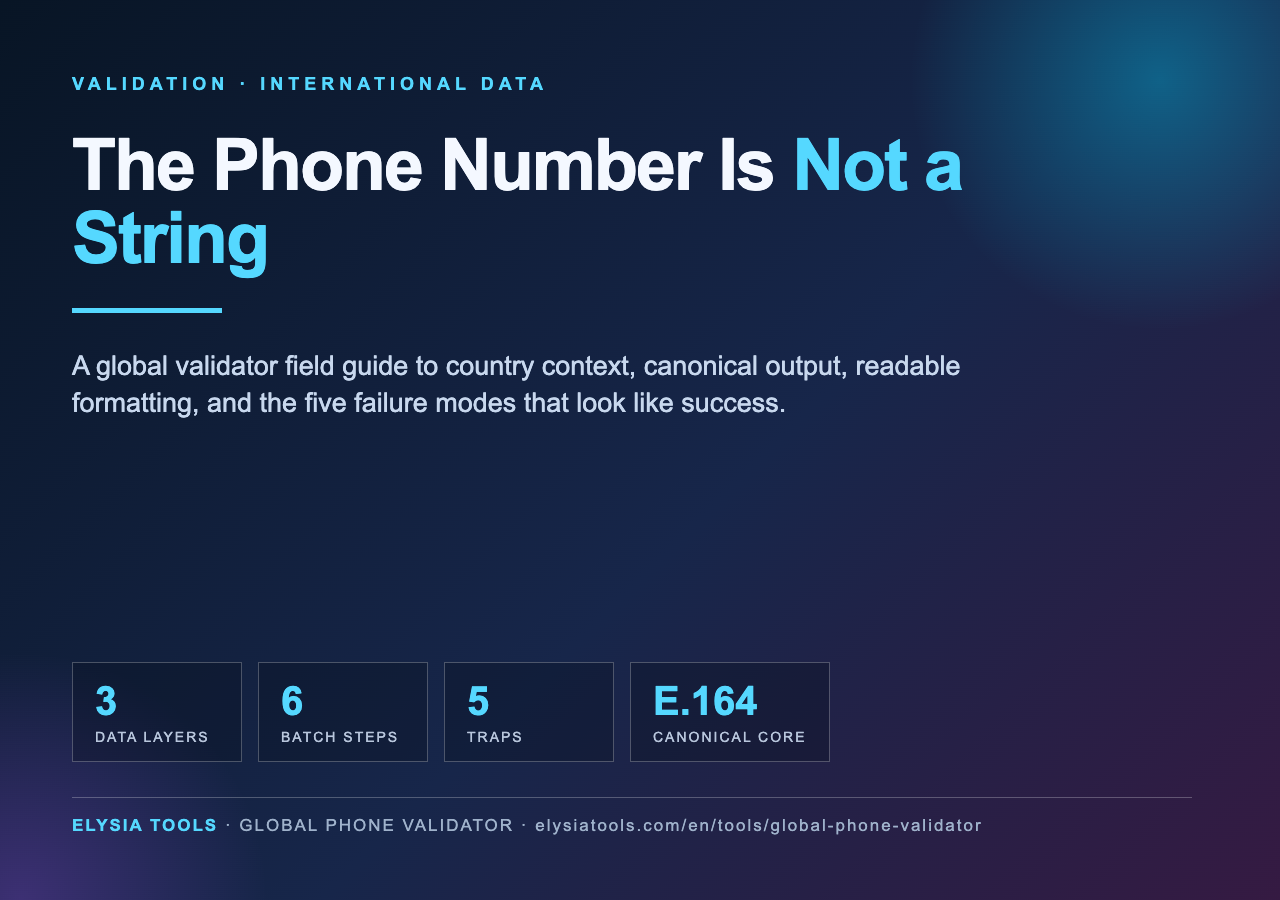
A phone number is simultaneously a country-specific identifier, a transport value, and a human-facing label. A reliable workflow keeps those roles separate, validates against the right numbering plan, and preserves enough detail to explain failures. Start with real multi-country fixtures, distinguish extraction from interpretation, and use Global Phone Validator when a single domestic pattern is not an honest model of your data.
The most useful result is not simply “valid.” It is a canonical value you can safely route, a display value a person can read, and a reason you can act on when the two do not line up. Explore more tools at elysiatools.com when the next boundary in your pipeline needs the same kind of explicit treatment.