
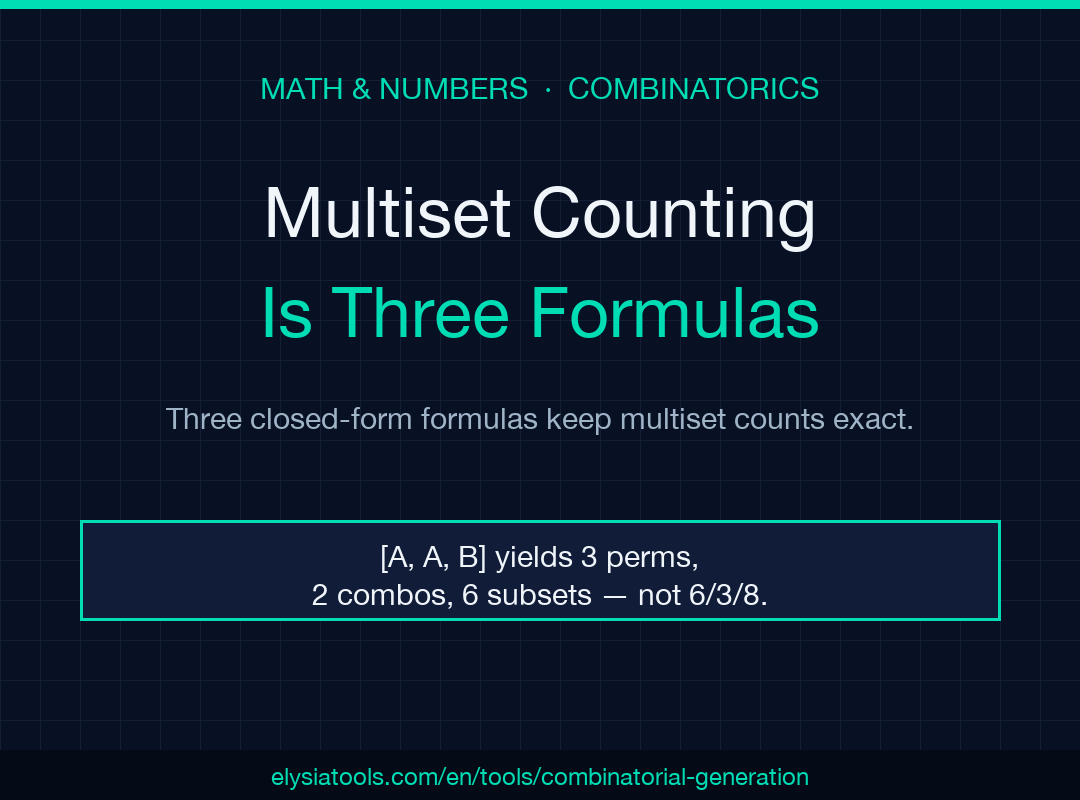
Counting distinct arrangements of repeated items is the kind of math that looks elementary until you actually have to compute it. Three A’s and one B yields six subsets, not eight; two A’s and one B yield three permutations, not six. The math is exact, but only when the formulas account for repeated elements — n! over Π(mᵢ!) for permutations, Π(mᵢ + 1) for subsets. This field guide walks through when those two formulas apply, why naive counting silently over-counts multisets, and how the Permutation / Combination / Subset Generator tool returns exact counts up to n=12 alongside the deduplicated, lexicographically ordered listings.
When the multiset count is the only thing that matters
You have the letters A, A, B, and you want to know how many distinguishable three-letter arrangements exist. The naive 3! = 6 answer is wrong because two of the three letters are identical. The correct count is 3! / 2! = 3 — the permutations AAB, ABA, BAA, and that’s it.
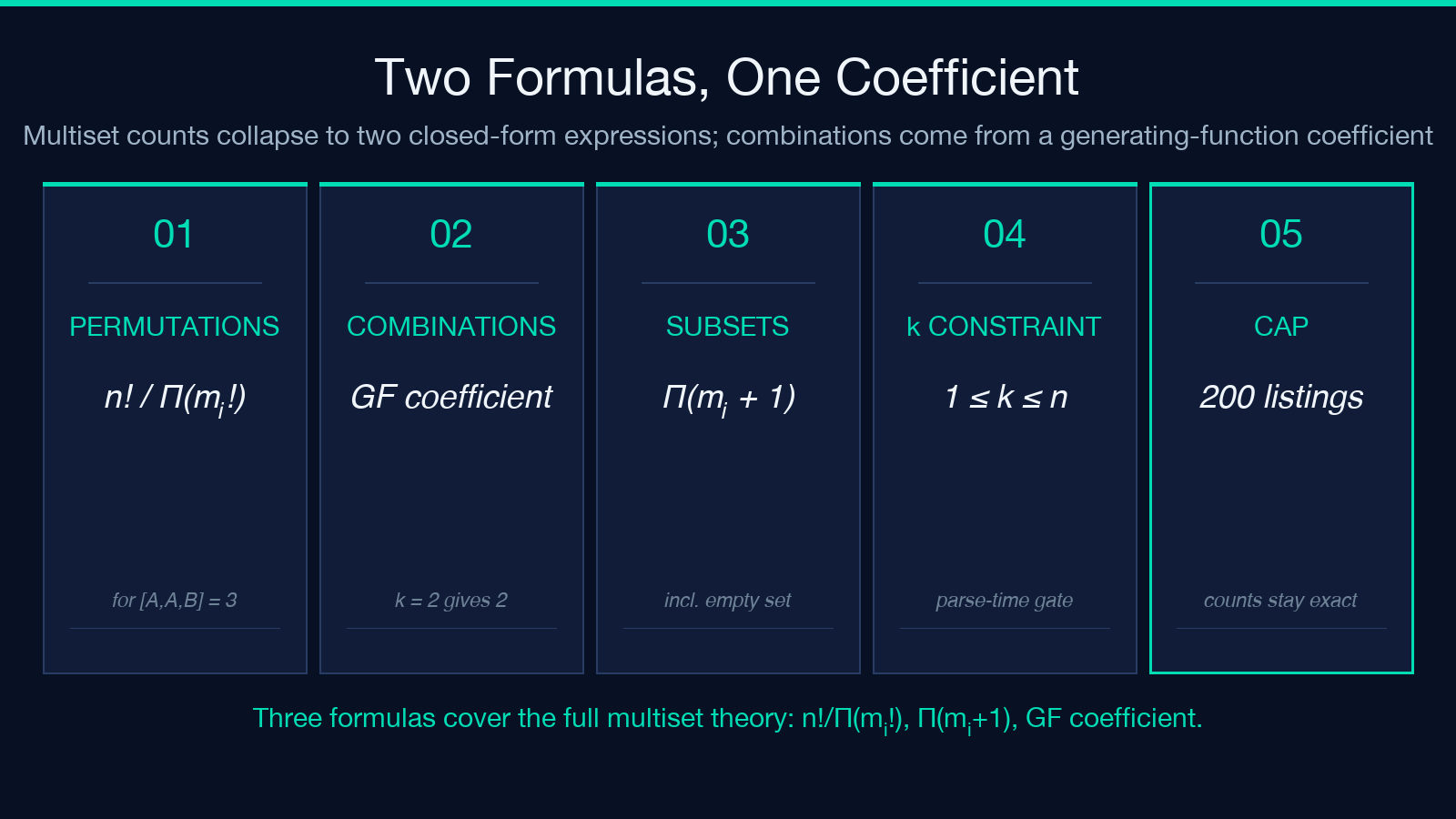
The general formula is n! / Π(mᵢ!) where mᵢ is the multiplicity of the i-th distinct item. For [A, A, B] that’s 3! / (2! · 1!) = 3. For [A, A, A, B] it becomes 4! / (3! · 1!) = 4. The factorial division cancels out the permutations that swap identical items, which the underlying counting otherwise double-counts.
This is the classic case where intuition overcounts by a factor of Π(mᵢ!). It’s also where most “how many anagrams does this word have?” Stack Overflow answers go wrong — they treat each letter as distinct. Try the Permutation / Combination / Subset Generator with the multiset [A, A, B] and you’ll see exactly three permutations, not six.
Combinations as generating-function coefficients
For distinct items, the number of ways to choose k from n is C(n, k). For multisets with repeated items, the answer comes from a different place: the generating-function coefficient.
For [A, A, B] with k = 2, expand (1 + x + x²)(1 + x). The coefficient of x² is 1 + 1 = 2 — the two combinations AA and AB. Note that AB and BA collapse to the same combination because order does not matter. The coefficient formula extends naturally: for a multiset with multiplicities m₁, m₂, ..., mₖ, the coefficient of x^j in Π(1 + x + x² + ... + x^(mᵢ)) is the number of distinct combinations of size j.
The tool handles this in code rather than symbolically, but the resulting count matches the coefficient exactly. For practical purposes, that means you can hand it [1, 1, 2, 3] and ask for k = 3 and you will get the same number you’d get from expanding the generating function and reading off the coefficient.
Subsets are the simplest case — and the easiest to miscount
The number of distinct subsets of a multiset [m₁, m₂, ..., mₖ] is Π(mᵢ + 1). Each item can appear 0, 1, 2, …, or mᵢ times in a subset, and those choices multiply.
For [A, A, B] that’s (2+1)(1+1) = 6. The six subsets are: {}, {A}, {A,A}, {B}, {A,B}, {A,A,B}. Note that {A} and {A,A} are distinct subsets because the multiset distinguishes them by count — a subset of a multiset is a function from items to non-negative integers, not a set of items.
The empty set is always included, so the formula gives at least 1 for any non-empty input.
Why the display cap matters when n gets large
The tool caps displayed permutations at 200 entries even though it can count them exactly up to n=12. For n = 12 distinct items, that’s 12! = 479,001,600 permutations — far more than any human wants to scroll through. The count stays exact because the formula n! / Π(mᵢ!) is closed-form; the listing is what’s truncated.
This split between “what we can compute” and “what we can show” is a feature, not a bug. If you need the full listing, you’ll need to either reduce n or accept the truncation. If you only need the count, the formula is exact up to the factorial-precision ceiling of the runtime (Python integers are arbitrary-precision, so the practical limit is RAM and patience).
Combinations mode enforces k <= n
The tool requires 1 <= k <= n for combinations mode. This is not arbitrary — when k > n you are asking for combinations of more items than you have, and the answer is 0 for distinct items or undefined for multisets with the generating-function formulation. Rejecting the input at parse time is cleaner than silently returning 0 and letting you wonder whether your configuration was wrong.
For multisets, the constraint is similar but slightly more forgiving: k = 0 is always valid (yielding the empty combination), and k = sum(mᵢ) is the largest valid value (yielding the multiset itself as a single combination).
Common pitfalls when working with multisets
Three traps that show up in real-world combinatorics problems:
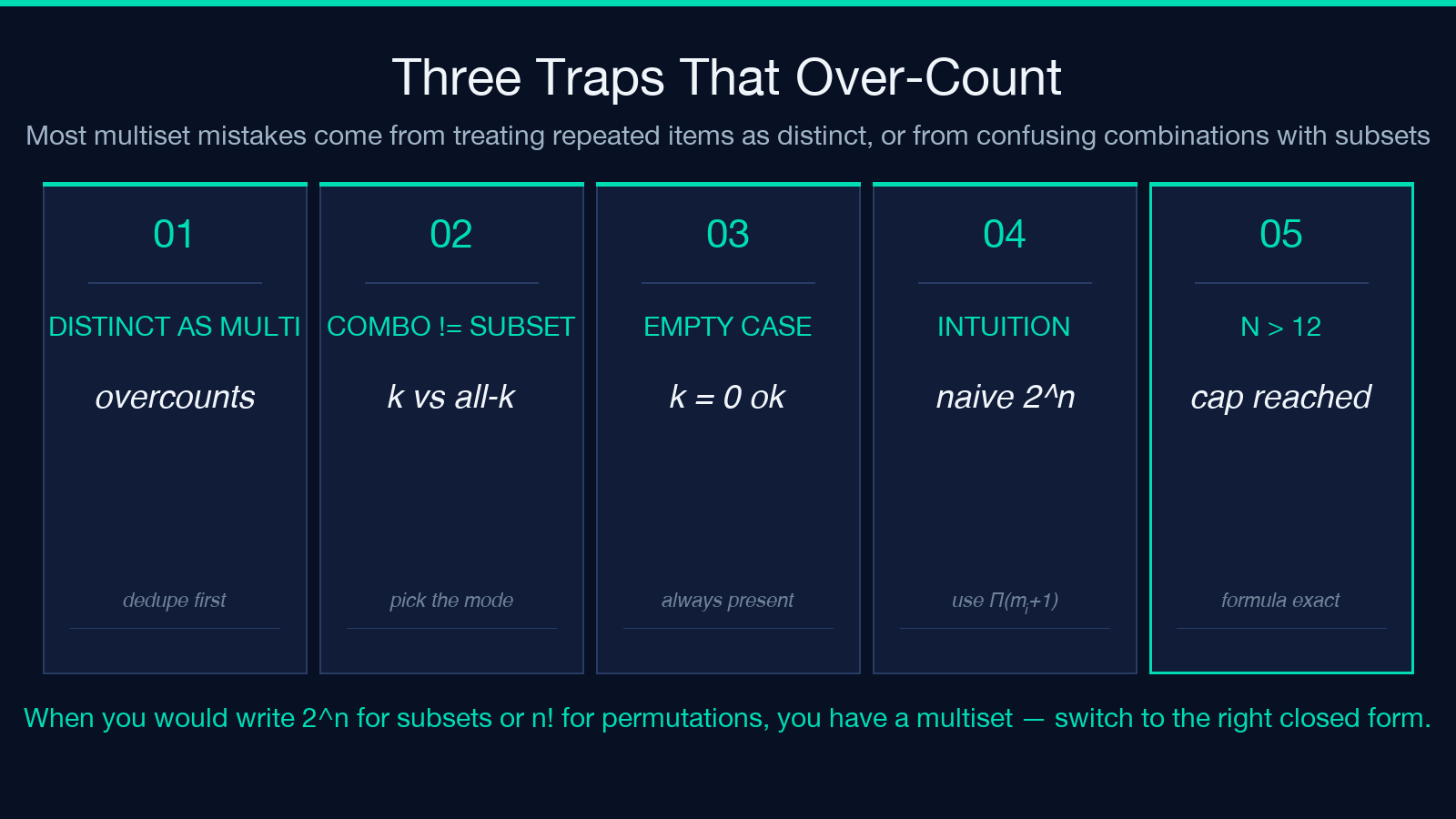
- Treating distinct items as a multiset — the letter “M” appears once in “MISSISSIPPI”, not eleven times. Tools that take a list of items treat each position as distinct unless you deduplicate first.
- Confusing combinations and subsets — combinations fix a size
k; subsets cover all sizes0tosum(mᵢ). They are related but not interchangeable. - Ignoring the empty case — for multisets with multiplicities summing to
n, the total number of combinations across all sizes isΠ(C(mᵢ + j, j))summed overj, which is usually much larger than the subset count.
The Permutation / Combination / Subset Generator handles all three correctly by keeping the three modes separate and computing each via its own formula. You do not have to pre-deduplicate or pre-pick k — you pick the mode that matches your question and let the tool apply the right formula.
When to use this tool versus a full programming environment
For exploratory work, the tool is faster than writing Python: paste your multiset, pick a mode, get the count and (up to 200) the actual listings in a single step. For production-grade work — say, generating all combinations of a 12-item set with constraint pruning — you’ll want a real programming language with backtracking and early termination. The tool is best for verification and exploration; for performance-critical enumeration, drop to code.
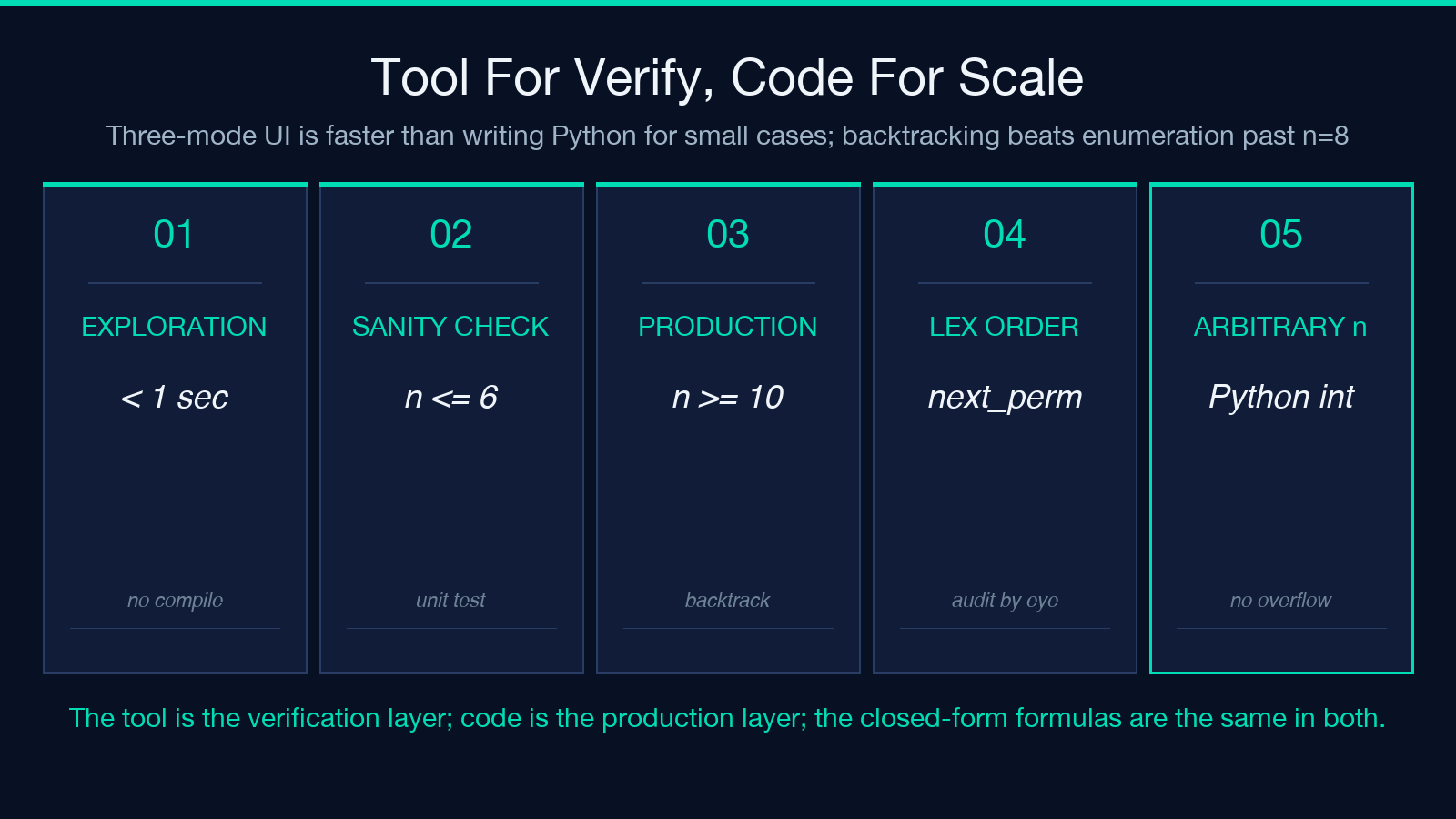
A useful pattern: use the tool to verify your hand-computed formula on small cases (n <= 6), then port the validated logic to code for the larger runs. The closed-form formulas (n! / Π(mᵢ!) for permutations, generating-function coefficient for combinations, Π(mᵢ + 1) for subsets) are the same regardless of where you compute them — the tool just gives you a sanity check without the compile-run cycle.
Closing — three things to remember. The two key formulas — n! / Π(mᵢ!) for permutations and Π(mᵢ + 1) for subsets — handle the multiset case correctly where naive n! and 2^n over-count. Combinations sit between them, with the generating-function coefficient as the canonical source. And the Permutation / Combination / Subset Generator keeps these three cases in separate modes so you do not have to pre-pick which formula applies.
For deeper work, the lex-ordered output (next_permutation based) makes it easy to verify that the count matches the listing — you can scroll the first 10, count them, and divide by the over-counting factor to see why the formula gives what it gives.
Explore more tools at elysiatools.com.
