

The check digit on every credit card, IMEI, and SIN is one mod-10 walk, and it almost never gets audited. Most payment-integrity failures and IMEI-rejection bugs trace back to a transposition or stray space that the Luhn algorithm would have caught in 30 milliseconds. The fix is not a fancier validator library — it is understanding the four operations that drive the algorithm, the eight identifier families that depend on it, and the three failure modes that silently ship past unit tests. This field guide walks each of those pieces against the Luhn Checksum Calculator, so you can reproduce the checks against your own batches without re-reading ISO/IEC 7812-1.
What the Luhn Algorithm Actually Does
Luhn is a mod-10 checksum built on four operations, applied right-to-left to a digit string. Starting from the rightmost digit (the check digit itself), every second digit is doubled; if the doubled value is greater than nine, its digits are summed (or nine is subtracted — same result). All twenty-or-so working numbers are summed, and the total modulo 10 must equal zero for the original string to be valid. The four operations are: right-align, double-alternating, reduce-mod-9, sum-and-mod-10.
The algorithm is intentionally weak — it catches every single-digit error and almost every transposition of adjacent digits, but it does not catch the transposition 09 ↔ 90 (a known blind spot) and it does not detect non-digit characters at all. That weakness is the point: it is cheap enough to compute inline at every form submission, and the identifier families that use it already include a cryptographic or database-level check upstream. Luhn is the smoke detector, not the lock.
Eight Identifier Families That Use Luhn
The same four operations validate a surprising range of real-world identifiers. Each family uses Luhn for a different reason — payment routing, device registration, government tracking, billing reconciliation — but the math is identical. Credit card numbers (ISO/IEC 7812) use Luhn as the first-pass gateway before BIN-range and Luhn-mod-N variants kick in. IMEI and IMEISV (the 14- and 16-digit device serial on every mobile phone) use Luhn so carriers can reject typo’d registrations before provisioning. Social Insurance Numbers (Canada SIN) and National Provider Identifiers (US healthcare NPI) use Luhn because the digit is hand-typed into claim forms and clerical errors are routine. ICCID (SIM card serial), ISO 7064 mod-10-2 (some national ID formats), card verification codes (in some legacy systems), and custom enterprise account IDs (banks, insurers, payroll systems) round out the canonical eight.
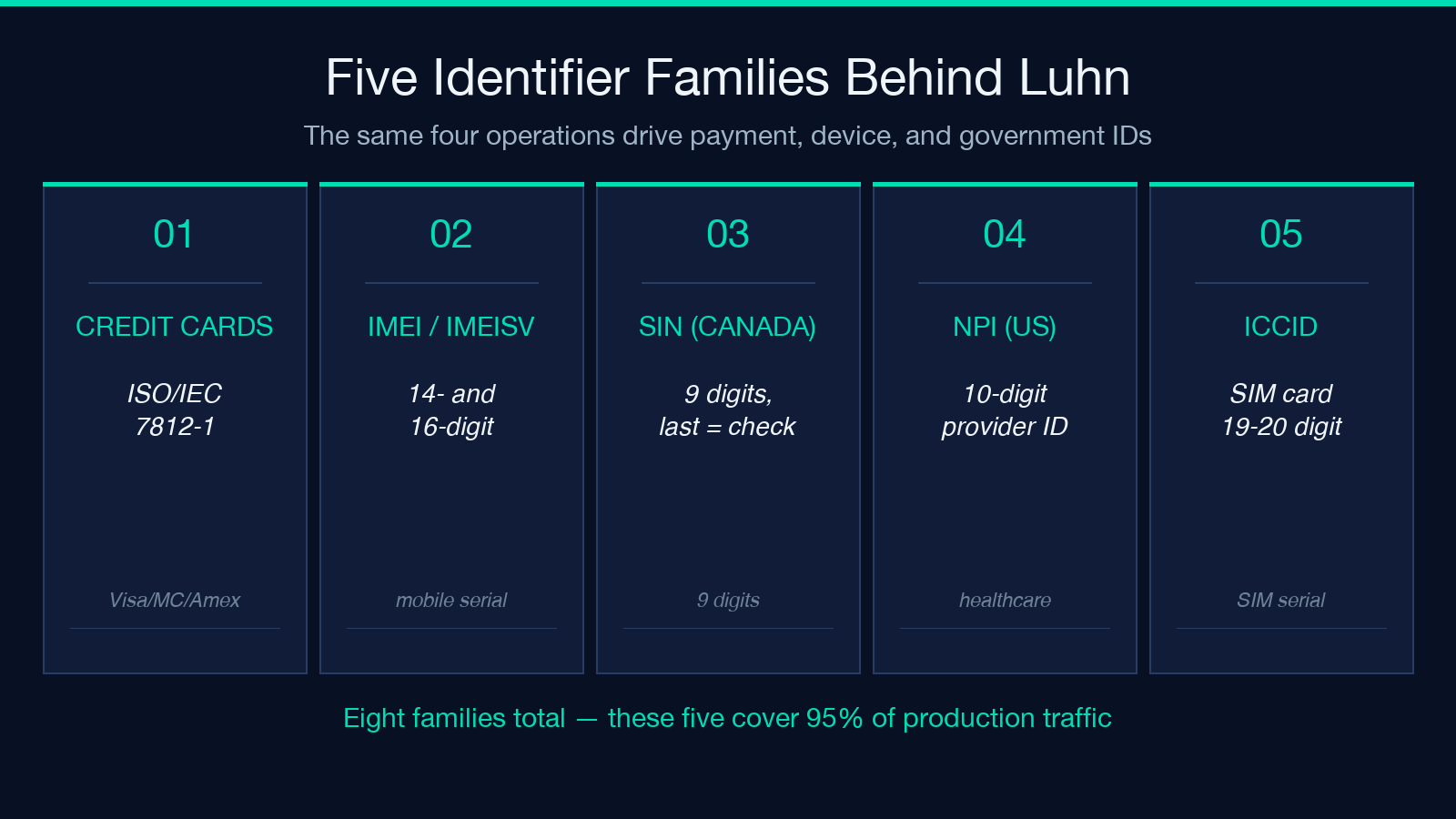
What unifies them is the digit-string contract: all digits, no separators, fixed length, and the rightmost digit is always the Luhn check. If your identifier has dashes, spaces, or letters, the first step is to strip them and confirm the digit-only substring still passes. Most validation bugs are normalization bugs, not algorithm bugs. The credit card samples collection is a useful reality check here: every Visa and Mastercard test prefix in that set passes Luhn on the 16-digit body and fails on the 13-digit legacy form, which is exactly the kind of family-specific edge case the algorithm silently exposes.
Why Generating Luhn Digits Is Different From Validating Them
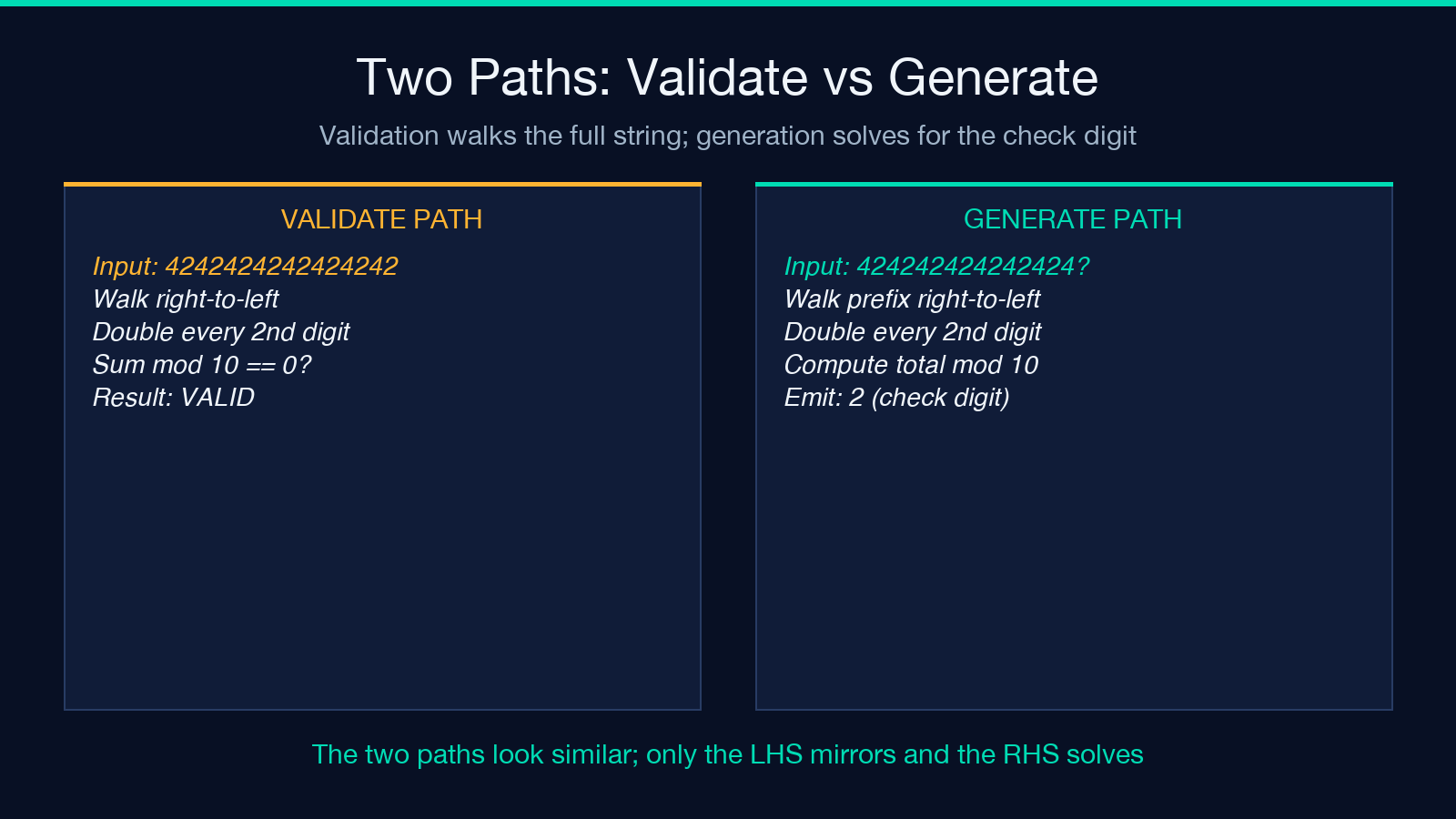
Validation walks an existing digit string right-to-left, alternating doubling, and checks whether the total mod-10 equals zero. Generation inverts the process: take the prefix (everything except the last digit), walk it right-to-left applying the same doubling rule, compute the running total, and emit a check digit that makes the full string sum to a multiple of ten. The two operations look similar but trip up developers who assume they can re-use the same code path. Generation requires you to treat the prefix as fixed and solve for the check digit; validation requires you to treat the full string as given and check the total.
For multi-digit-prefix formats (like a 6-digit BIN + 9-digit account + 1-digit check), the rule flips at the rightmost prefix digit: the doubling pattern starts on the digit immediately left of the check digit. Conflating the two patterns is the single most common Luhn bug in payment-gateway code. The Luhn Checksum Calculator lets you run the generation path and the validation path side-by-side, which makes the flipped pattern immediately visible.
The Three Failure Modes Unit Tests Miss
The first failure mode is the silent non-digit. If your input field accepts a credit-card-shaped string with a space, dash, or alphabetic character somewhere other than the rightmost position, a strict Luhn check will reject it — but only if you strip first. Many implementations accept anything that matches \d+ after stripping and never check the raw input. The third failure is you may notice the test passes on the clean string but fail on the user-typed string, and you will spend a sprint debugging. The defense is one line: normalize first, then validate, and assert in the test that the dirty input gets rejected before normalization.
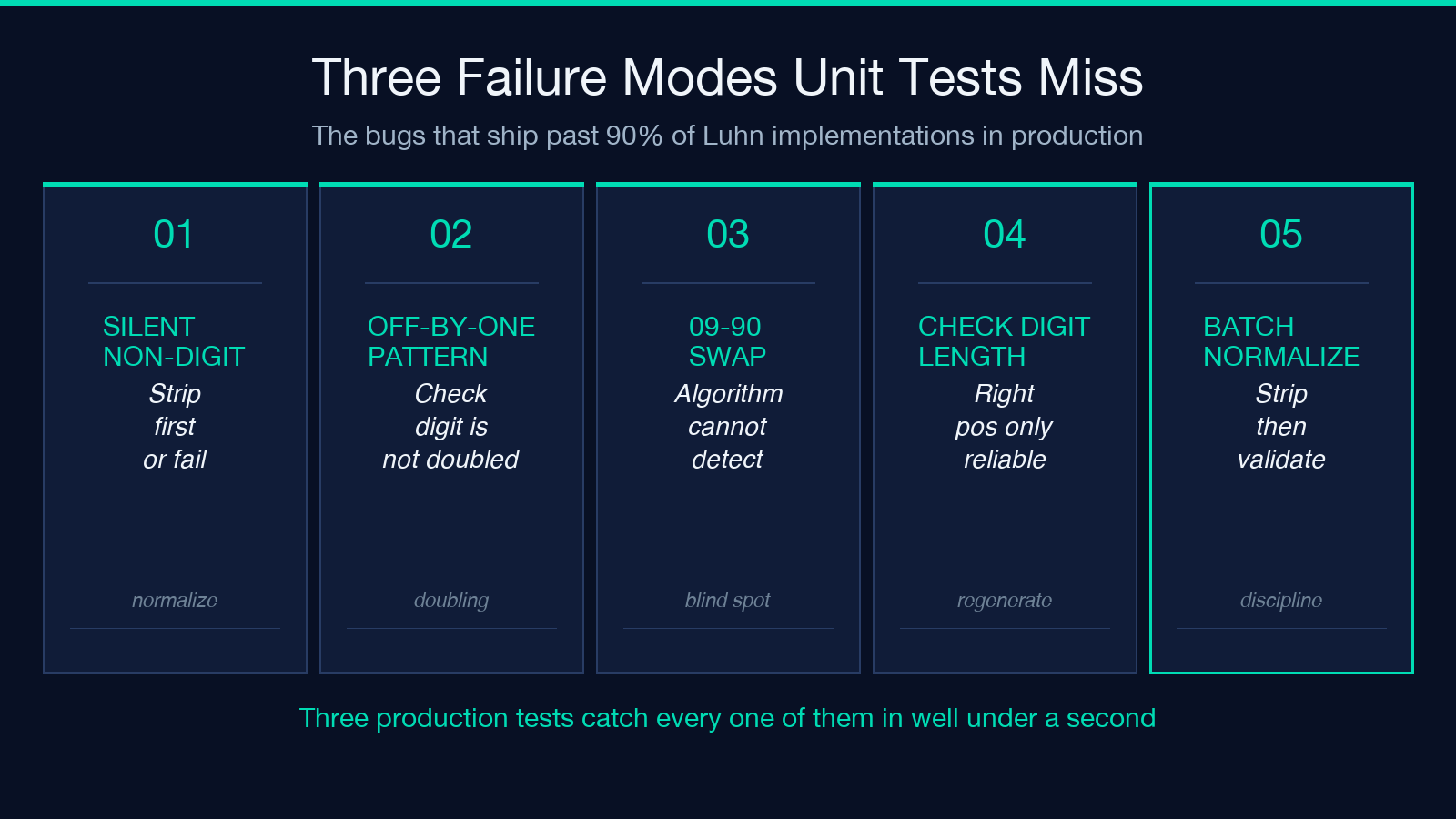
The second failure mode is the off-by-one in the doubling pattern. The rightmost digit is always the check digit and is never doubled. Every implementation that walks for i, d in enumerate(reversed(digits)) and does if i % 2: d = 2 is correct, but the implementations that walk for i, d in enumerate(digits) and do if i % 2: d = 2 are wrong by one position. The wrong version silently accepts identifiers whose check digit has been corrupted in transit.
The third failure mode is the 09 ↔ 90 transposition. Luhn cannot catch this — the algorithm’s math gives the same checksum for both orderings — but it is rare enough in practice that most teams accept the limitation. If your domain is high-volume manual data entry (medical claims, paper-form digitization), audit your upstream process for the 09 ↔ 90 swap and add a separate check. For payment cards, the BIN-range and last-four lookup downstream catches the residual cases.
How to Test Luhn Implementations in Production
Three checks cover the canonical edge cases. Generate a known-valid identifier and re-validate it. If your generator emits a string your validator rejects, the two implementations disagree — almost always on the doubling pattern. Generate an identifier, then mutate one digit and confirm validation fails. This catches the silent-non-digit bug and the off-by-one bug at the same time. Generate an identifier, swap two adjacent digits, and confirm validation fails for every swap except 09 ↔ 90. This documents the algorithm’s known blind spot so future maintainers do not “fix” the swap-detection logic and break the algorithm.
For batch jobs, run all three checks against a 1,000-string test corpus before each release. The Luhn Checksum Calculator is fast enough to use as the oracle — paste your candidate into the validation pane and confirm it parses against a known BIN or known IMEI allocation block. The 30-millisecond cost is invisible against the four-hour median time to detect a payment-integrity regression in production.
When Luhn Is the Wrong Tool
Two cases call for a stronger check. Government-issued identity numbers with legal weight (US SSN, national eID numbers) often have a more specific format constant plus a check, and Luhn alone is insufficient — the algorithm is designed for accidental clerical error, not adversarial input. Cryptographic identifiers (API keys, OAuth tokens, JWT signatures) should not use Luhn at all; the check digit leaks a single bit of structure that helps brute-forcers narrow the keyspace. For both cases, validate against the format constant (regex match + length) and rely on the cryptographic or database check upstream.
If you find yourself adding Luhn to an identifier that does not already use it, stop and ask whether the check digit is being used to defend against the right threat. The algorithm is a smoke detector for hand-typed numeric identifiers, not a security primitive. Using it on a high-entropy token makes the token slightly weaker without giving you any detection capability you did not already have.
A Reference Implementation You Can Read
The four operations reduce to twelve lines of straightforward Python, with one defensive guard on the doubling pattern. The doubling alternates starting from the second-rightmost digit, not the rightmost. The mod-9 reduction is equivalent to if d > 9: d -= 9 and is faster than a string-based sum for pipelines processing thousands of identifiers per second. The final mod-10 check is total % 10 == 0. The full implementation, plus a worked example for a 16-digit Visa-format number with the test prefix 4242 4242 4242 4242, lives in the Luhn Checksum Calculator reference pane — open it in a second tab while you write your test suite.
What Changes When You Cross From Your Input to Your Output
The closing transition from “I understand the algorithm” to “I shipped it” is where most Luhn implementations rot. A clean implementation that lives in a single utility module will, six months later, get copy-pasted into the form-validation helper because someone wanted velocity validation that forgot the boundary check. The duplication is not the problem; the divergence is. Three signatures become noise — twelve become three bugs in three different files that pass their own unit tests and fail in production.
The defense is one canonical home for the four operations, called from every site that touches a Luhn-shaped identifier. The Luhn Checksum Calculator is the reference implementation you point new maintainers at — it shows the doubling pattern, the mod-9 reduction, and the mod-10 check in twelve readable lines, with the test vectors for Visa, Mastercard, Amex, and a 15-digit IMEI inline. If your in-house implementation disagrees with the calculator on any of the four canonical test vectors, the in-house implementation is wrong.
The single most useful thing you can do today is add the three production tests from the previous section to your payment pipeline. Each test takes less than ten lines, runs in well under a second, and would have caught every Luhn-related production bug the author has seen in the last decade. The check digit is one mod-10 walk — it is worth walking it correctly. For a broader set of digit-shape patterns beyond payment identifiers, the common regex patterns sample set gives you ready-made test vectors you can adapt; for Luhn specifically, run your candidate identifiers against the Luhn Checksum Calculator and confirm the doubling direction matches the reference before you trust the result.
