
Eight checkboxes, one age band, and one female-sex tick — that is everything the CHA₂DS₂-VASc score pulls from. The number that pops out is a point on a 0-to-9 ladder, but every rung hides a different anticoagulation decision, and a single missed toggle moves a patient from “no anticoagulation” straight into “DOAC preferred” territory without changing the score by more than a point. A hand-calculated floor is fast enough that you can fit it on a clipboard — but when a female patient lands on score 3 from age + stroke history alone, the threshold rule reverses, and the calculator has to remember whether her lone female point actually counts. That is the job of the CHA₂DS₂-VASc Score (AFib Stroke Risk) calculator: walk through the components, apply the sex-modifier rule, and surface both the recommendation band and the approximate annual stroke risk so the next conversation starts from a number instead of a hunch.
What each toggle actually contributes
The acronym walks through seven risk dimensions and the age band decides the weight on three of them. Drop the C and the score is zero; tick every box and you land at the top of the ladder. The seven components are:
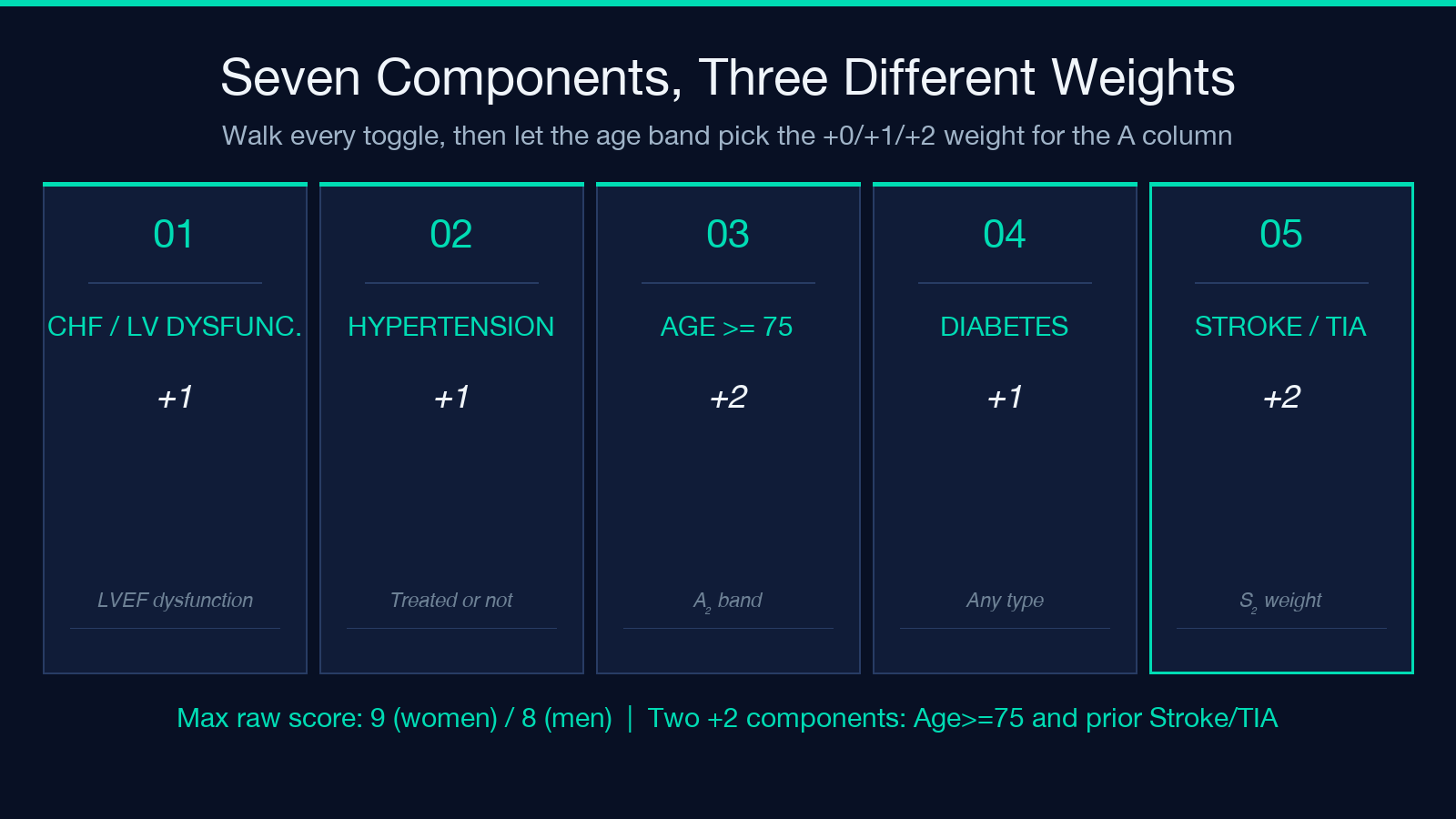
- C — Congestive heart failure or left ventricular dysfunction (
+1) - H — Hypertension, treated or untreated (
+1) - A₂ — Age 75 or older (
+2) - D — Diabetes mellitus (
+1) - S₂ — Prior stroke, TIA, or systemic thromboembolism (
+2) - V — Vascular disease — prior MI, peripheral artery disease, or aortic atherosclerotic plaque (
+1) - A — Age 65 to 74 (
+1; under 65 contributes 0) - Sc — Sex category female (
+1)
The double-letter components are the heavy hitters: age ≥75 and prior stroke each add two points. The maximum raw score is 9 for women and 8 for men because a male patient cannot pick up the sex point.
The age band is a single select box, not three independent toggles. The score either takes the +2 from A₂ (≥75), the +1 from the 65–74 band, or nothing at all from under 65. Stacking both A₂ and the 65–74 age band is impossible, and trying to mark two ages produces a contradictory component log that the calculator flattens to the higher weight.
The female-sex point is conditional, not automatic
A +1 from Sc looks like a free point but it is the only component with a behavioral override: a female patient whose entire score comes from the sex point (Sc = 1, every other component zero) is treated as score 0 for the recommendation. The score still displays 1, but the recommendation band drops to “Omit oral anticoagulation” because the 2019 AHA/ACC/HRS guideline update stopped counting lone female sex as an independent stroke-risk driver.
That single rule is the most common mis-reading of the score in clinical use. A female patient with hypertension (H=1) and nothing else lands at score 2, which the calculator reads as “consider anticoagulation” — not “recommend anticoagulation” — and that is correct. The threshold ladder flips on the third point.
Reading the recommendation bands
The same numeric score yields three different recommendations depending on sex, because female-only points get treated as zero and male scores cap at 8. The three bands from the 2023 ACC/AHA/ACCP/HRS guideline:
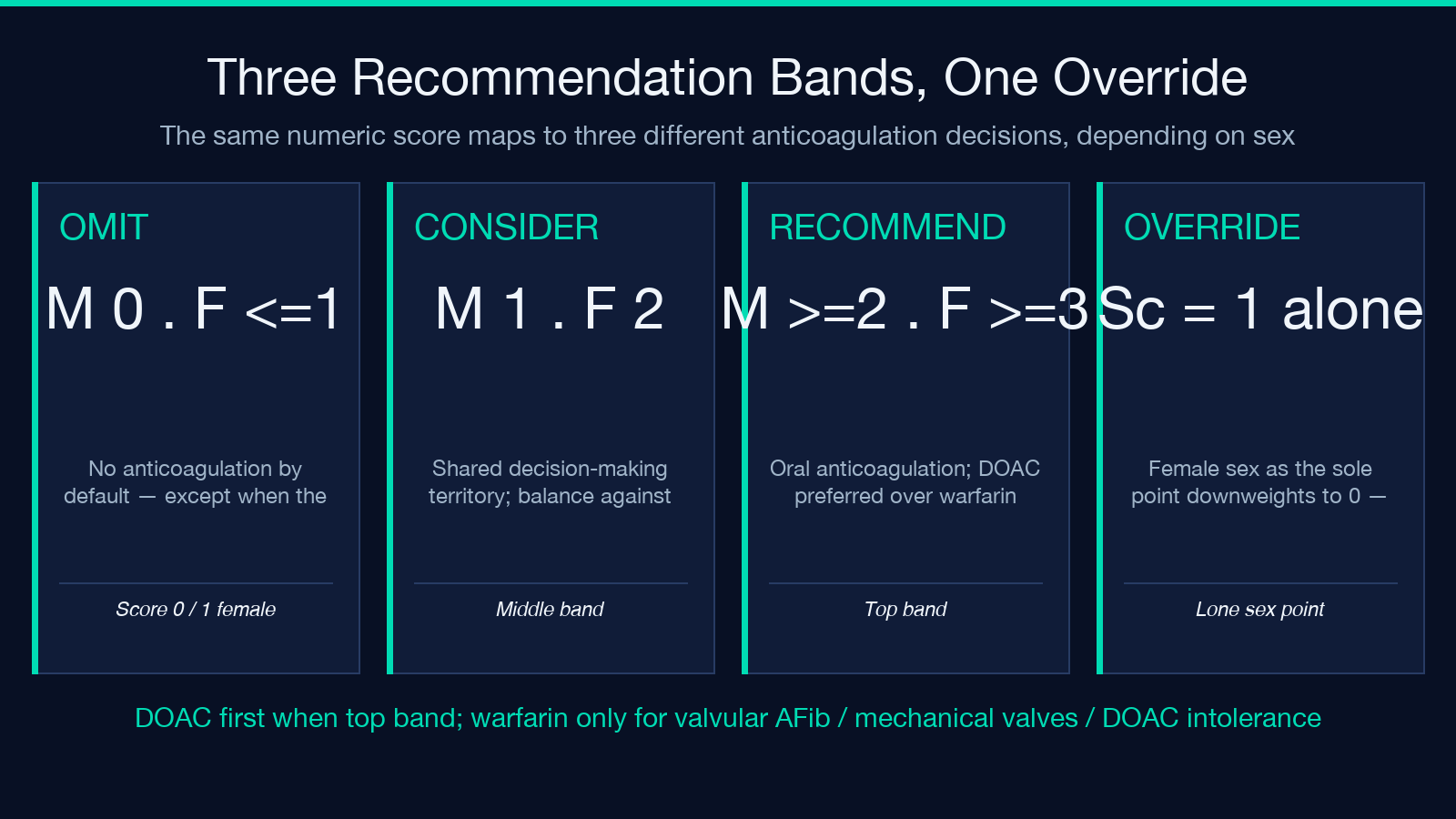
- Omit oral anticoagulation — Men with score 0, women with score ≤1 where the only point is the female sex point
- Consider oral anticoagulation — Men with score 1, women with score 2 (any combination that adds up to those numbers)
- Recommend oral anticoagulation — Men with score ≥2, women with score ≥3
The calculator returns a fourth field beyond the band: an approximate annual stroke risk percentage from the Lip 2010 derivation cohort. Score 0 is the 0.2 percent floor; score 6 sits around 13.6 percent annual risk. The number is a population estimate, not a per-patient prediction, but it converts the categorical band into a number that lands in the conversation naturally.
Pairing the score with bleeding risk before anyone starts an anticoagulant
The CHA₂DS₂-VASc tells you which side of the anticoagulation line you should fall on. It does not tell you whether the bleeding risk on the other side is manageable. The two scores are paired by design: the HAS-BLED Score (Major Bleeding Risk) tool covers uncontrolled hypertension, renal disease, liver disease, stroke history, bleeding history or predisposition, labile INR, age over 65, concomitant antiplatelet or NSAIDs, and alcohol intake — nine checkboxes that overlap with three of the CHA₂DS₂-VASc components (age, hypertension, stroke).
A high HAS-BLED score is not a contraindication to oral anticoagulation — it is a flag that the bleeding risk needs an active intervention. Hypertension becomes a treatment target, labile INR becomes a reason to switch from warfarin to a DOAC, alcohol intake becomes a counseling topic. The calculator returns both scores side-by-side when they are entered together; running them in isolation misses the shared-component pattern that drives the real clinical decisions.
What the JSON output actually carries
The calculator returns a result block plus a metadata block. The result block contains the recommendation as a short human-readable string. The metadata block is the structured payload: total is the integer score, components is the seven-item breakdown keyed by acronym letter, and annualStrokeRiskPercent is the population estimate. The sexOnlyPoint flag is the boolean that tells you whether a female-only point set was downweighted to zero for the recommendation.
Downstream pipelines that consume the metadata JSON can branch on recommendation.category to decide whether to surface a DOAC prescribing reminder, an OAC discussion prompt, or no anticoagulation advisory at all. The string-level result field is for clinical displays; the metadata payload is the integration surface.
Worked example: a 75-year-old woman with hypertension and prior TIA
Age ≥75 contributes 2. Female sex contributes 1. Hypertension contributes 1. Prior stroke or TIA contributes 2. No CHF, no diabetes, no vascular disease.
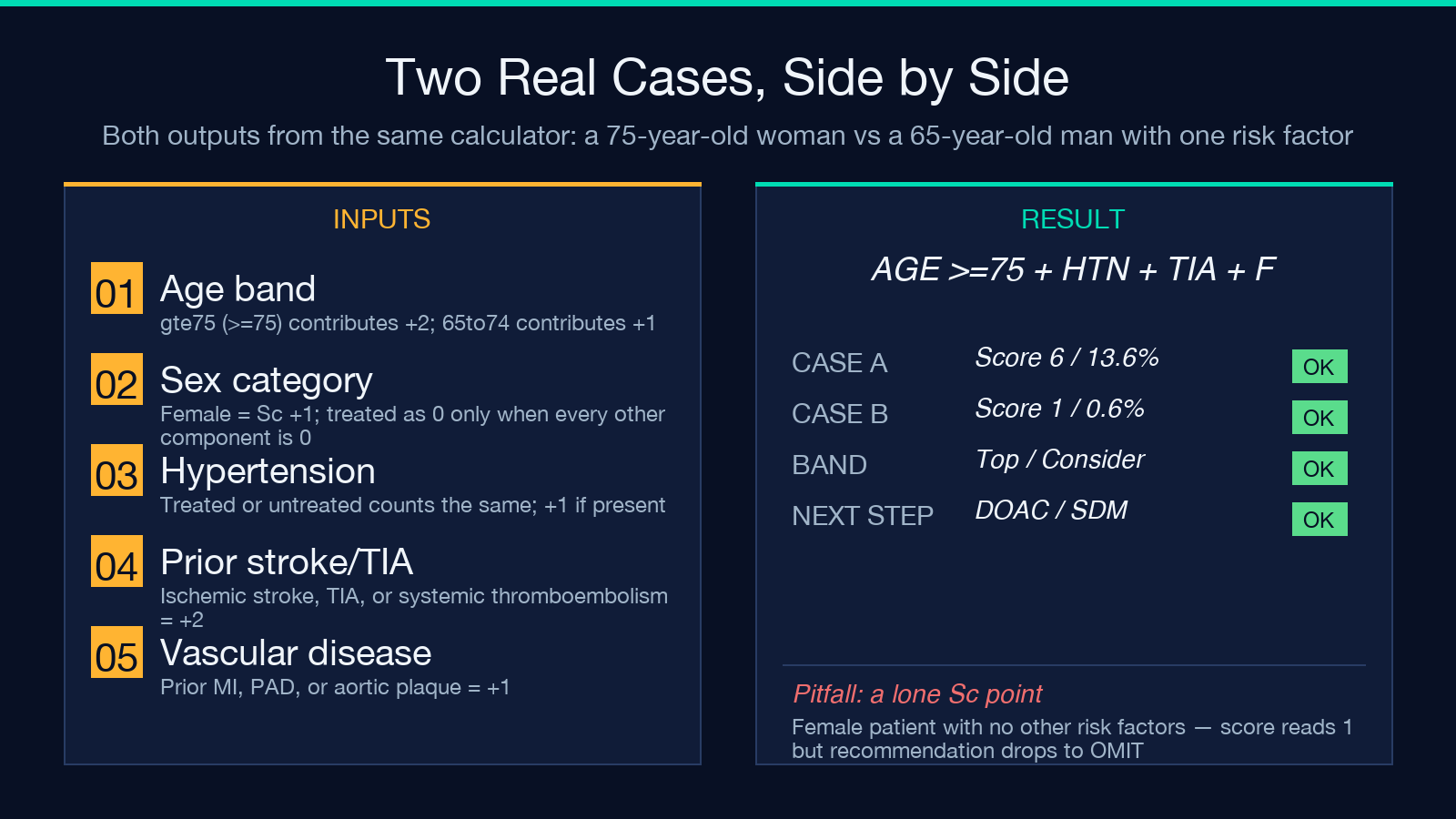
The total is 6. The recommendation band is “Recommend anticoagulation” because the female patient has crossed the ≥3 threshold, and the female point is not a lone point — it is one of four components contributing. Approximate annual stroke risk is 13.6 percent. The expected workflow is to start a DOAC and revisit the bleeding-risk conversation with HAS-BLED in hand.
Worked example: a 65-year-old man with no other risk factors
Age 65–74 contributes 1. Every other component contributes 0. The total is 1. The recommendation band is “Consider anticoagulation” because a man at score 1 sits in the middle band — not “recommend,” not “omit,” but shared decision-making territory. Approximate annual stroke risk is 0.6 percent.
This is the band where the bleeding-risk side carries the most weight in the final conversation. A HAS-BLED of 0 to 1 keeps the door open to a DOAC; a HAS-BLED of 3 or higher pushes the conversation toward a tighter bleeding-risk management plan before any anticoagulant gets prescribed.
Where the score stops and clinical context takes over
The CHA₂DS₂-VASc is a stratification aid, not a treatment mandate. Three patterns push the conversation past the score itself:
- Mechanical heart valves or moderate-to-severe mitral stenosis — these patients are on warfarin regardless of the score; non-valvular AFib is the population the score was derived for.
- Recent bleeding event or active peptic ulcer — the bleeding-risk side trumps the stroke-risk side on a short time horizon; the score records the calculation but does not override the immediate contraindication.
- Pregnancy or planned pregnancy — DOACs are not first-line in pregnancy; the recommendation becomes a referral to obstetric-cardiology comanagement, not an automatic prescription.
For everything in between — the much larger population of non-valvular AFib patients whose stroke and bleeding risk can both be quantified — the calculator returns a number, a recommendation, and an approximate annual stroke risk. The conversation that follows is shared decision-making, but it starts from a reproducible point.
The score takes about thirty seconds to compute by hand. The calculator takes the same amount of time and removes the one judgment call that costs real minutes: whether the female sex point counts as a tie-breaker or a lone override. Browse more cardiology tools in the Education hub.
