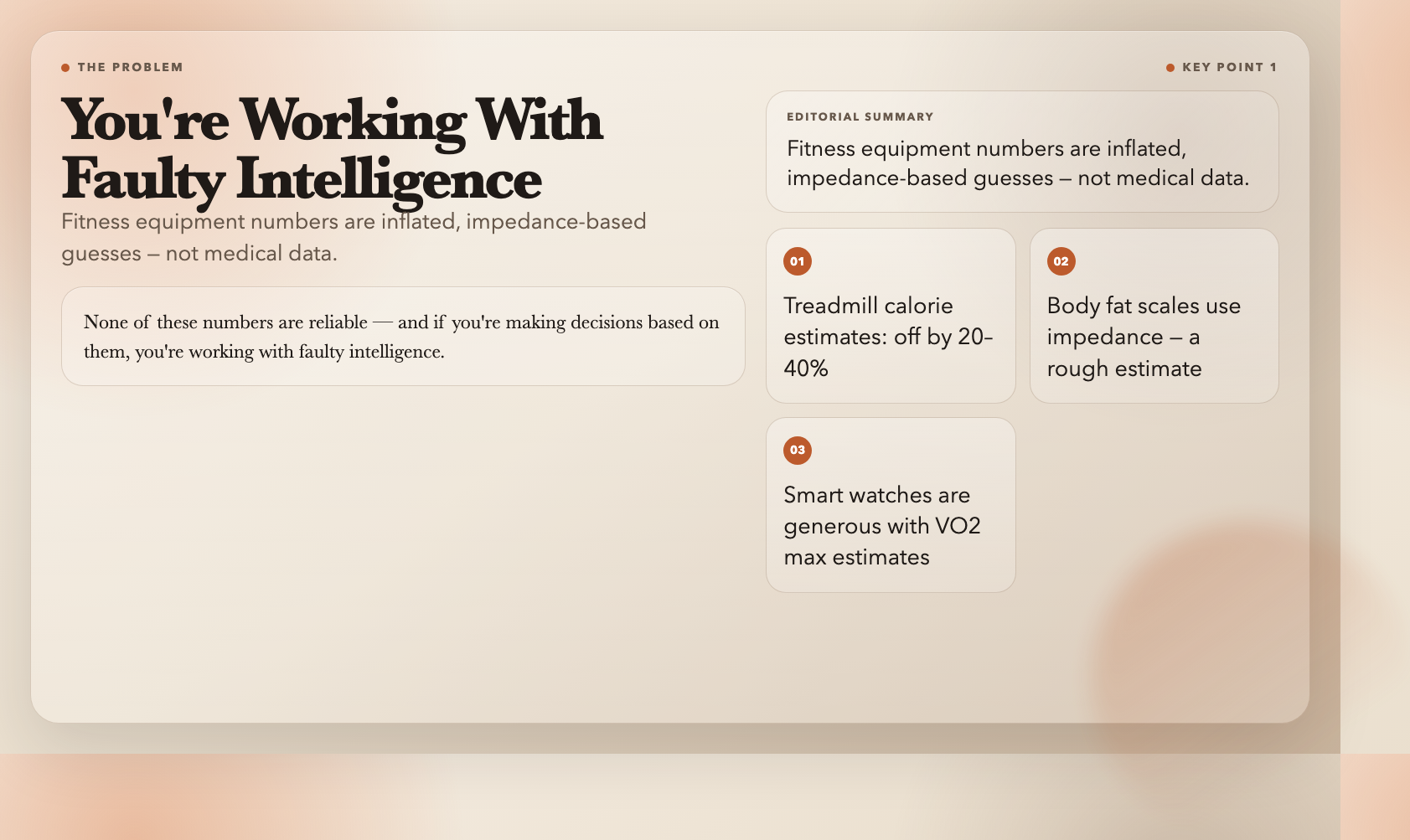
The treadmill’s calorie count is inflated. The body fat scale is impedance analysis dressed up as medical science. The fitness watch is generous with its VO2 max estimate. None of these numbers are reliable — and if you’re making decisions based on them, you’re working with faulty intelligence.
Fitness equipment wasn’t built for accuracy. It was built to feel rewarding. Here’s what to use instead.
BMI Calculator
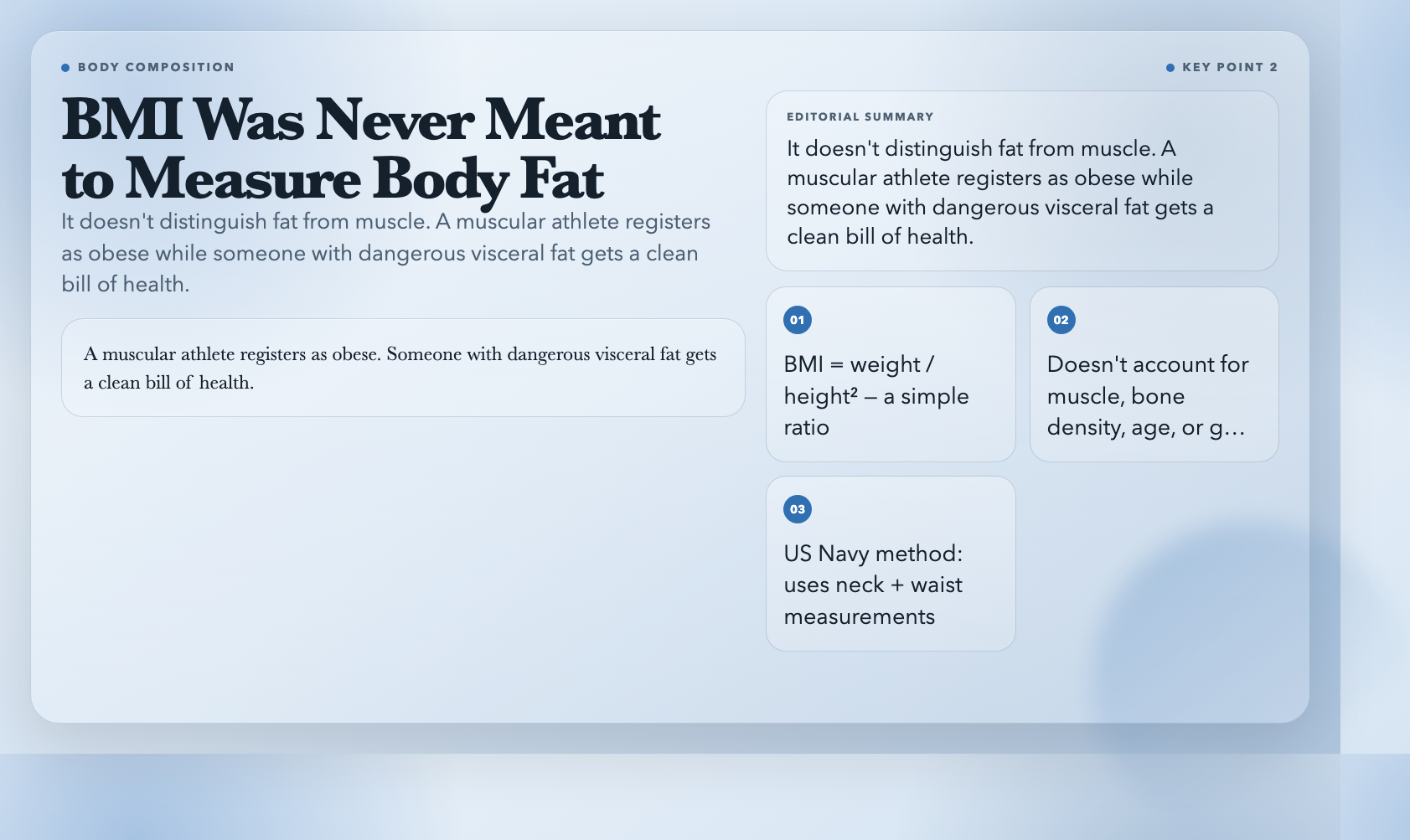
Let’s start with the most misunderstood number in health. BMI — Body Mass Index — a metric most of us have been measured against since childhood. The problem: BMI doesn’t measure body fat. It uses weight divided by height squared. A muscular athlete registers as “obese.” Someone with dangerous visceral fat gets a clean bill of health. It doesn’t distinguish fat from muscle, and it ignores age, gender, and bone density entirely.
Try it: BMI Calculator
Body Fat Calculator (US Navy Method)
For a complete picture of body composition, try the US Navy body fat estimation. It uses neck and waist measurements (plus hip for women) alongside height — no equipment beyond a tape measure. The US military has used this method for decades.
Here’s why it matters more than BMI. A 5’10”, 180-pound man with a 34″ waist and 15″ neck falls in the “fitness athlete” range. Same person, same body — BMI calls him overweight. Body fat categories are age and gender-adjusted, so essential fat, athletes, fitness, average, and obese ranges are all personalized to the individual.
Try it: Body Fat Calculator (US Navy)
Daily Calorie Needs Calculator
This is where most nutrition plans fall apart. People don’t know their maintenance calories. Without that number, every meal plan is a guess.
This calculator estimates Basal Metabolic Rate from height, weight, age, and gender using the Mifflin-St Jeor equation — the formula most registered dietitians use as a baseline. It multiplies by an activity multiplier to get Total Daily Energy Expenditure (TDEE), then lets you set a deficit or surplus target. No magic, no guessing.
Try it: Daily Calorie Needs Calculator
Calorie Burned Calculator
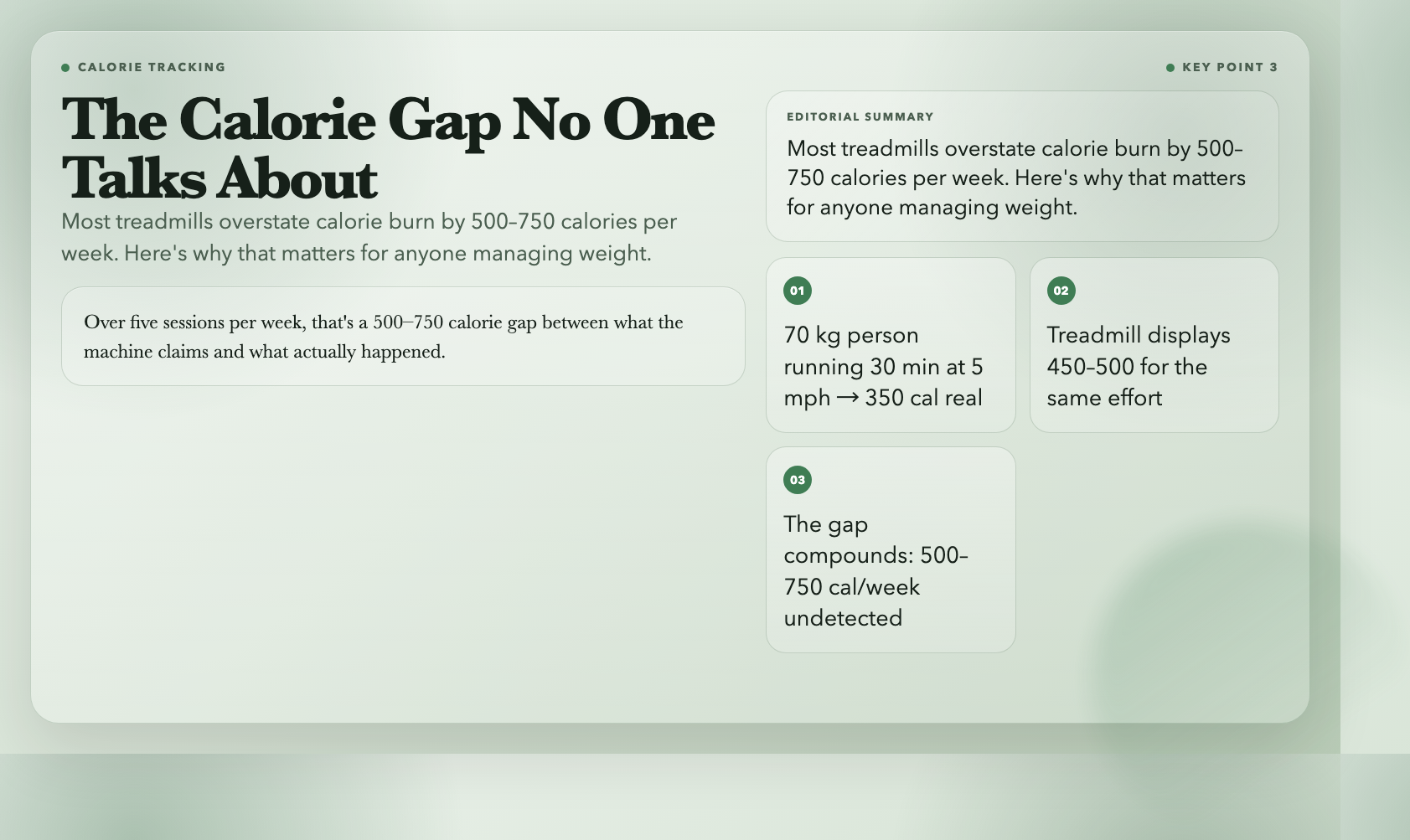
Cardio machines are generous with their calorie estimates — consistently, and by a lot. A 70 kg person running at 5 mph for 30 minutes burns roughly 350 calories. Most treadmills display 450–500 for the same effort. Over five sessions per week, that’s a 500–750 calorie gap between what the machine claims and what actually happened.
This calculator accounts for your actual weight, the specific activity, duration, and intensity. Running at 5 mph and running at 6 mph burn different amounts. Most gym equipment doesn’t differentiate — it applies one number to everything.
Try it: Calorie Burned Calculator
VO2 Max Calculator
VO2 max — your maximum aerobic capacity — is one of the strongest predictors of long-term health. Research consistently shows it outperforms blood pressure, cholesterol, and standard blood tests for predicting longevity. Lab testing requires expired gas analysis during maximal effort. Impractical for most people.
Field tests are a practical alternative. This calculator supports six protocols: 1.5-mile run test, Cooper test, beep/shuttle run test, Rockport walking test, 6-minute walk test, and a custom test. Plug in your time, heart rate, age, and gender — it returns your estimated VO2 max with an age and gender-adjusted category.
For reference: a 30-year-old man with a VO2 max around 45 ml/kg/min is in “good” shape. Elite endurance athletes often exceed 60. The range is wide, and knowing your starting point tells you where to focus.
Try it: VO2 Max Calculator
Target Heart Rate Calculator
Training in the wrong heart rate zone is one of the most common training mistakes. Most people train too easy on easy days and too hard on hard days — using formulas that don’t account for individual differences.
This calculator offers two approaches. The simple formula: 220 minus your age. The more accurate alternative: the Karvonen method, which factors in your resting heart rate. Here’s why the difference matters. A 30-year-old with a resting heart rate of 65 bpm training at 70% intensity gets 133 bpm from the simple formula. The Karvonen method returns 149 bpm — a 16-beat gap. Weeks of training in the wrong zone means systematically missing your adaptation targets.
Try it: Target Heart Rate Calculator
Sleep Cycle Calculator
Most people set an alarm without considering sleep cycles. Every 90 minutes, your body moves through light sleep → deep sleep → REM. Waking mid-cycle — even after 7 or 8 hours — leaves you groggy and slower. The number of hours matters less than ending on the right note of the cycle.
This calculator works in both directions. Enter your bedtime and it shows optimal wake-up times that land you at the end of a full cycle (accounting for roughly 14 minutes to fall asleep). Enter your wake-up goal and it tells you when to close your eyes. Choose 4, 5, or 6 complete cycles — 6, 7.5, or 9 hours — based on your schedule.
Try it: Sleep Cycle Calculator
Walking Calorie Calculator
People underestimate how much terrain affects calorie burn. A 70 kg person walking on flat ground at 3 mph for 60 minutes burns roughly 280 calories. The same person hiking moderate hills for 90 minutes burns closer to 550. Most gym machines give you the flat-ground number regardless of what you’re actually doing.
This calculator accounts for weight, distance, duration, walking speed, and terrain. For anyone using walking as part of a weight loss or fitness plan, the terrain difference matters more than most people realize.
Try it: Walking Calorie Calculator
The Foundation Is the Numbers
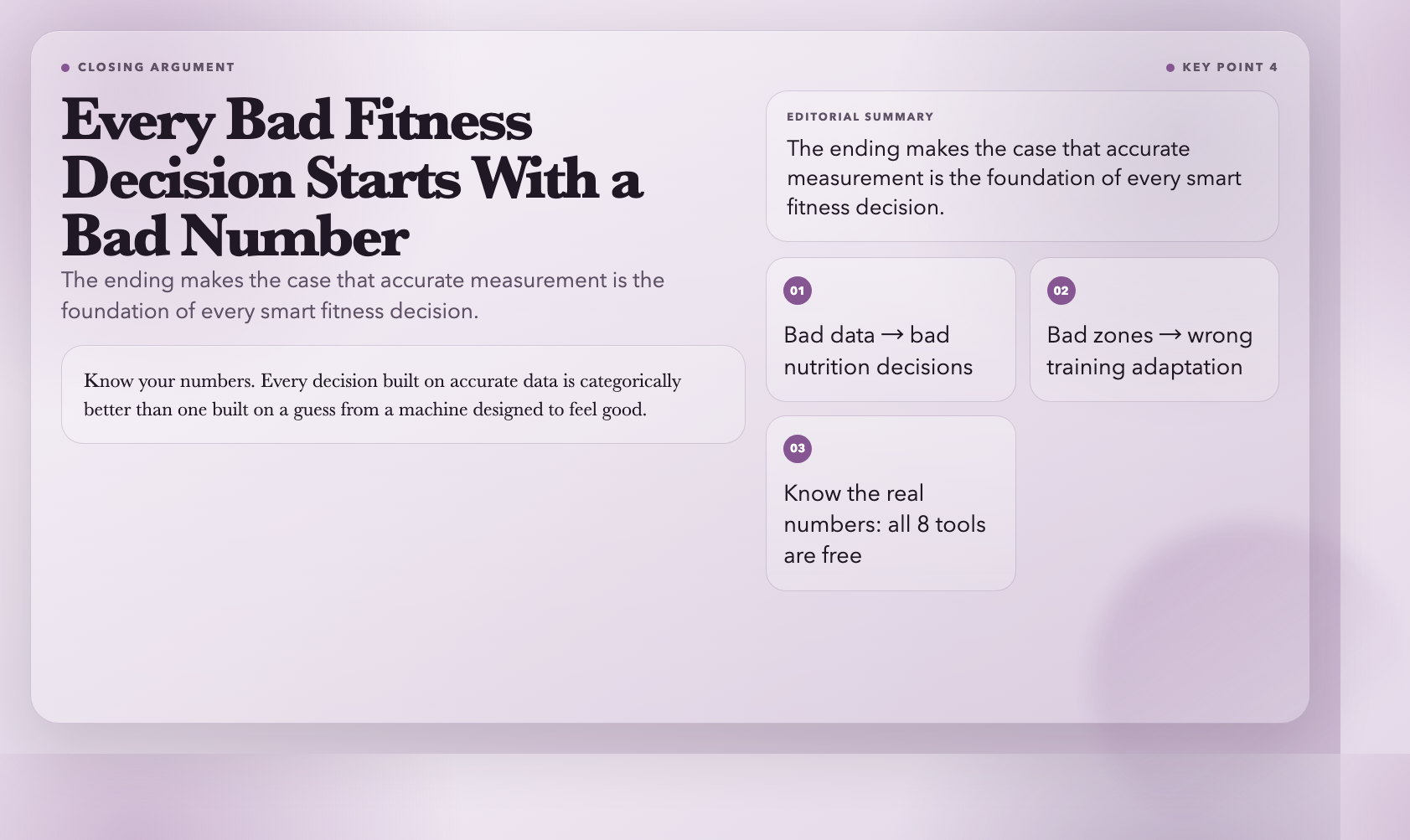
Every bad fitness decision starts with a bad number. You ate back the calories the treadmill said you burned — and you’re at a surplus you never saw coming. Your body fat isn’t 22%, it’s 16%, so the goal wasn’t as far as you thought. The heart rate zone was off by 16 beats, so the “easy” run was actually moderate, and the “hard” one wasn’t hard enough.
The 8 calculators above are free, require no account, and work in any browser. Know your numbers. Every decision built on accurate data is categorically better than one built on a guess from a machine designed to feel good.