A test card form rejects your placeholder. The QA ticket moves to “blocked”. You stare at the input field and realize the bug isn’t in your form — it’s in your test data. You’ve been pasting the same Visa number into every checkout flow for two months, and Stripe’s test-mode fraud heuristic just learned your face. Real-looking, Luhn-valid, brand-correct test card numbers are the unglamorous foundation of every payment integration, and most teams are doing it wrong with hardcoded strings that drift through staging into production logs.
This article breaks down how to generate proper test credit card numbers — why the Luhn checksum matters, how each card brand encodes its issuer identity in the first six digits (the BIN/IIN), and how a small generator can produce nine major brand profiles including Visa, MasterCard, American Express, Discover, JCB, and China UnionPay. The tool ships with batch generation, two output formats, and zero dependencies on a payment processor sandbox.
Why Card Numbers Aren’t Just Random Digits
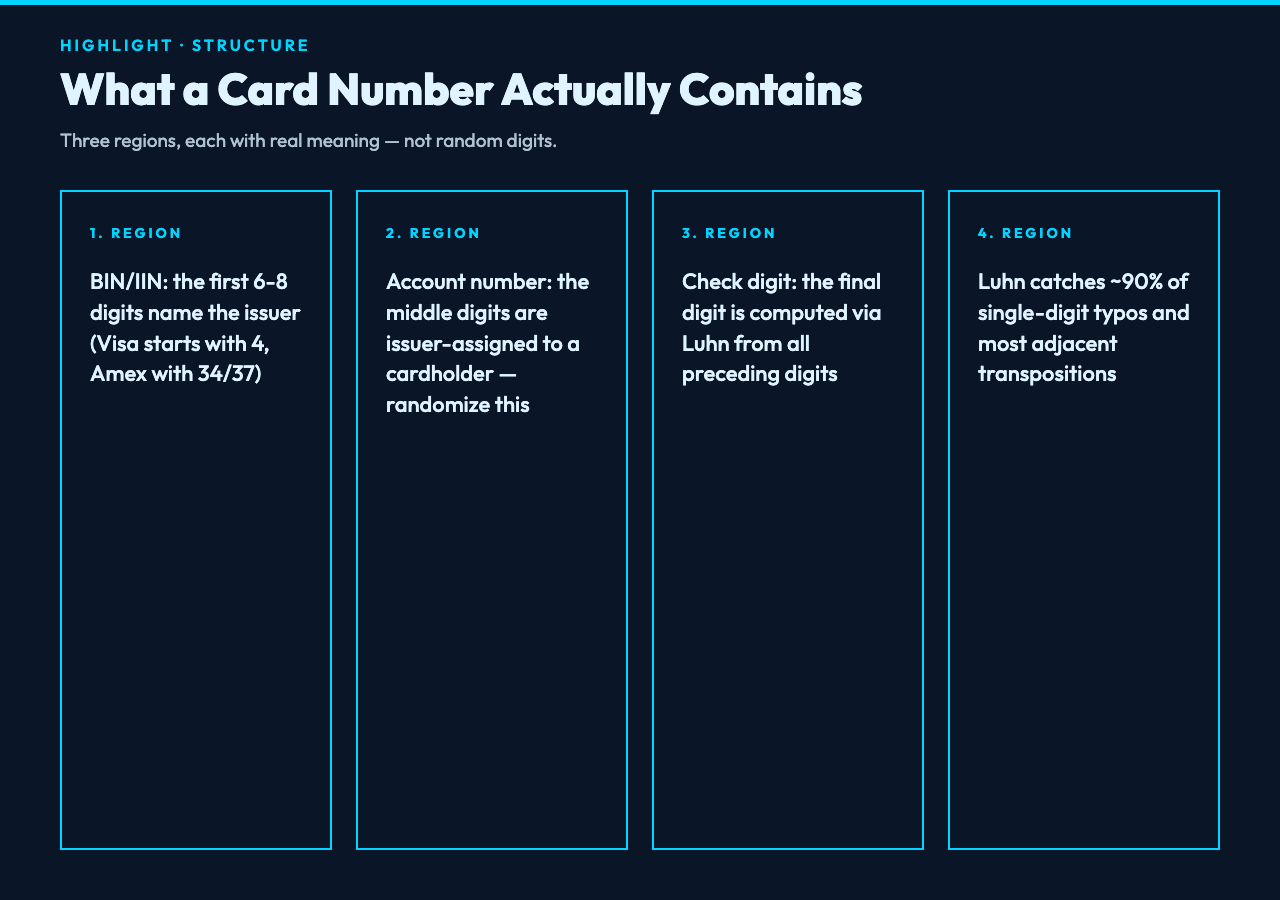
A 16-digit number looks random. It isn’t. The structure of a payment card number has three regions, each carrying real meaning:
- BIN/IIN (Bank Identification Number / Issuer Identification Number) — the first 6 to 8 digits. Identifies the issuing bank. Visa always starts with
4. MasterCard uses51-55or the new2221-2720range. American Express is34or37. Discover begins with6011,644-649, or65. JCB uses3528-3589. China UnionPay starts with62. - Account number — the middle digits. Issuer-assigned to a specific cardholder. This is the part you randomize.
- Check digit — the final digit. Computed by the Luhn algorithm from all preceding digits. Any validation routine in production runs this digit through the same algorithm to confirm the number is well-formed.
The Luhn check is a modulo-10 sum, not a cryptographic hash. It catches about 90% of single-digit typos and almost all transpositions of adjacent digits. That’s “good enough” for catching human entry errors at a checkout form — and exactly why your payment processor uses it on every transaction, not just signup.
The Luhn Algorithm in 30 Seconds
For a number like 4532015112830366:
- Starting from the rightmost digit (the check digit), double every second digit moving left:
6,3×2=6,0,3×2=6,8,2×2=4,1,1×2=2,5,0×2=0,2,3×2=6,5,4×2=8,5,4×2=8 - Where doubling produces a two-digit number (e.g.
6×2=12), sum the digits:1+2=3. - Sum all digits:
6+6+0+6+8+4+1+2+5+0+2+6+5+8+5+8=72. - If the total modulo 10 is zero, the number passes Luhn.
72 % 10 = 2≠ 0, so this number fails.
To produce a Luhn-valid number, you randomize all digits except the check digit, then compute the check digit that brings the sum modulo 10 to zero. That’s the entire trick — the generator’s value isn’t the randomness, it’s enforcing this invariant correctly for each card brand.
What the Tool Actually Generates
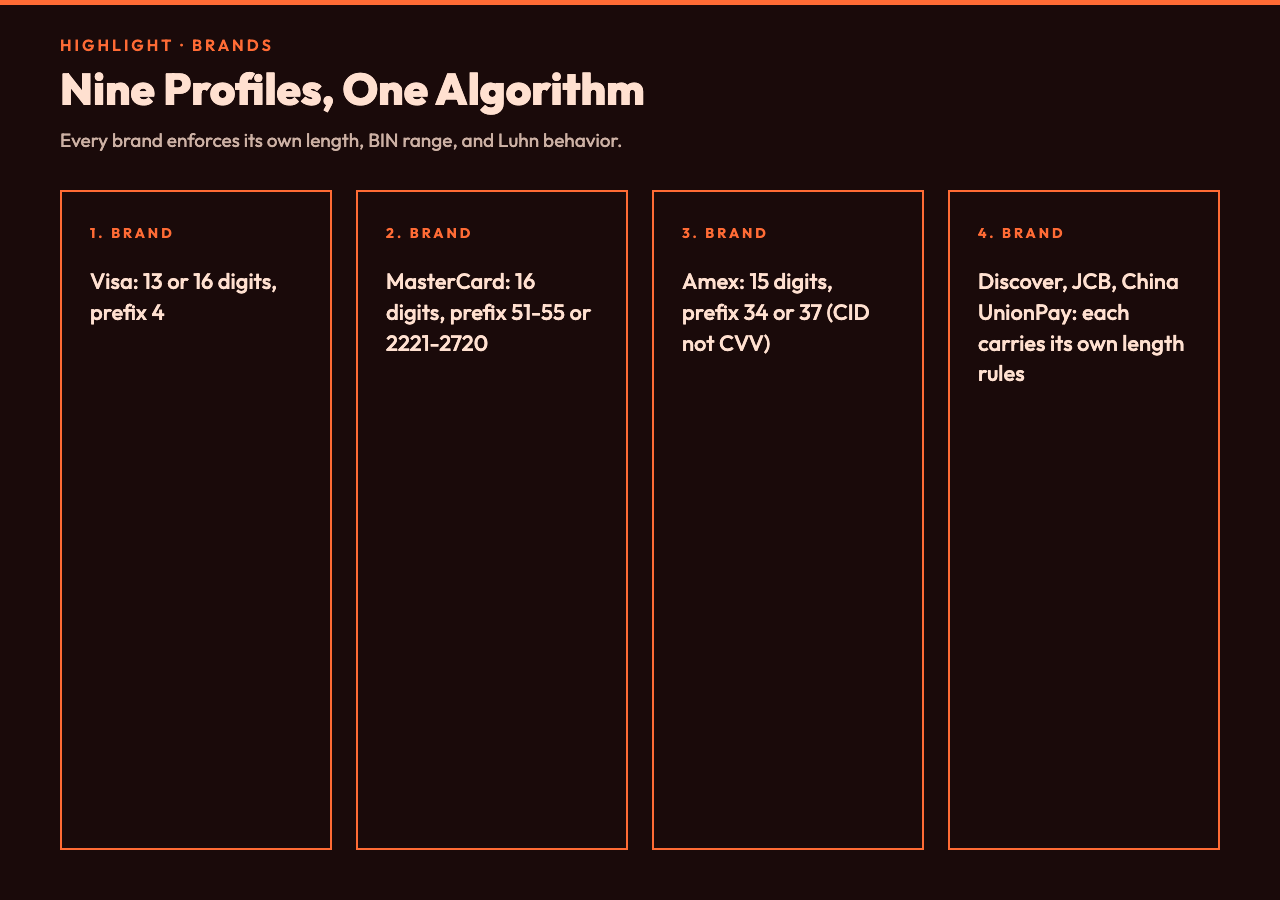
The Credit Card Generator covers nine card profiles. Each one enforces the right length, the right BIN prefix, and the right Luhn behavior for that brand:
| Brand | Length | BIN prefix |
|---|---|---|
| Visa (16-digit) | 16 | 4xxx |
| Visa (13-digit) | 13 | 4xxx xxxx xxxx |
| MasterCard | 16 | 51-55 or 2221-2720 |
| American Express | 15 | 34 or 37 |
| Discover | 16 | 6011, 644-649, 65 |
| JCB | 16 | 3528-3589 |
| China UnionPay | 16-19 | 62 |
The output comes in two formats: plain (4532015112830366) for pasting into API payloads and JSON fixtures, and spaced (4532 0151 1283 0366) for visual inspection in form UIs. The quantity field accepts any positive integer, so a single click produces 50 cards for a load test, 5 for a screenshot mockup, or 1,000 for a fuzzing pass.
All numbers pass Luhn and respect each brand’s length rules, but they’re not tied to any real cardholder account — no processor will approve a charge on them, and no fraud system will treat them as legitimate. That’s exactly what you want for a test fixture.
Three Use Cases Where the Right Generator Matters
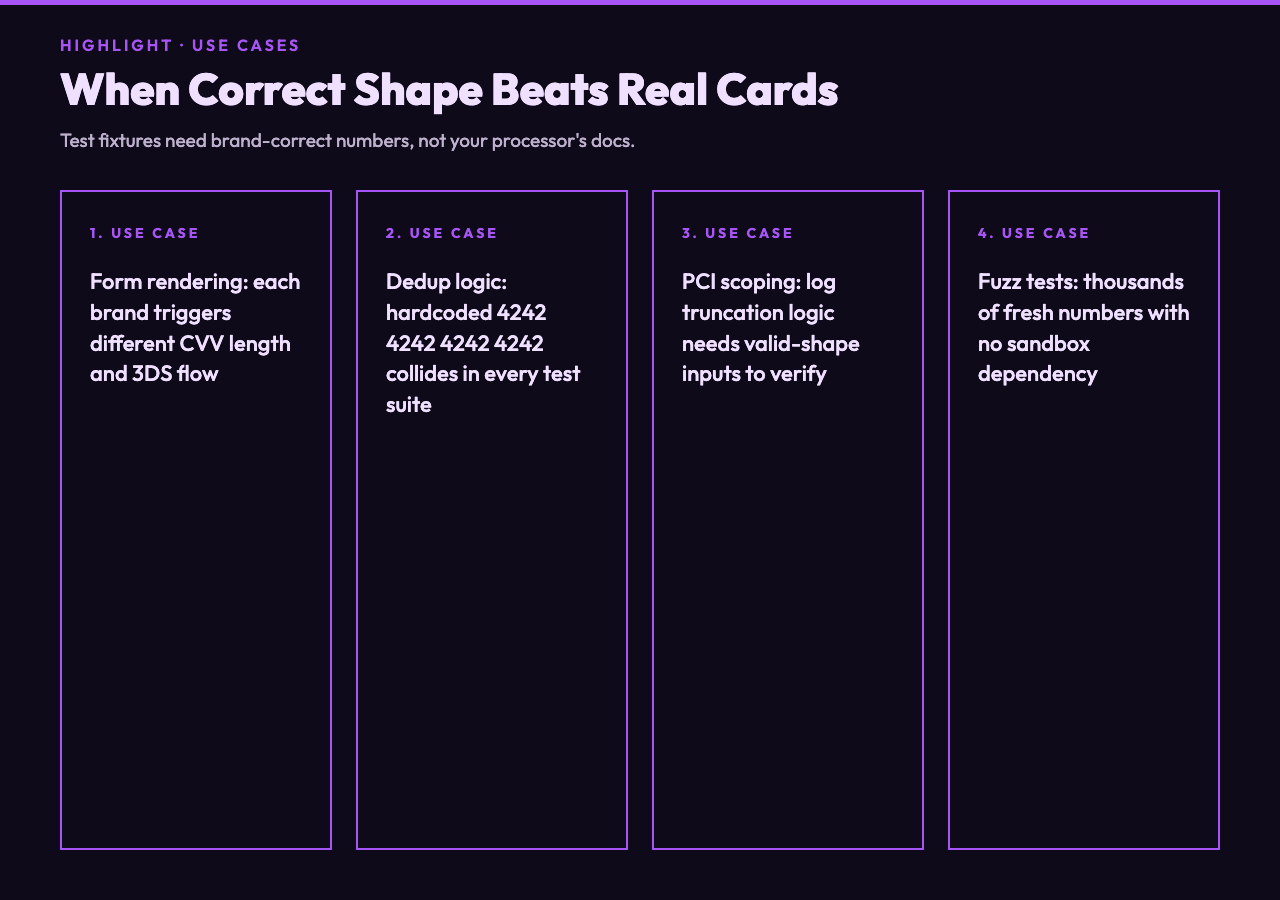
Payment form rendering tests. Your checkout UI validates card type from the BIN prefix to decide whether to show a CVV field (3 digits) or a CID field (4 digits, Amex). Hardcoded 4242424242424242 tells you nothing about how the form behaves when the user starts typing a Discover card. The generator lets you build a fixture library of every brand, exercise the form’s branching logic, and confirm CVV input length, expiration date parsing, and zip code field appearance all behave correctly.
Stripe / payment-processor sandbox testing. Stripe’s own test card list is a fixed set of branded numbers. They’re useful for hitting Stripe’s test mode, but they’re not randomized — every developer in the world uses 4242 4242 4242 4242 for the success path. If your test suite ever depends on a unique number per run (for idempotency checks, for “no duplicate charges” assertions, for receipt deduplication), you need freshly-generated Luhn-valid numbers that don’t collide with the canonical Stripe set. The generator produces them in batch.
Load and fuzz testing. A staging server that accepts thousands of card numbers per minute from a single source IP needs to test rate limiting, deduplication, and PAN truncation logic in logs (PCI DSS requires only the first 6 and last 4 digits to be stored). The generator with quantity=1000 produces a stable set of valid numbers without needing a payment-processor sandbox.
Why Brand Matters Even in Test Data
The most common bug pattern in payment integrations is treating all 16-digit numbers as Visa. The downstream logic that decides which icon to show, which CVV length to validate, which 3DS challenge flow to trigger, and which fee tier to apply is all driven by the BIN prefix. A test suite with only Visa numbers will pass even if your Discover handling is completely broken.
Generating one card per brand — and including the long-tail brands like JCB and China UnionPay that real customers actually use — surfaces the bugs that hide behind “all my tests are green.” If your form can’t handle a 19-digit UnionPay number, you’ll find out before a Shanghai customer does.
What to Use It For — And What Not To
The generator is built for development and testing. The numbers it produces pass the Luhn checksum and respect brand BIN ranges, but they are not real cardholder accounts. No acquirer will authorize a transaction on them, no fraud system will recognize them as legitimate, and using them against a production payment endpoint is at best a wasted transaction and at worst a violation of PCI DSS and your processor’s terms of service.
For real test transactions, use your payment processor’s documented test cards (Stripe publishes 4242 4242 4242 4242 for success, 4000 0000 0000 0002 for generic decline, 4000 0027 6000 3184 for 3DS-required, and dozens of others). For everything else — form rendering, parser tests, fuzz tests, deduplication logic, regex fixtures — the Credit Card Generator gives you correct shape without leaking real PII into your codebase.
One closing note on the algorithm itself: the Luhn check was patented in 1960 and has been public domain since the 1970s. It’s not cryptography. It’s a smoke detector — useful, ubiquitous, and not a substitute for actual fraud prevention. If you’re building the fraud system, layer device fingerprinting, 3DS, and behavioral signals on top of a clean Luhn-valid input pipeline. The generator’s job is to make sure the pipeline never breaks because someone hand-typed a bad test number.
Generate your first batch at elysiatools.com/en/tools/credit-card-generator — pick a brand, set a quantity, copy the output, and ship the fixture. Your QA tickets will move again.
Explore more developer tools at elysiatools.com/en/tools.