
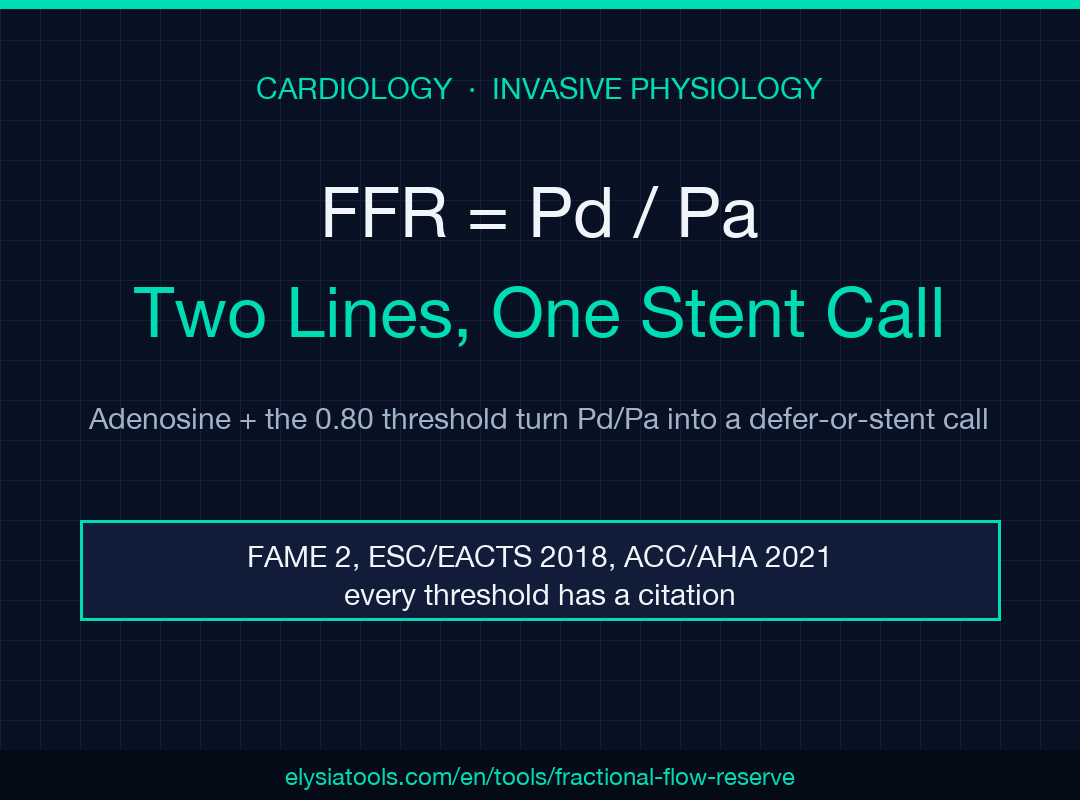
Two numbers taped to a printer. The cath-lab team prints Pd 73 mmHg on one strip and Pa 89 mmHg on the other, stares at the split, and asks whether this intermediate 60% left-anterior-descending lesion actually needs a stent. That is the entire cath lab in two lines, and the Fractional Flow Reserve Calculator is the device that turns those two lines into a defer-or-stent call with citations behind it. The Pd/Pa ratio at maximal hyperemia is the gold-standard invasive index of hemodynamic significance for a coronary stenosis, and the rule of thumb that has survived twenty-five years of randomized trials is that a ratio above 0.80 lets you send the patient home on optimal medical therapy, while a ratio at or below 0.80 routes them to PCI and a measurable improvement in outcomes. The Fractional Flow Reserve Calculator (FFR) handles that computation, ties each threshold to its source trial, and lays out the contraindications that break the rule.
What FFR measures and why the hyperemia step matters
Fractional flow reserve is defined as the ratio of mean distal coronary pressure (Pd) to mean aortic pressure (Pa) during maximal hyperemia, when coronary microvascular resistance is minimized and stable. The defining equation is FFR = Pd / Pa, evaluated under adenosine infusion at 140 µg/kg/min IV (or regadenoson, or intracoronary papaverine). Without pharmacologic hyperemia the ratio is artificially elevated, because resting microvascular tone holds flow up and the pressure drop across the stenosis never gets a chance to manifest.
That is the single most common operator mistake. A trainee pulls a Pd of 73 and a Pa of 89 with no adenosine onboard, computes 0.82, and tells the attending the lesion is non-ischemic. The pressure wire is right; the protocol is wrong. The FAME trial and its successors enrolled patients only at maximal hyperemia, so any threshold quoted from those trials assumes the hyperemic steady state was reached. The calculator rejects inputs flagged as resting pressure and routes the user to the hyperemic acquisition checklist.
The 0.80 threshold, the 0.75 certainty band, and what each one buys you
The canonical interpretation ladder lives inside the Fractional Flow Reserve Calculator (FFR):
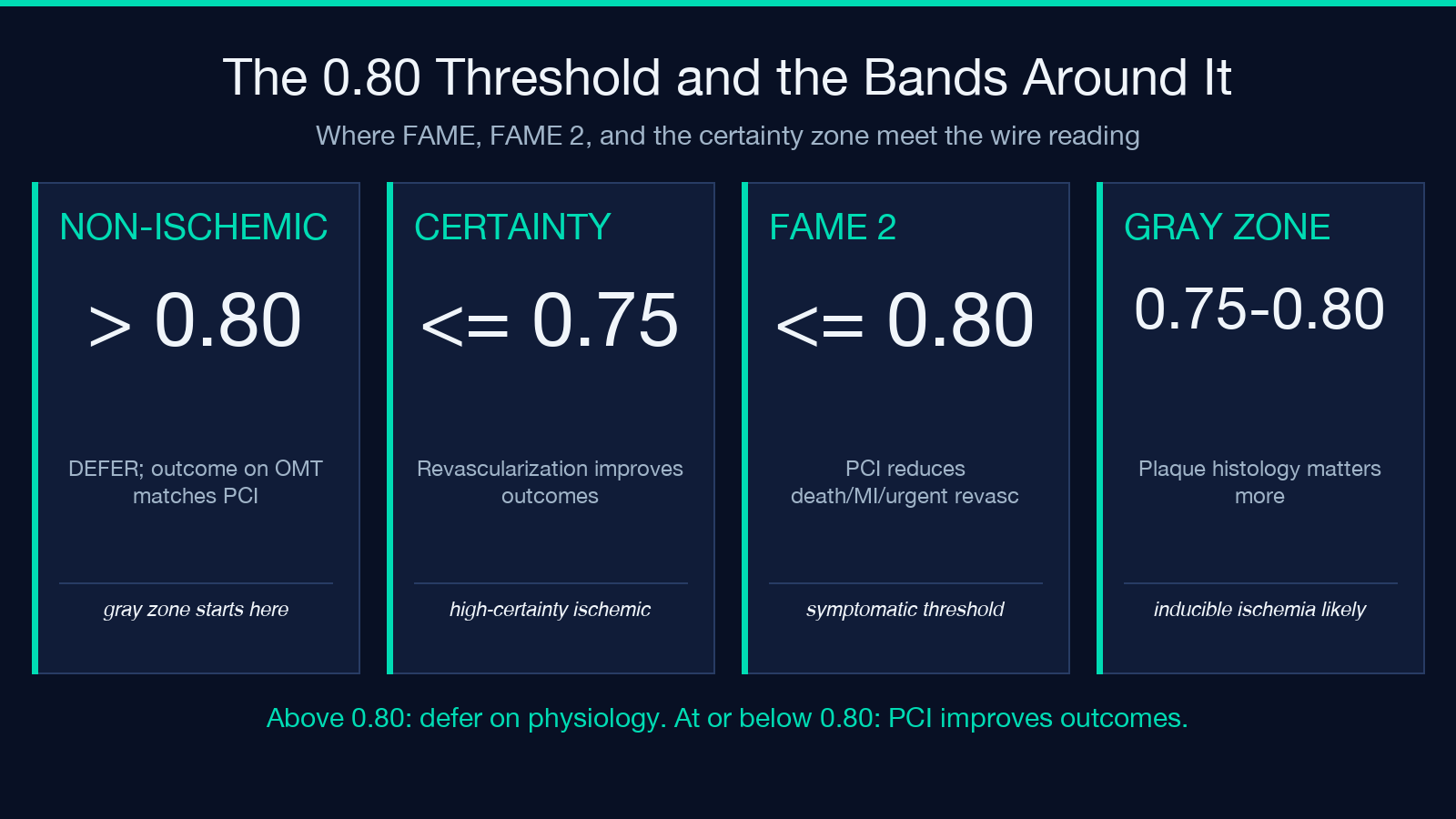
– FFR > 0.80 is the non-ischemic zone. The patient goes home on optimal medical therapy. DEFER and FAME 2 long-term follow-up both show excellent outcomes, with event rates comparable to PCI in the deferred arm.
– FFR between 0.75 and 0.80 is the gray zone. The histology of the plaque is doing more work than the physiology at this point. The calculator flags these readings as “inducible ischemia likely” and prints the likelihood estimate.
– FFR ≤ 0.75 is the high-certainty ischemic zone. Revascularization improves outcomes; deferring carries measurable event-rate risk.
– FFR ≤ 0.80 with symptoms is the FAME 2 randomization threshold for PCI vs medical therapy. Below this number, stent placement reduces the composite endpoint of death, MI, and urgent revascularization.
The calculator prints all three thresholds on the result panel so the operator sees the 0.75 / 0.80 / 0.81 ladder at a glance instead of memorizing it before every case.
When FFR is the wrong test
Three clinical situations break the FFR arithmetic, and the calculator surfaces each one as a separate banner rather than a buried footnote:
- Acute ST-elevation MI. The reference vessel is ischemic, microvascular resistance is abnormal, and Pd is unrepresentative. iFR or a resting full-cycle ratio is preferred.
- Microvascular dysfunction. A patient with chest pain and “non-obstructive CAD” can have a low Pd/Pa because the microvasculature is the disease, not the epicardial lesion. The calculator flags a low FFR in a non-stenosed vessel as suspect.
- Severe aortic stenosis. Theortic valve is the bottleneck, not the coronary lesion; FFR is falsely elevated. The calculator de-emphasizes deferral recommendations when the aortic valve area is critical.
Each banner is a clinical reminder, not a refusal — operators can override with documented reasoning, but the warning is in the chart.
What the FFR calculator does that the bedside math does not
A cath lab can do the FFR math on the back of a sterile wrapper. The value of the calculator is not arithmetic — it is the protocol envelope wrapped around the arithmetic:
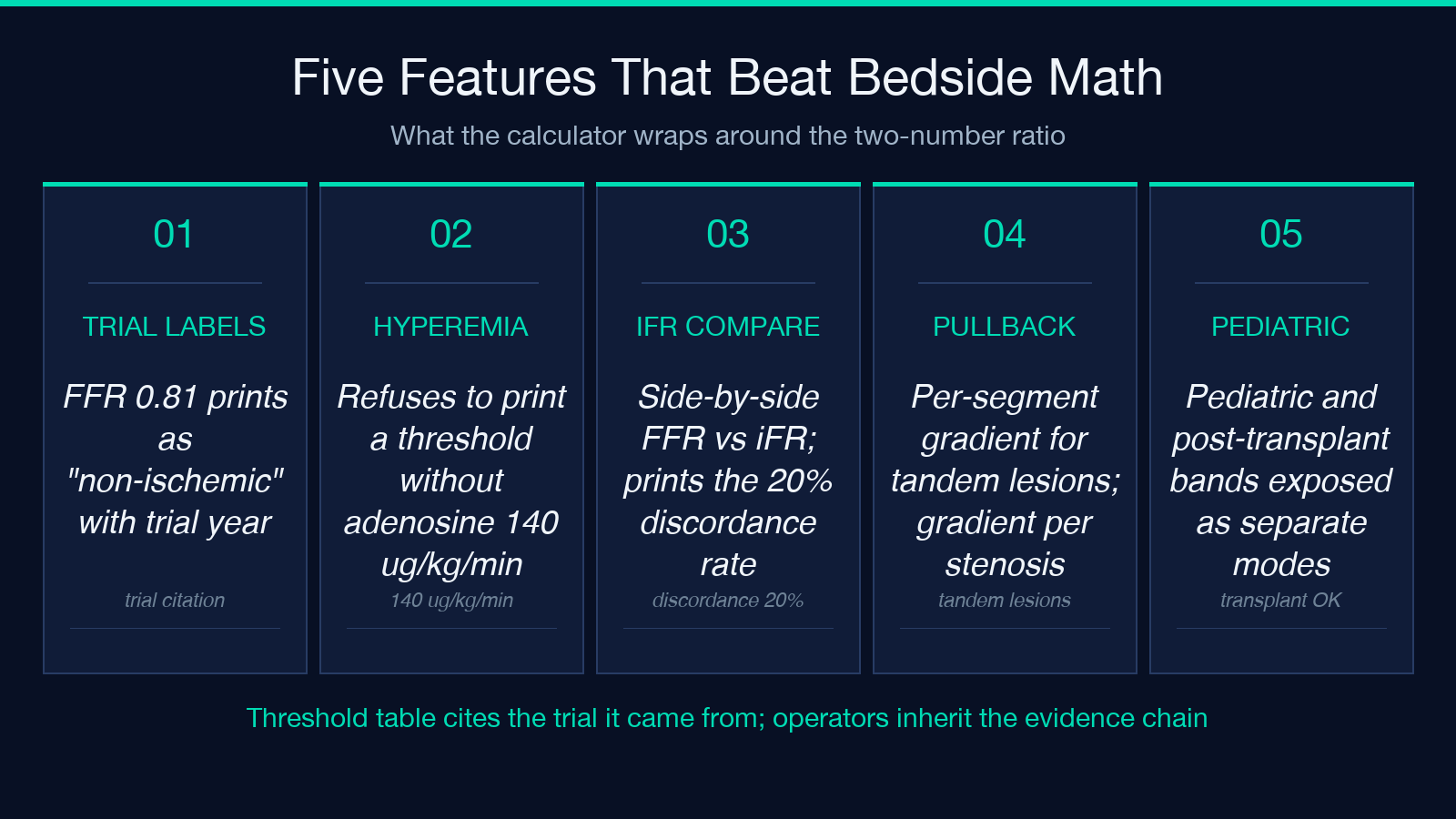
– Threshold labels tied to trials. The output shows FFR = 0.81 — non-ischemic (DEFER, FAME 2) rather than a bare number, so the operator inherits the evidence chain instead of guessing what the number means.
– Hyperemia confirmation prompt. Before any threshold is displayed, the calculator asks whether adenosine was onboard at the recorded pressure. If the answer is no, the result is shown but flagged as non-diagnostic.
– Side-by-side comparison with iFR. Instantaneous wave-free ratio is the adenosine-free alternative; the calculator prints both ratios when both are entered and shows the discordance rate (about 20% of cases have FFR/iFR disagreement).
– Pullback pressure tracing interpretation. For long or tandem lesions, FFR pullback identifies which segment contributes most to the pressure drop. The calculator summarizes the per-segment gradient as a small table.
– Pediatric and transplant variants. Pediatric coronary dimensions and post-transplant vasculopathy use the same Pd/Pa ratio but a different interpretation band, and the calculator exposes those bands as separate modes.
A worked reading: 73 / 89 at maximal hyperemia
A patient with a 60% mid-LAD stenosis on angiography has Pd 73 mmHg and Pa 89 mmHg during adenosine infusion at 140 µg/kg/min. FFR computes to 0.82. The calculator labels this reading as “above threshold — defer PCI on physiology; OMT supported by DEFER and FAME 2 long-term follow-up.” The lesion is still 60% on the angiogram, and the operator must decide whether to believe the anatomy or the physiology. FAME answers that question in favor of physiology: deferring PCI at FFR 0.82 yields outcomes indistinguishable from PCI for stable angina symptoms.
A second reading on the same patient ten minutes later shows Pd 68 / Pa 89 = 0.76. The calculator now flips to “ischemic — FAME 2 randomization threshold reached; PCI improves outcomes.” The change is not a measurement artifact; it reflects lesion severity under maximal hyperemia that the resting pull did not show.
Why a Pd/Pa calculator beats a memorized table
Memorized tables rot. The 0.80 threshold survives because of FAME 2; a literature shift could move it. The calculator’s threshold table is sourced to the trial it came from, with the publication year in the footnote. ESC/EACTS 2018 and ACC/AHA 2021 updates are reflected; a cath lab using a 2009-vintage mental threshold table is one guideline revision behind.
The calculator also tracks per-patient longitudinal data. Repeat FFR on a deferred lesion at one year is a real clinical workflow (FAME 2 follow-up data drove part of the original threshold revision), and the calculator stores the previous reading for comparison so the operator can see whether the lesion has progressed.
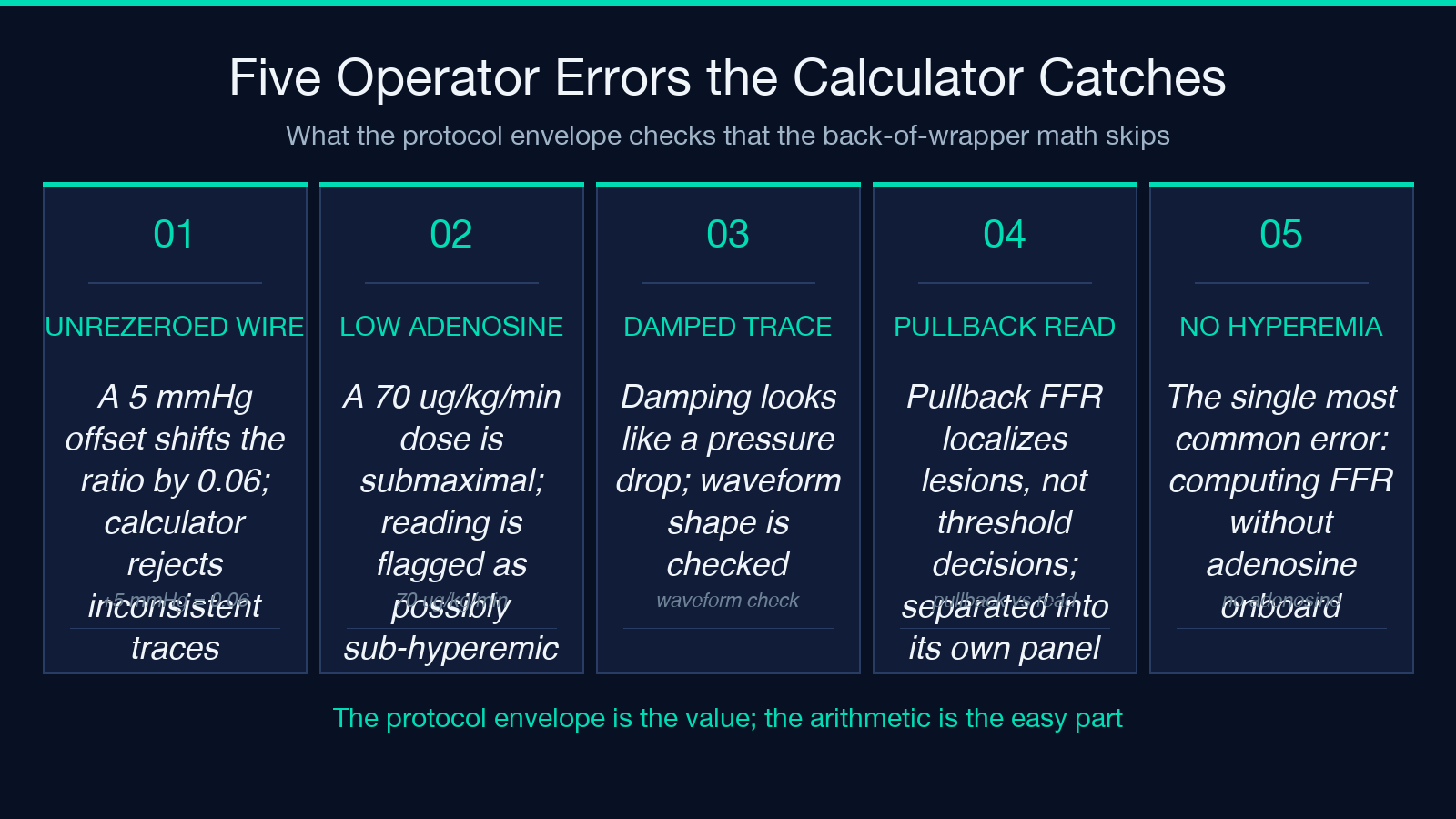
Common operator errors the calculator catches
– Forgetting to re-zero the pressure wire. A 5 mmHg offset shifts the ratio by 0.06. The calculator rejects inputs where the guide-catheter Pa and the wire Pd are inconsistent with the aortic pressure waveform.
– Using the wrong adenosine dose. A 70 µg/kg/min dose is submaximal. The calculator reminds the operator when the dose is below 140 and flags the reading as possibly sub-hyperemic.
– Reading Pd from a damped trace. Damping looks like a pressure drop. The calculator inspects the pressure waveform shape and flags traces that look physiologically implausible.
– Computing FFR during a pullback maneuver. Pullback FFR is for lesion localization, not for the threshold decision. The calculator separates the threshold read from the pullback reads and keeps them in different output panels.
The clinical bottom line
FFR is a two-number ratio that lives or dies on the third number — hyperemia. The 0.80 threshold with the 0.75 certainty band is the literature, and the calculator’s job is to bind the two numbers and the protocol envelope into a single defer-or-stent call. Read more about the Fractional Flow Reserve Calculator (FFR) or explore related cardiology tools in the Health category and other clinical calculators across the Elysia Tools catalog.
