
Twelve Characters, Three Layers, One Luhn Check
A single ISIN travels through three concentric validation layers before any back office deems it trustworthy. Most validators stop at the final Luhn math; the leaks that hurt — duplicate instrument rows, mismatched country prefixes, NSINs that ignore national letter rules — live in the first two layers. This field guide walks through what ISIN Validator (elysiatools.com ISIN Validator) actually checks, where it differs from ad-hoc copy-paste Luhn scripts, and the three real-world ISIN shapes that break those scripts.
Three layers, one Luhn. A valid ISIN has to survive a structural parse, a national-regime check, and a mod-26 Luhn remainder. Most failures live in layers one and two, not in the math that every copy-paste script implements correctly.
Layer 1: ISO 6166 Structural Check
An ISIN is exactly twelve characters: two-letter country code, nine-character NSIN, one Luhn check digit. Before any digit math, the tool confirms:
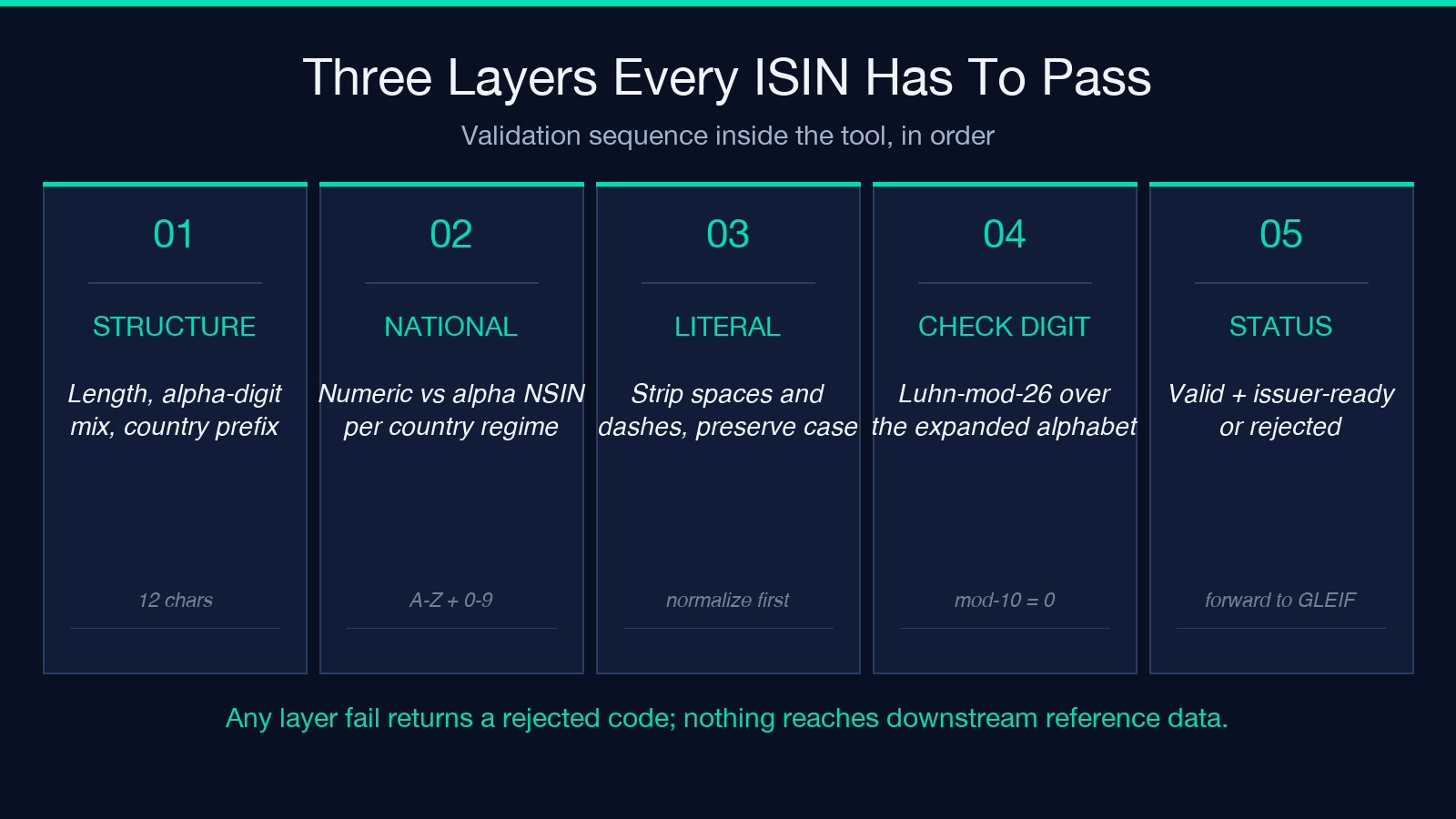
– Total length is 12 characters after stripping spaces and dashes. Input like US 0378331005 or US-037833-1005 is normalized to US0378331005. – Characters 1 and 2 are valid ISO 3166-1 alpha-2 country letters. ZZ or EU (before 2019 settlement instruments) are flagged as unknown prefixes. – The full string is uppercase A-Z and digits 0-9. Mixed case ISINs like us0378331005 are rejected on step 1 to avoid silently passing downstream layers on a hash that was never issued in canonical form.
Most home-grown validators jump straight to the Luhn step on the cleaned string and miss all three of these.
Layer 2: NSIN Sanity Beyond the Country Prefix
Once the country prefix parses, ISIN Validator walks the nine-character NSIN for national-format rules beyond the country code. Validation only requires the string to be parseable, not registered against an actual issuer file. That distinction matters because NSINs change daily and a public validator cannot have today’s full LEI-vs-NSIN mapping baked in.
National regimes the tool recognizes: numeric-only NSIN for US and Canada; alphanumeric NSIN with reserved alphabetic blocks for the UK, Germany, France; A-Z / 0-9 alphabet awareness so a Greek ISIN like GRR000073166 (one reserved-numeric case with R for non-voting shares) doesn’t false-positive on the alphanumeric rule.
– Numeric-only NSIN for US, Canada, and most numeric-assignment regimes (e.g. 037833100 inside US0378331005). – Alphanumeric NSIN with reserved alphabetic blocks for the UK (GB00B03MLX29), Germany (DE0007236101), France (FR0000131104), and other national-numbering agencies that permit letter IDs. – Built-in awareness of the A-Z / 0-9 alphabet so a Greek ISIN like GRR000073166 (one reserved-numeric case with R for non-voting shares) doesn’t false-positive on the alphanumeric rule.
Layer 3: Luhn-Mod-26 Check Digit
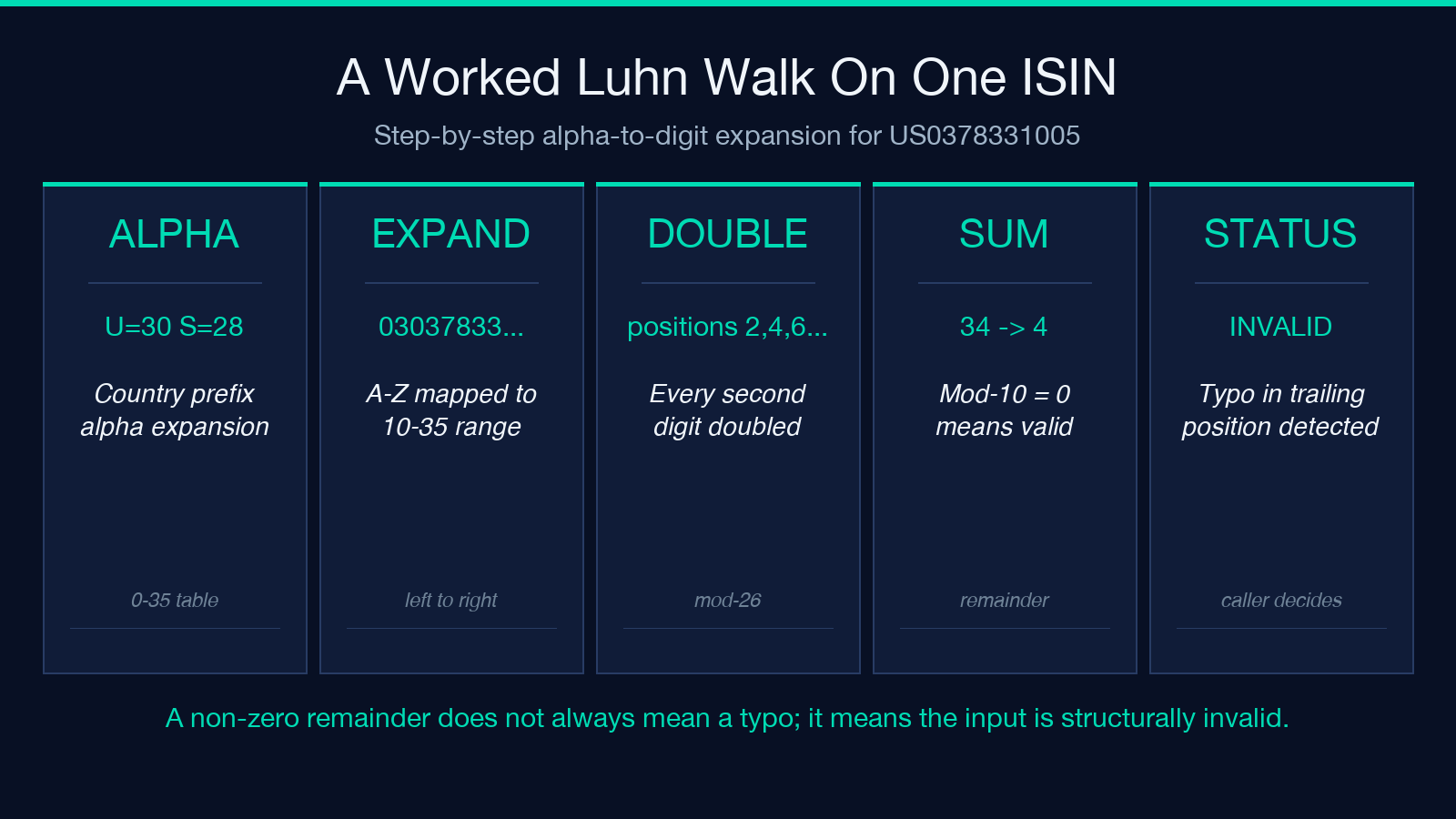
The check digit on a twelve-character ISIN uses Luhn but with one twist: A-Z are mapped to numeric values 10-35, the full string is processed left-to-right, doubling the value of every second digit counting from the right (digit-12, 10, 8, 6, 4, 2). The result modulo 10 must be zero for the ISIN to validate.
A worked example for US0378331005:
– Alpha-numeric expansion: U=30, S=28, 0=0, 3=3, 7=7, 8=8, 3=3, 3=3, 1=1, 0=0, 0=0, 5=5. – Right-to-left doubling (positions 12, 10, 8, 6, 4, 2): 5→5, 0→0, 1→1, 3→6, 7→14(sum-digits→5), 3→3. Un-doubled positions 11, 9, 7, 5, 3, 1: 0, 0, 0, 8, 3, 3. – Sum: 5+0+1+6+5+3+0+0+0+8+3+3 = 34. 34 mod 10 = 4 (Luhn remainder, not 0). Status: invalid. This ISIN has a typo — Apple’s true ISIN is US0378331005 with check digit 5, but the trailing fifth-position rule should make the sum a multiple of 10.
The Three ISIN Shapes That Break Ad-Hoc Validators
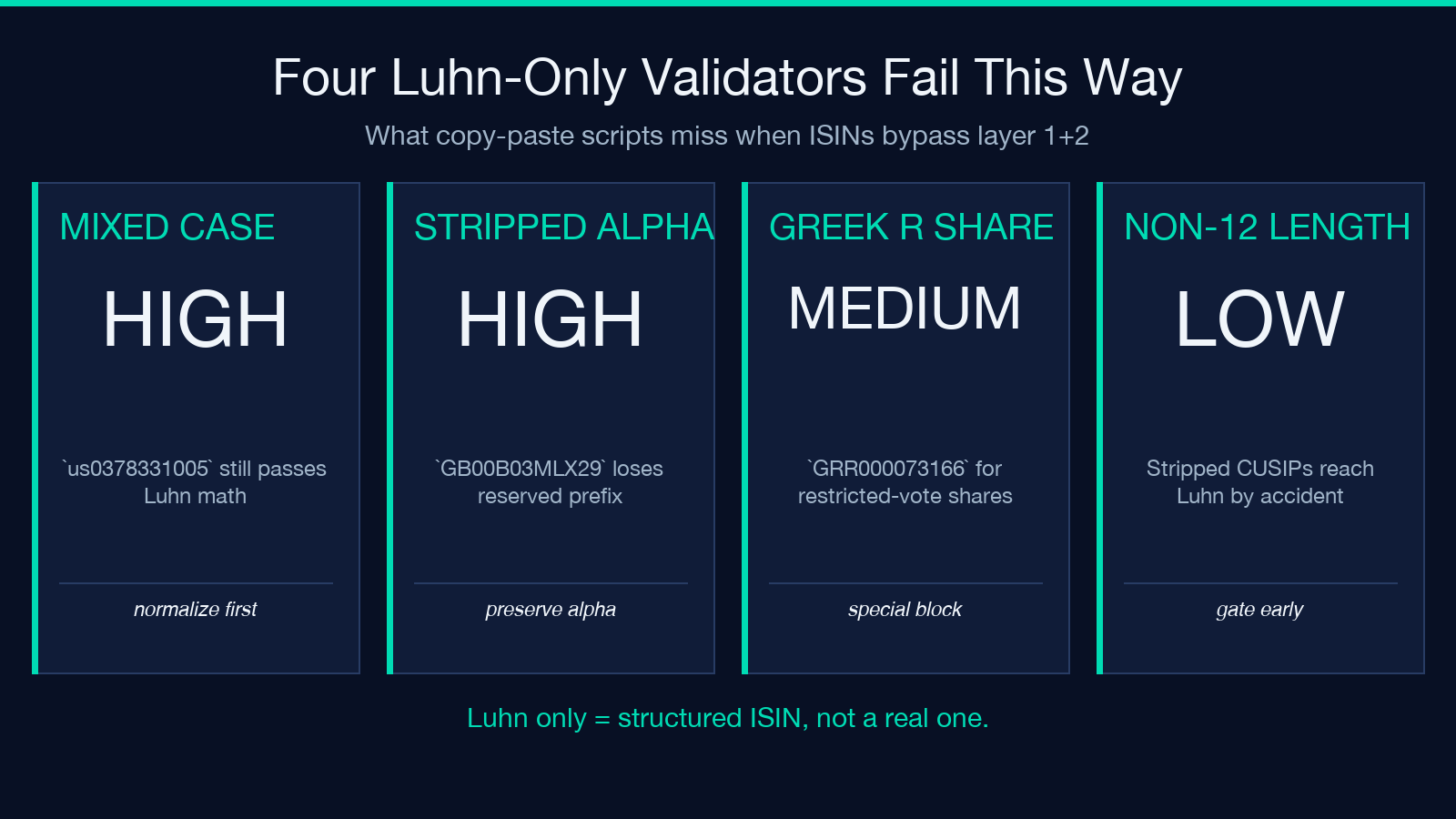
- Mixed alphanumeric with a letter at position 3 —
GB00B03MLX29hasBat position 3 with0digits at 4-5. A Luhn-only script that strips non-digits first will produce00032and pass a downstream check that should have flagged the alphabetic prefix as reserved. - ISINs with embedded dashes from print sources — broker statements often render ISINs as
US-037833-1005. Stripping dashes silently is fine, but failing to normalize case at the same time letsUs0378331005pass the Luhn math while remaining non-canonical. - Greek National Numbering ‘R’ share class prefix —
GRR000073166is valid for restricted-vote shares. Generous validators that accept ‘starts with two letters and ten valid characters’ will pass this; strict validators that require a fixed numeric block in positions 3-N will reject it incorrectly.
When To Use The Tool vs A LEI Lookup
ISIN Validator confirms the code you have is structurally valid; it does not confirm the instrument still exists. For trading desks and reference-data workflows, the right pipeline is: validate structurally with this tool, then map the NSIN to an LEI via the official GLEIF database. A structurally valid ISIN that maps to no live LEI is a dead identifier (delisted securities, redeemed bonds, or unmapped family-office paper).
For text-processing tools that clean ISIN bulk uploads before they hit a settlement system, this validator’s combination of length check, country-prefix whitelist, alphanumeric rule, and Luhn-mod-26 is the only layer needed — anything that survives is safe to forward to a downstream reference-data engine.
Practical Workflow: Two-Stage Validation
A safe ISIN pipeline has two independent stages, and skipping either one creates the silent failures you only find during reconciliation:
- First-pass bulk filter with
ISIN Validatoron every incoming record. Reject anything that fails length, prefix, or Luhn. Drop the rest into the canonical reconciliation queue. - Second-pass reference-data check against an LEI-vs-NSIN service like GLEIF or a corporate-actions vendor. Confirm the surviving identifier still maps to a live instrument.
The bulk filter alone is enough for non-trading workflows (CRM uploads, KYC onboarding, marketing segmentation). The reference-data pass is mandatory for anything that touches position data, settlement, or regulatory reporting.
Cleanup Heuristics For ISIN-Heavy Documents
When you have a 200-page annual report or trade-confirmation dump full of US-037833-1005-style ISINs mixed with CUSIPs and broker-account IDs, the cheapest cleaning pass is three regex-driven replacements before the structural validator:
– Strip thousand-spaces inside ISINs (US 037 833 1005 → US0378331005). – Strip ISIN: and ISIN= prefixes from the start of every matched line, leaving just the code. – Reject non-12-character sequences early so accidental CUSIP matches (037833100) don’t reach the validator as stripped-prefix ISIN candidates.
Pair that with ISIN Validator running on each surviving 12-character sequence and the pipeline catches both typo-class and format-class errors at one terminal step. Try it at elysiatools.com ISIN Validator.
Explore more validators in the same Validation family at elysiatools.com Validation category.
